
15 Loaded Carry Workouts for Full-Body Strength

High-Protein Burger Bowl Recipe for Muscle-Building Meals
Minimum Effective Dose Strength Training Guide

The Best Post-Workout Skincare Routine for Men Complete Guide
15 Loaded Carry Workouts for Full-Body Strength
Loaded carries are among the simplest and most productive exercises for building practical, full-body strength. Pick up a challenging weight, organize your posture, and move without allowing the load to pull you out of position. That basic task trains the hands, forearms, shoulders, upper back, core, hips, and legs at the same time. It can also improve work capacity without requiring complicated equipment or a long list of exercises. A good loaded carry workout is not just a heavy walk. The position of the weight changes the challenge. Holding two dumbbells by your sides emphasizes grip and total-body tension. Carrying one weight forces the trunk to resist leaning and rotation. Supporting a load overhead increases the stability demand on the shoulder and upper back. Holding it against the chest makes breathing and bracing more difficult. By combining several positions, you can build strength that transfers to lifting, sports, physical work, and everyday life.
This guide covers 15 loaded carry workouts and variations for full-body strength. It also explains how heavy to go, how far to walk, how to organize carries in a weekly plan, and how to avoid the mistakes that turn an effective strength exercise into a sloppy conditioning drill.
What Is a Loaded Carry Workout?
A loaded carry is any exercise in which you hold an external resistance while walking or marching. Dumbbells, kettlebells, a trap bar, sandbag, weight plate, barbell, or specialized strongman equipment can all be used. You can hold the resistance at your sides, at shoulder height, against your chest, or overhead.
During a carry, the body must repeatedly stabilize itself with every step. Your grip keeps the load secure. upper back and shoulders maintain the carrying position. Your abdominal muscles prevent unwanted extension, side bending, and rotation. The hips and legs produce steady movement while your feet and ankles adapt to each ground contact. This combination makes loaded carries unusually efficient for developing integrated strength.
Carries can be programmed for distance, time, or steps. Short, heavy efforts of 10 to 25 yards primarily develop strength. Moderate efforts lasting 20 to 45 seconds blend strength and muscular endurance. Longer carries can improve conditioning, but the weight should never be so light that posture and tension no longer matter.
Benefits of Loaded Carry Workout for Full-Body Strength
Stronger Grip and Forearms
Heavy carries require sustained grip rather than a single hard squeeze. This can improve the ability to hold a bar during deadlifts, rows, pull-ups, and other pulling exercises. Better grip also supports daily tasks that involve lifting, carrying, or controlling awkward objects.
Better Core Stability
The core’s job during a carry is to keep the rib cage, pelvis, and spine organized as the limbs move. Uneven carries are especially effective because the weight tries to bend or rotate the torso. Resisting that movement trains stability without relying on endless crunches or aggressive spinal flexion.
More Resilient Shoulders and Upper Back
Different carrying positions teach the shoulder blades and upper back to support load. Farmer’s carries reinforce strong arms-at-the-sides posture, rack carries challenge the front of the shoulders and upper back, and overhead carries demand control through a large shoulder range. The result can be better stability, provided the variation matches your current mobility and strength.
Leg Strength and Conditioning
Every step is a small single-leg strength task. Heavy carries challenge the glutes, quadriceps, hamstrings, calves, feet, and ankles while raising the heart rate. They are especially useful for lifters who want conditioning that still feels connected to strength training.
Simple, Scalable Training
Loaded carries are easy to modify. A beginner can use light dumbbells and short distances, while an advanced lifter can use a trap bar, heavy kettlebells, or a sandbag. You can make a carry harder by increasing the weight or distance, changing the load position, slowing the walk, or using an uneven setup.
How to Perform Loaded Carry Workout Correctly
Before walking, establish a strong starting position. Stand tall with the ribs stacked over the pelvis, the head neutral, and the shoulders controlled rather than aggressively shrugged. Brace the midsection as if preparing to absorb a firm push. Take short, quiet steps and keep the feet pointing in a natural direction.
Avoid leaning backward, rushing, or allowing the weights to swing. A carry should look deliberate. You should be able to keep the load close to the body and maintain the same posture at the end of the set that you had at the beginning. If your grip opens, shoulders collapse, or torso tilts excessively, end the set.
Use a clear, unobstructed walking lane. Turn slowly when necessary instead of twisting sharply under load. Set the weights down by hinging and bending the knees, not by folding through the lower back. When training with very heavy implements, use an area where a dropped weight will not endanger you or anyone nearby.
15 Loaded Carry Workouts and Variations
1. Dumbbell Farmer’s Carry
Hold a dumbbell in each hand with the arms straight and the weights beside your thighs. Walk for 20 to 40 yards while maintaining a tall torso and controlled steps. The farmer’s carry is the best starting point for most lifters because it develops grip, upper-back strength, core stiffness, and total-body coordination with minimal technical complexity.
Perform three to five sets. For strength, choose a weight that makes 15 to 25 yards challenging. For general fitness, use a moderate load for 30 to 45 seconds. Keep the dumbbells from bouncing against the legs and avoid shortening your posture as your grip fatigues.
2. Kettlebell Farmer’s Carry
This version uses two kettlebells held at the sides. Because a kettlebell’s weight hangs below its handle, it can feel different from a dumbbell and may demand more control from the wrists. Keep the bells slightly away from the thighs so they do not strike the legs, but do not flare the arms outward.
Complete four sets of 30 yards with a controlled turnaround. This carry works well after kettlebell swings, squats, or presses, and it can be progressed by using heavier bells or adding five yards to each set.
3. Trap-Bar Loaded Carry Workout
Stand inside a loaded trap bar, brace, and lift it using a strong deadlift position. Once fully upright, walk with short steps for 10 to 30 yards. The centered handles allow many lifters to carry more total weight than they can with dumbbells.
Use the trap-bar carry for three to five heavy sets of 10 to 20 yards. Rest two to three minutes between sets. Do not chase distance when the load is near your limit. The objective is to maintain a strong lockout and stable walking mechanics, not to survive a long, deteriorating set.
4. Suitcase Carry
Hold one dumbbell or kettlebell at your side as if carrying a suitcase. Walk without leaning toward or away from the weight. The asymmetrical load challenges the obliques, deep abdominal muscles, hips, and lower-back stabilizers.
Perform three or four sets of 20 to 40 yards per side. Use the same distance and weight on both sides. If you feel yourself tilting, reduce the load and imagine keeping your belt line level while reaching the top of your head toward the ceiling.
5. Front-Rack Kettlebell Loaded Carry Workout
Clean two kettlebells into the rack position. Keep the forearms relatively vertical, elbows near the torso, and wrists neutral. Walk while maintaining abdominal pressure and resisting the tendency to lean backward.
Complete three sets of 20 to 30 yards. The front-rack position challenges the upper back, shoulders, arms, and anterior core while making breathing under tension part of the exercise. Start lighter than you would for a farmer’s carry.
6. Single-Arm Front-Rack Carry
Hold one kettlebell or dumbbell at shoulder height and leave the other arm relaxed or extended slightly for balance. Keep the torso square and avoid rotating toward the load. This variation combines the anti-lateral-flexion challenge of a suitcase carry with the upper-body demand of a rack carry.
Perform three sets of 20 to 30 yards per arm. It is a smart accessory exercise for lifters who want stronger bracing for unilateral presses, split squats, and athletic movement.
7. Double-Dumbbell Front-Rack Loaded Carry Workout
Hold two dumbbells at shoulder level with the palms facing inward. Keep the weights controlled rather than resting them passively on the shoulders. Walk for 20 to 30 seconds while keeping the ribs down and the lower back neutral.
Use three or four sets with 60 to 90 seconds of rest. This version can be easier to set up than a double-kettlebell rack carry, making it useful in a commercial gym. It also fits naturally after dumbbell presses or front squats.
8. Goblet Carry
Hold one kettlebell or dumbbell vertically against the chest. Keep the elbows close, brace the abdomen, and walk without allowing the weight to pull the shoulders forward. The goblet carry is accessible to beginners and teaches the relationship between breathing, posture, and trunk tension.
Perform three sets of 30 to 45 seconds. To increase the challenge without immediately adding weight, hold the load an inch away from the chest. That small change increases the demand on the arms, upper back, and core.
9. Bear-Hug Loaded Carry Workout
Wrap both arms around a sandbag, heavy medicine ball, or other soft implement and pull it tightly against the torso. Walk for distance while staying tall. Because the load compresses the front of the body, breathing becomes more difficult and the upper back must work hard to prevent collapse.
Use four sets of 20 to 40 yards. The bear-hug carry is an excellent option for general strength, strongman-style training, and anyone preparing to handle awkward real-world objects. Keep the implement high enough that it does not interfere with your stride.
10. Zercher Carry
Support a barbell, sandbag, or strongman implement in the bends of the elbows. Keep the hands together, upper back engaged, and torso upright. The forward load challenges the biceps, upper back, abdominal wall, glutes, and legs.
Begin with three sets of 15 to 25 yards. Use a bar pad or towel if a bare bar causes excessive discomfort. This is an advanced variation for healthy lifters who can maintain their brace; it should not be forced if the elbow position feels painful.
11. Single-Arm Overhead Loaded Carry Workout
Press a dumbbell or kettlebell overhead and lock the elbow in a stable position. Keep the biceps near the ear, ribs controlled, and wrist stacked over the elbow and shoulder. Walk slowly without letting the weight drift forward or outward.
Perform three sets of 15 to 25 yards per arm with a light-to-moderate load. Overhead carries demand adequate shoulder mobility and control. If you cannot reach overhead without arching the lower back or if the position causes pain, choose a front-rack carry instead.
12. Double-Arm Overhead Carry
Hold two dumbbells or kettlebells overhead with elbows locked and shoulders stable. This version requires more total-body tension and less opportunity to compensate than the single-arm variation. Use a conservative load and an open walking lane.
Complete three sets of 15 to 20 yards. Stop before the elbows soften or the ribs flare. The double-arm overhead carry is best used as a controlled stability exercise, not a maximal-strength test.
13. Waiter’s Carry
The waiter’s carry uses one kettlebell overhead, often with the bell resting against the back of the forearm. The offset center of mass asks the shoulder and wrist to make constant small adjustments. Keep your gaze forward and walk with the torso upright.
Perform two to four sets of 20 yards per side. This variation can improve overhead confidence, but it must be earned through pain-free pressing and sufficient shoulder mobility. Never use speed to compensate for poor control.
14. Bottoms-Up Kettlebell Carry
Hold a kettlebell upside down by the handle with the bottom of the bell pointing toward the ceiling. Position it near shoulder height and squeeze the handle firmly. The unstable setup challenges grip, wrist alignment, rotator-cuff control, and concentration.
Use a light kettlebell for three sets of 15 to 20 yards per arm. Move slowly and keep the area around you clear. If the bell begins to tip, lower it safely rather than fighting a failed position. This is a precision exercise, not a place to demonstrate maximal strength.
15. Mixed-Position Carry
Hold one weight overhead and another at your side or in the front-rack position. This creates different demands on each side of the body and requires the trunk to resist rotation and side bending. Change positions after each set so both sides receive equal work.
Perform three sets of 15 to 25 yards in each configuration. Use weights that allow complete control in the weaker position. Mixed carries are advanced and should come after you have mastered suitcase, rack, and overhead carries separately.
Complete Loaded Carry Workouts
Beginner Full-Body Carry Workout
Warm up with five minutes of easy walking, bodyweight squats, hip hinges, arm circles, and light marching. Then perform a dumbbell farmer’s carry for three sets of 30 seconds, a goblet carry for three sets of 25 seconds, and a suitcase carry for two sets of 20 yards per side. Rest 60 to 90 seconds after each set.
Use loads that allow perfect posture and leave a small amount of grip strength in reserve. Complete this workout once or twice per week for four weeks. Add five seconds or five yards before increasing the weight.
Intermediate Strength and Conditioning Workout
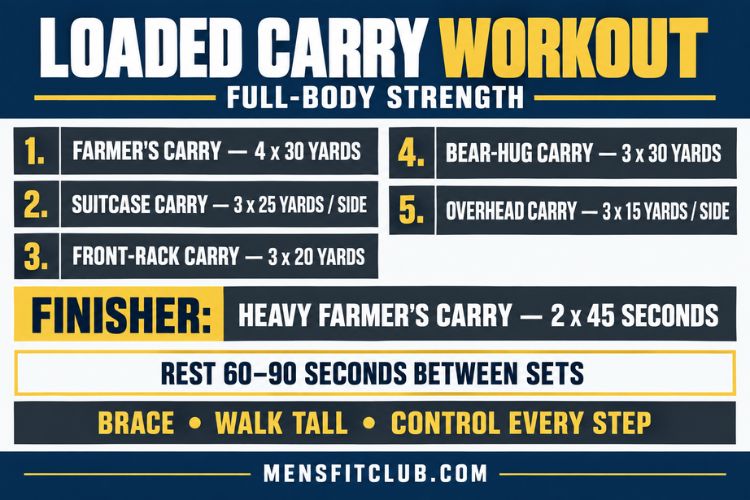
After a dynamic warm-up, perform four 25-yard kettlebell farmer’s carries, three 20-yard front-rack carries, three 25-yard suitcase carries per side, and three 30-yard bear-hug carries. Rest 60 to 120 seconds between sets, taking more time after the heavier carries.
This workout balances bilateral strength, unilateral core stability, and conditioning. It can replace a traditional conditioning finisher or serve as a short standalone session on a non-lifting day.
Advanced Loaded Carry Strength Workout
Begin with four heavy trap-bar carries of 15 yards, resting two to three minutes. Follow with three single-arm overhead carries of 20 yards per side, three mixed-position carries of 15 yards in each configuration, and three heavy bear-hug carries of 25 yards. Finish with two moderate farmer’s carries lasting 45 seconds.
Advanced does not mean careless. Use loads that preserve alignment, and reduce the weight if grip failure changes your walking pattern. Because this session places substantial stress on the hands, trunk, and upper back, avoid scheduling it immediately before heavy deadlifts.
How Heavy Should Loaded Carries Be?
There is no universal perfect weight. Equipment, limb length, training experience, surface, and carrying position all affect difficulty. Choose the load according to the goal and judge it by movement quality.
For strength, use a heavy weight you can carry with excellent posture for roughly 10 to 25 yards. For muscle endurance and general fitness, use a moderate weight for 20 to 45 seconds. Overhead and bottoms-up carries require much lighter loads than farmer’s or trap-bar carries.
A useful rule is to stop the set when you could manage only a few more controlled steps. Do not wait for the implement to fall from your hands. Leaving a small reserve makes progression safer and keeps technique consistent across sets.
How to Program Loaded Carries
Most lifters need one to three carry variations in a session, not all 15 at once. Choose positions that complement your main training. After deadlifts, a suitcase or rack carry may be more appropriate than another maximal grip exercise. After upper-body pressing, farmer’s carries or bear-hug carries can provide full-body work without adding more overhead volume.
Carries usually fit best near the end of a strength workout. Heavy trap-bar carries may be placed earlier because they require more force and concentration. Use two to five sets per variation and train loaded carries one to three times per week, depending on recovery and overall training volume.
Progress one variable at a time. Add a small amount of weight, five to ten yards, five seconds, or one set. You can also progress from a stable bilateral position to a unilateral or overhead position. Avoid increasing weight and distance simultaneously, because that makes it harder to identify why technique or recovery has declined.
Common Loaded Carry Mistakes
The first mistake is selecting a load that forces poor posture. Heavier is not automatically better when the torso bends, the shoulders collapse, or each step becomes uncontrolled. Reduce the load and own the position.
The second mistake is walking too fast. Speed can make the weights swing and reduce the stability challenge. Use deliberate steps unless fast carries are part of a specific sport program coached in a suitable environment.
Another common error is holding the breath for the entire set. Brace firmly, but use short, controlled breaths behind the brace. If you cannot breathe without losing position, the load or distance may be too demanding.
Finally, do not use every challenging variation in the same workout. Grip, shoulders, and trunk can accumulate fatigue quickly. A few well-executed carries will produce better training than a long circuit performed with declining technique.
Who Should Modify or Avoid Loaded Carries?
Loaded carries can be scaled for many people, but pain is not a normal requirement. Anyone with a recent hand, wrist, elbow, shoulder, back, hip, knee, or foot injury should obtain appropriate professional guidance before loading the movement. People with balance limitations should begin in a stable setting with conservative weights and supervision when needed.
Overhead carries require pain-free overhead motion. If you cannot keep the ribs and pelvis stacked with the arm overhead, use a farmer’s, suitcase, goblet, or front-rack carry while working on mobility and control separately. Stop any variation that produces sharp pain, numbness, dizziness, or unusual shortness of breath.
Frequently Asked Questions
Can loaded carries build muscle?
Yes. Loaded carries provide meaningful tension for the forearms, traps, shoulders, upper back, abdominal muscles, glutes, and legs. They are most effective for muscle growth when combined with a balanced resistance-training program that includes presses, pulls, squats, hinges, and sufficient nutrition.
Are loaded carries good for losing fat?
Carries can raise the heart rate and increase training energy expenditure, but fat loss depends primarily on maintaining an appropriate calorie deficit over time. Use carries to build strength and work capacity while supporting the larger nutrition and activity plan.
How long should a loaded carry workout last?
A focused carry workout can take 15 to 30 minutes. When carries are added to the end of a strength session, five to 12 minutes may be enough. Quality matters more than filling a predetermined amount of time.
Can I do loaded carries every day?
Light carries may be tolerated frequently, but daily heavy carries can overwork the grip, elbows, shoulders, and lower back. Most people will progress with one to three weekly sessions and at least one easier day between demanding carry workouts.
What is the best loaded carry for beginners?
The dumbbell farmer’s carry is usually the best introduction because it is simple to set up and easy to scale. The goblet carry and light suitcase carry are also useful once the lifter can maintain steady posture and breathing.
Final Thoughts on Loaded Carry Workout Training
Loaded carries prove that effective strength training does not have to be complicated. By picking up weight and walking with control, you train grip, posture, core stability, shoulder support, leg drive, and conditioning in one movement. The key is to match the variation to your ability and treat every step as a strength repetition.
Start with farmer’s, goblet, and suitcase carries. Build consistent technique, then introduce rack, bear-hug, overhead, and mixed-position variations. Track the load, distance, time, and quality of each set. With gradual progression, these 15 loaded carry workouts can become a durable part of a full-body strength program and help you build strength that is useful both inside and outside the gym.
Related MensFitClub Strength Workouts
Keep building practical strength with the MensFitClub guide to the Farmer’s Walk Workout, then strengthen a common weak link with these Exercises To Improve Grip Strength. For heavier functional training, explore the Strongman Workout Guide. You can also pair loaded carries with a 30 Minute Dumbbell Strength Workout or use them alongside this Dumbbell Power Workout to develop total-body strength, stability, work capacity, and a more powerful grip.


Most Recommended

Subscribe to our Newsletter
Stay up to date on the latest men’s health, fitness and lifestyle trends and tips.
About Us
Men’s Fit Club was started with the goal of empowering men to get the most out of their lives. This meant going beyond exercise and diet tips to really address the broad range of issues that men face on a daily basis – topics like recreation, finding love, sexual health and even sound fashion advice.
Quick Links
© COPYRIGHT MEN'S FIT CLUB 2026. All Rights Reserved