
15 Loaded Carry Workouts for Full-Body Strength

High-Protein Burger Bowl Recipe for Muscle-Building Meals
Minimum Effective Dose Strength Training Guide

The Best Post-Workout Skincare Routine for Men Complete Guide
Minimum Effective Dose Strength Training Guide
Strength training does not have to dominate your week to deliver meaningful results. You do not need six gym sessions, dozens of exercises, or a complicated spreadsheet to become stronger. For many men, the real challenge is not a lack of motivation. It is finding a plan that fits around work, family, recovery, travel, and everything else competing for attention. Minimum effective dose strength training solves that problem by focusing on the smallest practical amount of training that still produces measurable progress.
The idea sounds simple, but it is often misunderstood. A minimum effective dose workout is not an excuse to rush through a few easy sets. It is a deliberately compact approach built around productive exercises, challenging effort, consistent progression, and enough recovery. Every set needs a reason to be in the program. When those pieces are in place, two or three concise sessions per week can improve strength, preserve or build muscle, support bone health, and make everyday movement easier.
This guide explains how minimum effective dose strength training works, who can benefit from it, and how to build a time-efficient routine without sacrificing quality. You will also find a complete two-day plan, optional third sessions, progression rules, exercise substitutions, and practical advice for adjusting the program as your needs change.
What Is Minimum Effective Dose Strength Training?
The minimum effective dose, often shortened to MED, is the smallest amount of training required to create the desired adaptation. In strength training, that means completing enough challenging work to encourage your body to become stronger while avoiding unnecessary volume that adds time and fatigue without providing a worthwhile return.
The word “minimum” is relative. A beginner may improve from just a few hard working sets per movement pattern each week because almost every well-performed strength session provides a new stimulus. An experienced lifter who is close to his genetic potential may need more volume, heavier loading, or greater specificity to keep progressing. The correct dose also depends on whether the goal is general strength, maximum powerlifting performance, muscle growth, healthy aging, or simply maintaining existing ability during a busy period.
For most recreational lifters, MED training usually means two or three full-body workouts per week. Each session emphasizes a small group of compound movements, includes limited accessory work, and lasts approximately 30 to 50 minutes. The lifter records performance and gradually increases the demand through weight, repetitions, technique, or range of motion.
Minimum effective dose is therefore not one universal number of sets. It is a decision-making framework. Start with a modest amount of high-quality work, monitor your results, and add only what is necessary when progress slows.
Why Less Training Can Still Produce Results
Strength improves when the body receives an adequate stimulus and then has time and resources to adapt. More training can create a larger stimulus, but only up to a point. Every additional set also creates fatigue. If extra work interferes with performance, recovery, sleep, joint comfort, or consistency, it may reduce the quality of the overall program.
A lower-volume routine concentrates effort on the sets that matter most. Compound exercises such as squats, deadlifts, presses, rows, and pull-ups train several muscle groups simultaneously. A relatively small exercise menu can therefore cover the major movement patterns and provide a strong whole-body stimulus.
Frequency also matters. Two full-body sessions expose each major muscle group to resistance twice per week without requiring a long bodybuilding split. That repeated practice can improve lifting skill, confidence, and movement efficiency. Over time, small increases in load or repetitions accumulate into substantial progress.
This approach is especially effective when the alternative is an ambitious plan that is rarely completed. A theoretically perfect five-day routine has little value if it consistently conflicts with your schedule. Two focused sessions performed nearly every week are far more useful than sporadic bursts of excessive training.
Benefits of a Minimum Effective Dose Strength Training Approach
It makes consistency easier
A compact plan creates fewer scheduling conflicts and a lower mental barrier to starting. Knowing that a session will take about 40 minutes makes training easier to protect during a demanding week. Consistency gives you more opportunities to practice exercises, build confidence, and progress over months rather than repeatedly restarting.
It improves recovery management
Lower training volume generally produces less soreness and systemic fatigue. This can be useful for men over 40 or 50, athletes balancing strength with running or sport, physically active workers, and anyone managing high levels of life stress. Better recovery does not mean the workouts are effortless; it means the stress is targeted and manageable.
It highlights productive exercises: Minimum Effective Dose Strength Training
When time is limited, every exercise must earn its place. The program naturally prioritizes movements that train multiple muscles and transfer well to daily life. There is less room for redundant variations or sets completed only to chase fatigue.
It leaves room for other goals
Strength may be important without being your only priority. A minimum-dose plan can coexist with hiking, cycling, martial arts, recreational sports, mobility work, or Zone 2 cardio. It also works as a maintenance phase during travel, a busy season at work, or a period when recovery is limited.
It provides a clear starting point
Many people add volume before learning what they actually need. Beginning with a modest dose lets you observe how your body responds. If strength increases, technique improves, and you feel recovered, the plan is doing its job. If results stall after several well-executed weeks, you can make a small, informed adjustment.
Who Should Use Minimum Effective Dose Strength Training?
This style of training is a strong choice for busy professionals, parents, beginners, older men, endurance athletes, and former lifters returning after a break. It is also useful for experienced trainees who want to maintain strength during a demanding phase of life.
Beginners benefit because they can develop the basic movement patterns without being overwhelmed by a large exercise list. Returning lifters can rebuild tolerance gradually instead of recreating their previous workload immediately. Men over 50 may appreciate having more recovery time between sessions, especially when sleep, joint history, or other activities affect readiness.
MED training is less suitable for someone preparing for a high-level powerlifting meet, pursuing maximum bodybuilding development, or already adapted to substantial training volume. Those goals often require more specialized practice and work. However, even advanced lifters can use minimum-dose phases to maintain performance when time is restricted.
Anyone with an injury, significant pain, a medical condition, or a long period of inactivity should obtain appropriate professional guidance before beginning. Exercises should be selected according to current ability, not ego or previous personal records.
The Core Principles of Minimum Effective Dose Strength Training
Train the major movement patterns
A balanced plan should include a squat or knee-dominant movement, a hip hinge, an upper-body push, and an upper-body pull. Loaded carries and direct trunk training are valuable additions when time permits. These patterns cover the body efficiently and can be performed with barbells, dumbbells, kettlebells, machines, or bodyweight.
You do not need the same exercise forever. A goblet squat can replace a barbell back squat, a trap-bar deadlift can replace a conventional deadlift, and a machine chest press can replace a bench press. The best variation is one you can perform safely, progress consistently, and recover from.
Make the working sets challenging
Low volume only works when the working sets provide a meaningful stimulus. Most sets should finish with approximately one to three good repetitions still possible. This is commonly described as one to three repetitions in reserve, or RIR. Stopping far too early may not stimulate enough adaptation, while repeatedly training to absolute failure can create unnecessary fatigue and technical breakdown.
Beginners should initially leave more repetitions in reserve while learning technique. As coordination improves, effort can gradually increase. A set should look controlled from the first repetition to the last, even when the final repetitions move more slowly.
Use progressive overload Minimum Effective Dose Strength Training
The body needs a gradually increasing challenge. Progressive overload can mean adding weight, completing more repetitions with the same weight, improving range of motion, using better control, or performing the same work with less perceived effort.
For a simple MED program, double progression is highly effective. Choose a repetition range such as five to eight. Keep the same load until you reach eight repetitions on every prescribed set with good form and the target effort. Then add a small amount of weight and return to the lower end of the range.
Rest long enough to perform well
Trying to make every strength session feel like cardio can reduce lifting quality. Rest about two to three minutes after demanding compound sets and 60 to 90 seconds after lighter accessory work. Very heavy sets may require longer. If time is tight, pair noncompeting exercises—for example, a press with a row—rather than cutting rest so aggressively that performance collapses.
Track the essentials
Record the exercise, load, repetitions, and approximate repetitions in reserve. This takes less than a minute but prevents guesswork. If performance trends upward and recovery remains good, continue. If the numbers are unchanged for several weeks, review technique, sleep, nutrition, exercise selection, and total training dose.
The Minimum Effective Dose Strength Training Program
The following two-day full-body plan suits healthy adults with basic lifting experience. Schedule the sessions with at least two days between them, such as Monday and Thursday or Tuesday and Friday. The working sets listed do not include warm-up sets.
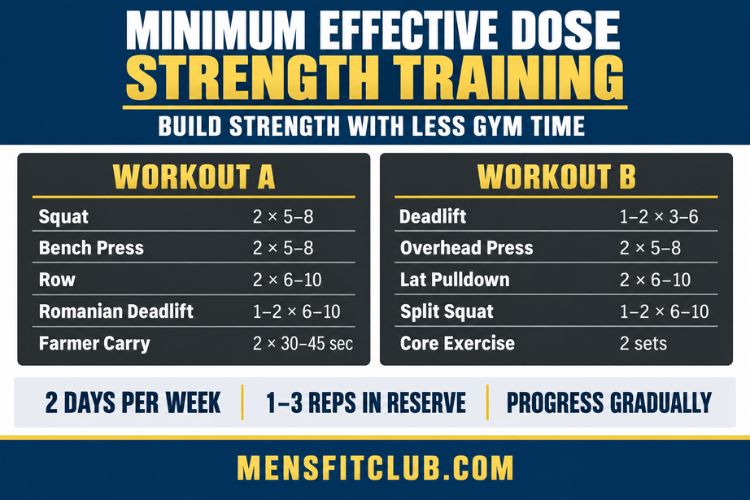
Workout A
Begin with a squat variation for two working sets of five to eight repetitions. Options include the barbell back squat, front squat, goblet squat, leg press, or a controlled split squat. Select a version that allows a comfortable range of motion and stable technique.
Next, perform a horizontal press for two sets of five to eight repetitions. The barbell bench press, dumbbell bench press, machine chest press, or weighted push-up can all work. Follow it with a row for two sets of six to ten repetitions using a cable, chest-supported machine, dumbbells, or a barbell.
Finish with a Romanian deadlift for one or two sets of six to ten repetitions and a farmer’s carry for two trips of 30 to 45 seconds. If grip or space makes carries impractical, use a plank or Pallof press for two controlled sets.
Workout B Minimum Effective Dose Strength Training
Start with a hip-dominant lift. Perform one challenging set of three to six repetitions on a conventional, sumo, or trap-bar deadlift after completing several gradual warm-up sets. If you are newer to the hinge, use two sets of six to eight Romanian deadlifts or kettlebell deadlifts instead.
Perform an overhead press for two working sets of five to eight repetitions. Dumbbells, a barbell, a landmine, or a machine may be used. Then complete two sets of six to ten repetitions on a vertical pull, such as pull-ups, assisted pull-ups, or lat pulldowns.
Add a single-leg movement for one or two sets of six to ten repetitions per side. Reverse lunges, step-ups, or split squats are effective. Finish with two sets of an abdominal exercise such as a dead bug, cable chop, ab-wheel rollout, or side plank.
Weekly program overview Of Minimum Effective Dose Strength Training
| Day | Exercise | Working sets | Repetitions |
|---|---|---|---|
| Workout A | Squat variation | 2 | 5–8 |
| Workout A | Horizontal press | 2 | 5–8 |
| Workout A | Row | 2 | 6–10 |
| Workout A | Romanian deadlift | 1–2 | 6–10 |
| Workout A | Carry or anti-rotation exercise | 2 | 30–45 seconds or 8–12 |
| Workout B | Deadlift or hinge variation | 1–2 | 3–8 |
| Workout B | Overhead press | 2 | 5–8 |
| Workout B | Vertical pull | 2 | 6–10 |
| Workout B | Single-leg exercise | 1–2 | 6–10 per side |
| Workout B | Trunk exercise | 2 | 8–15 or 20–40 seconds |
This creates roughly eight to ten working sets per session. With an efficient warm-up and sensible exercise setup, most trainees can finish in 35 to 50 minutes.
How to Warm Up Without Wasting Time With Minimum Effective Dose Strength Training
A warm-up should prepare you to lift, not exhaust you. Begin with three to five minutes of easy movement if it helps you feel ready. Walking, cycling, rowing, or simple dynamic movements are all reasonable choices. Then perform specific warm-up sets for the first major exercise.
For example, before squatting with 185 pounds, you might perform several controlled repetitions with an empty bar, then five repetitions at 95 pounds, three at 135, and one or two at 165. The exact jumps depend on your strength and the exercise. Later movements may require fewer preparation sets because the body is already warm.
Avoid turning the warm-up into a separate workout. Its purpose is to rehearse technique, assess readiness, and approach the working load safely. If a joint feels painful or movement quality is unusually poor, adjust the exercise or load rather than forcing the planned numbers.
How to Progress the Minimum Effective Dose Strength Training Program
Use the first two weeks to establish suitable loads. Finish most working sets with two or three repetitions in reserve. Add repetitions within the listed range whenever possible without losing form. Once you reach the top of the range on all sets, increase the load at the next session.
For upper-body exercises, an increase of two-and-a-half to five pounds is often sufficient. Lower-body exercises may tolerate five to ten pounds, although smaller jumps are perfectly acceptable. Adjustable dumbbells, fractional plates, resistance bands, or additional repetitions can make progression smoother.
Do not expect every exercise to improve every week. Progress is rarely perfectly linear, particularly for experienced lifters. Judge the trend across four to six weeks. One extra repetition with the same load is progress. The same performance with cleaner technique or less effort may also indicate adaptation.
If an exercise stalls for three consecutive exposures, first confirm that sleep, food intake, rest periods, and technique are adequate. Then reduce the load by about five to ten percent and build again, change to a similar variation, or add one working set to that movement. Change one variable at a time so you can understand its effect.
The Optional Third Workout
Two sessions are enough to begin, but some men enjoy a short third session. Treat it as supportive rather than mandatory. It could include two sets each of pull-ups, push-ups, goblet squats, curls, triceps extensions, lateral raises, calves, and light carries. Select three or four movements and finish in 20 to 30 minutes.
Another option is a technique session using lighter loads at approximately five repetitions in reserve. Practice the squat, bench press, or deadlift without creating substantial fatigue. This can help lifters who value skill development but cannot recover from another hard workout.
The third day should not reduce performance in the two primary sessions. If it creates persistent soreness, joint irritation, or declining numbers, scale it back or remove it.
How to Know Whether Your Training Dose Is Enough
Your program is effective if key lifts are gradually improving, normal daily tasks feel easier, technique is becoming more stable, and you are recovering before the next session. Depending on your goal and nutrition, you may also notice muscle gain or improved body composition.
Do not judge the program by soreness, sweat, or exhaustion. Those sensations can occur without useful progress. Performance is a more reliable guide. Review your training log every four weeks and ask whether repetitions, loads, range of motion, or movement quality have improved.
The dose may be too low if performance remains flat for several weeks despite consistent attendance, appropriate effort, adequate sleep, and sufficient nutrition. Add conservatively—usually one weekly set for the lagging movement or muscle group—and observe the response for another few weeks.
The dose may be too high if performance repeatedly falls, soreness lasts into the next session, motivation drops, sleep worsens, or joints become increasingly irritated. First reduce optional work and avoid training to failure. A temporary reduction in load or sets can help restore performance.
Nutrition and Recovery for Low-Volume Strength Training
A short workout does not eliminate the need for recovery. Aim for a consistent sleep schedule and enough total sleep to feel alert and perform well. Chronic sleep restriction can impair training quality, appetite regulation, and recovery even when workout volume is modest.
Consume enough protein across the day to support muscle repair and retention. Many active adults do well with roughly 1.6 grams of protein per kilogram of body weight per day, though individual needs and medical considerations vary. Distribute protein across several meals and include foods you can sustain, such as lean meat, fish, eggs, dairy, beans, lentils, tofu, or a convenient protein supplement.
Total calorie intake should match the goal. A modest surplus can support muscle gain, while a controlled deficit may be appropriate for fat loss. Strength progress may be slower during an aggressive calorie deficit. Hydration, fruits, vegetables, whole-food carbohydrates, and dietary fats also contribute to performance and health.
Light activity on nonlifting days can support recovery and general fitness. Walking is particularly useful because it is accessible, easy to regulate, and unlikely to interfere with strength sessions. Mobility work should address an actual restriction or need rather than becoming an elaborate daily obligation.
Common Minimum Effective Dose Mistakes
Confusing minimum with effortless
Brief training must still be challenging. If every working set finishes with six or seven repetitions in reserve, the stimulus may be too small. Build technical competence first, then learn to approach hard sets with control.
Constantly changing exercises
Variety can be enjoyable, but frequent changes make progression difficult to measure. Keep the primary exercises for at least six to eight weeks unless they cause pain, do not suit your equipment, or clearly fail to meet your needs.
Adding random finishers
A carefully designed 40-minute session can quietly become a 75-minute session when every workout ends with extra circuits. Optional conditioning is not inherently bad, but it should support your goals and recovery. More fatigue is not automatically more effective.
Skipping the training log
Without records, it is easy to repeat the same loads indefinitely or mistake effort for improvement. Track a few basic numbers and let them guide your decisions.
Removing too much volume too soon
Minimum effective dose is not a competition to see how little you can do. If you already train successfully with higher volume, reduce gradually and monitor strength, muscle retention, enjoyment, and recovery. The correct minimum is the smallest dose that reliably serves your goal—not simply the smallest imaginable workout.
Minimum Effective Dose Training at Home
The same principles work outside a gym. A pair of adjustable dumbbells, a bench, resistance bands, and a pull-up bar provide many options. Use goblet squats, split squats, dumbbell Romanian deadlifts, floor presses, overhead presses, one-arm rows, pull-ups, and loaded carries.
When available weight is limited, increase the challenge with single-leg variations, pauses, slower lowering phases, longer ranges of motion, or higher repetition targets. For example, a rear-foot-elevated split squat may remain demanding with far less weight than a bilateral squat. Push-ups can be progressed with a weighted backpack, bands, handles, or elevated feet.
Avoid making every home set extremely slow merely to create discomfort. Use controlled tempo, maintain good mechanics, and choose variations that allow objective progression.
Frequently Asked Questions
Is two days of strength training per week enough?
Two well-designed full-body sessions can be enough for beginners to build strength and for many experienced lifters to make progress or maintain performance. The sessions must include appropriate exercises, challenging working sets, and progressive overload. Individual needs rise with training experience and more ambitious goals.
How many sets are needed to build strength?
There is no single number for everyone. Starting with one to three hard working sets per exercise, performed across two weekly full-body sessions, is a practical low-volume approach. Add work only if recovery is good and progress has genuinely stalled.
Can I build muscle with minimum effective dose training?
Yes, especially if you are a beginner, returning after time away, or currently doing little resistance training. Muscle growth generally responds to additional productive volume, so a minimum-dose plan may not maximize hypertrophy. It can still build meaningful muscle when sets are sufficiently challenging and nutrition supports the goal.
Should I train to failure?
Most compound sets should stop before absolute failure. Leaving one to three repetitions in reserve usually provides a strong stimulus with less technical breakdown and fatigue. Occasional failure on a safe isolation or machine exercise may be acceptable, but it is not required.
How long should I follow this plan?
Follow it for at least eight weeks, provided exercises feel comfortable and performance trends upward. There is no mandatory end date. You can continue longer by changing loads and repetitions, or substitute similar exercises after a training block.
Can I combine this plan with cardio?
Yes. Add walking, cycling, rowing, or other cardio according to your goals. Keep harder endurance sessions away from demanding lower-body strength workouts when possible. Begin with manageable amounts and monitor leg fatigue and lifting performance.
Final Thoughts on Minimum Effective Dose Strength Training
Minimum effective dose strength training is not about doing the least work possible. It is about identifying the least amount of well-directed work that reliably moves you forward. That distinction matters. The program still requires focus, honest effort, good technique, progressive overload, and patience.
For many men, two full-body sessions per week create the ideal balance between progress and practicality. They train the fundamental movement patterns, leave room for recovery and other activities, and are easier to maintain during a busy life. Start with the plan as written, record your results, and resist the temptation to add work before you know whether it is needed.
The most effective program is not the one with the most exercises or the longest sessions. It is the one that provides enough stimulus, fits your real schedule, and can be repeated consistently. Train hard enough to adapt, recover well enough to return stronger, and let steady progress prove the value of a smaller dose.
Disclaimer: This article is for general educational purposes and is not medical advice. Consult a qualified healthcare or fitness professional before starting a new exercise program, particularly if you have an injury, chronic condition, unexplained symptoms, or a long period of inactivity.
Related MensFitClub Strength Training Guides
To put the minimum effective dose approach into action, start with this practical 2 Day Full-Body Workout Plan To Build Strength And Muscle or use the 2 Hour Per Week Strength Workout Plan when your weekly schedule is especially tight. Men balancing training with work and family can also follow the 3 Day Strength And Conditioning Plan For Busy Dads. For age-specific guidance, review these recommendations for Strength Training After 50 Including Sets Reps And Recovery, while anyone who wants to improve strength and cardiovascular fitness together can use the Barbell Strength And Zone 2 Cardio Weekly Workout Plan.


Most Recommended

Subscribe to our Newsletter
Stay up to date on the latest men’s health, fitness and lifestyle trends and tips.
About Us
Men’s Fit Club was started with the goal of empowering men to get the most out of their lives. This meant going beyond exercise and diet tips to really address the broad range of issues that men face on a daily basis – topics like recreation, finding love, sexual health and even sound fashion advice.
Quick Links
© COPYRIGHT MEN'S FIT CLUB 2026. All Rights Reserved