


Sled-Free HYROX Workout Without Equipment at Home

Barbell Contrast Training Workout for Explosive Power

2 Day HIIT and 3 Day Strength Weekly Schedule
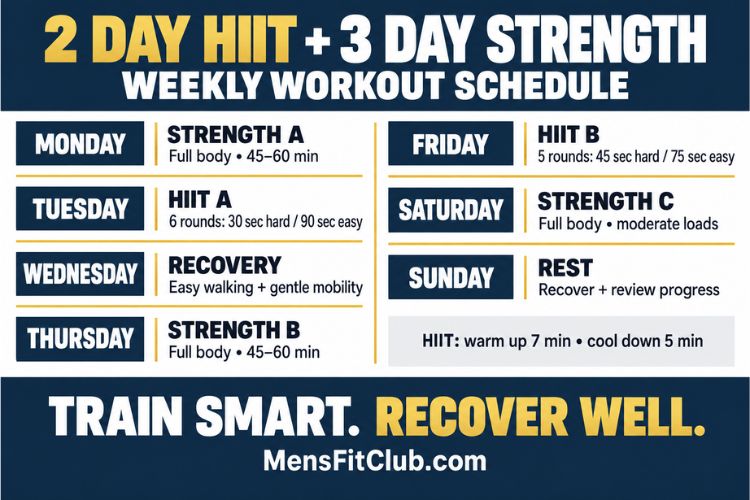
A 2 day HIIT and 3 day strength weekly schedule gives your workouts a clear structure: three sessions dedicated to lifting, two sessions focused on conditioning, and two days available for recovery. It can suit men who want to become stronger, improve cardiovascular fitness, and support healthier body composition without spending every day in the gym.
The challenge is managing effort. Five training days do not need to become five exhausting workouts. Strength sessions should build gradually, while high-intensity interval training should involve short, repeatable efforts rather than constant all-out sprints. Your weekly schedule works best when each session leaves enough energy for the next one.
This plan combines full-body strength training with low-impact cardio intervals. It includes exercises, sets, repetitions, rest periods, and a six-week progression. Use it as a starting template and adjust the workload to your experience, equipment, and recovery.
Why Combine 2 HIIT Days With 3 Strength Training Days?
Strength training and HIIT serve different purposes within a balanced workout routine. Lifting gives you regular opportunities to practice movement patterns and increase resistance. Intervals challenge your ability to work at a higher cardiovascular intensity and recover between efforts.
Three full-body strength workouts distribute lifting across the week. Instead of cramming every exercise into one long session, you practice squatting, hinging, pushing, pulling, and bracing several times. Different exercise choices and moderate training volumes help make that frequency manageable.
Two HIIT sessions provide a practical conditioning schedule for someone who already tolerates regular exercise. However, beginners should work toward that frequency. ACSM’s HIIT guidance recommends starting with one weekly session and adding a second as readiness improves, with sessions spread throughout the week.
Who Should Use This Weekly Workout Plan?
This schedule is intended for generally healthy adults who already exercise consistently and can perform basic strength exercises with controlled technique. It is particularly useful when you want a repeatable five-day routine instead of choosing random workouts each morning.
If you are returning after a long break, begin with two strength sessions and easy cardio. Add the third lifting day first, then introduce intervals gradually. Seek individualized guidance before vigorous exercise if you have symptoms, a relevant medical condition, or uncertainty about your ability to train safely.
The 2 Day HIIT and 3 Day Strength Weekly Schedule
Monday is Strength Workout A, Tuesday is HIIT Workout A, and Wednesday is a recovery day. Thursday is Strength Workout B, Friday is HIIT Workout B, and Saturday is Strength Workout C. Sunday is another recovery day.
This arrangement separates the two interval sessions and gives you a break after the first two workouts. Thursday through Saturday still creates three consecutive training days, so Friday’s interval session stays short and Saturday’s strength workout uses moderate loads.
Weekly Training Time and Recovery Expectations
Allow approximately 45–60 minutes for each strength workout, including warm-up sets. HIIT sessions take approximately 20–30 minutes, including warm-up, intervals, and cooldown. The weekly total is roughly three to four hours, depending on rest periods and exercise setup.
Alternating cardio and lifting does not automatically guarantee muscle recovery. Cycling, rowing, and running all involve muscles you also use during strength training. If Friday’s intervals leave your legs fatigued on Saturday, reduce the interval volume or move that session to Sunday and make Friday a recovery day.
How Hard Should You Train?
For strength exercises, choose loads that let you finish most sets with approximately two or three good repetitions remaining. This means you stop before technique deteriorates rather than grinding through every possible repetition.
For intervals, use perceived effort on a scale from one to ten. Hard bouts should generally feel around eight: challenging breathing, limited ability to speak, and controlled movement. Recovery bouts should feel around two or three. These are practical effort targets, not exact physiological measurements.
Warm Up Before Every Workout
Before lifting, spend five minutes walking, cycling, or rowing gently. Follow with a few controlled squats, hip hinges, shoulder movements, and exercise-specific warm-up sets. Increase the load gradually before starting your working sets.
Before HIIT, use seven minutes to build from easy movement to moderate effort. Include two short pickups below your intended interval intensity. Finish with approximately five minutes of easy movement so your breathing settles gradually.
Monday: Full-Body Strength Workout A
Monday starts with foundational exercises for the legs, chest, back, and trunk. Use a squat variation, a horizontal press, a row, a hip hinge, and a core exercise. Rest enough to make the next set productive.
Goblet Squat or Barbell Back Squat
Perform three sets of six to eight repetitions, resting two to three minutes between sets. Use a goblet squat if you are learning the movement or training with dumbbells. Choose a back squat if you have the equipment and technique to use it comfortably.
Dumbbell Bench Press and Supported Row
Perform the dumbbell bench press for three sets of eight to ten repetitions. Rest approximately two minutes between sets. If you do not have a bench, use a dumbbell floor press, recognizing that its range of motion is shorter.
Next, perform a chest-supported row for three sets of eight to twelve repetitions, resting 90–120 seconds. A one-arm supported dumbbell row is another option. Keep your torso stable and avoid turning the final repetitions into swinging movements.
Romanian Deadlift and Dead Bug
Perform two sets of eight to ten Romanian deadlifts, resting about two minutes. Use dumbbells or a barbell. Push your hips backward, keep the weights close, and stop lowering when you reach the limit of your controlled hinge.
Finish with two sets of six to ten dead bug repetitions per side. Move slowly and maintain comfortable trunk control. The goal is coordinated bracing, not rushing through a high repetition count.
Tuesday: HIIT Workout A 2 Day and 3 Day Strength Training
Tuesday uses short intervals with generous recovery. A stationary bike is a useful default because you can adjust effort quickly without jumping or landing. An elliptical or another familiar cardio machine can also work.
Thirty-Second Intervals With Ninety-Second Recovery
After the seven-minute warm-up, complete six rounds of 30 seconds hard followed by 90 seconds easy. The interval block lasts 12 minutes and contains only three minutes of hard work. Finish with a five-minute cooldown for a total of approximately 24 minutes.
Keep your output reasonably consistent across rounds. If you can only complete the first effort by going all-out, you started too aggressively. Reduce resistance or speed enough to make the remaining bouts repeatable.
Choose Conditioning That Fits Your 2 Day HIIT and 3 Day Strength Training
Avoid making heavy deadlifts, technical kettlebell movements, or loaded jump squats the default HIIT method for this schedule. A familiar cyclic activity makes effort easier to regulate while your lifting sessions provide the resistance work.
Wednesday: Recovery and Comfortable Movement
Wednesday provides a break from structured hard training. Take an easy walk, perform a few comfortable mobility movements, or rest completely. You should finish any activity feeling as fresh as when you started.
Add Walking Without Overestimating Your Cardio Minutes With 2 Day HIIT and 3 Day Strength
Two short HIIT workouts do not automatically satisfy weekly aerobic activity recommendations. Adult guidelines call for at least 150 minutes of moderate aerobic activity, 75 minutes of vigorous activity, or an equivalent combination, plus muscle-strengthening activity on at least two days.
Only the hard portions of these intervals clearly approach vigorous effort; easy recovery periods may not. Build toward the aerobic target with additional brisk walking or other moderate activity as tolerated. Keep recovery-day walking easy if your body needs a lighter day.
Thursday: Full-Body Strength Workout B
Thursday emphasizes a hip hinge, vertical pressing, pulling, and single-leg strength. The exercise selection differs from Monday while still covering the major movement patterns.
Trap Bar Deadlift or Dumbbell Deadlift
Perform three sets of five to six repetitions, resting two to three minutes. Use a trap bar if it is available and familiar, or choose a dumbbell deadlift with a setup that lets you maintain control.
Overhead Press and Lat Pulldown 2 Day HIIT and 3 Day Strength Training
Perform a dumbbell overhead press for three sets of six to ten repetitions. Rest approximately two minutes between sets. Keep your trunk steady and use a comfortable pressing range. A landmine press can be an alternative if overhead pressing does not suit you.
Follow with a lat pulldown for three sets of eight to twelve repetitions. Rest 90–120 seconds. Assisted pull-ups are another option. Pull with control and avoid leaning backward to move a load that is too heavy.
Reverse Lunge and Side Plank
Perform two sets of eight repetitions per leg of reverse lunges, resting 90–120 seconds after both legs. Begin with bodyweight if balance is challenging, and use support when needed. Split squats offer another controlled single-leg option.
Finish with two side plank holds of 15–30 seconds per side. Choose a position you can maintain while breathing normally. End the hold when your alignment changes rather than extending it through discomfort.
Friday: HIIT Workout B 2 Day and 3 Day Strength
Friday’s HIIT workout uses slightly longer efforts, but the total hard work remains modest. Choose a stationary bike or elliptical and avoid introducing an unfamiliar activity that could leave you unusually sore before Saturday.
Forty-Five-Second Intervals With Seventy-Five-Second Recovery
After warming up for seven minutes, complete five rounds of 45 seconds hard followed by 75 seconds easy. This creates a ten-minute interval block with three minutes and 45 seconds of harder work. Cool down for five minutes, bringing the session to approximately 22 minutes.
Adjust Friday to Protect Saturday’s Workout
Friday is the first session to reduce when accumulated fatigue appears. Drop to four rounds, use 30-second efforts instead, or replace the intervals with easy cardio. Do not increase interval volume simply because the workout feels brief.
Stop if you develop chest pain, faintness, or unusual severe breathlessness. Ordinary exertion should improve during recovery; concerning symptoms are a reason to end training and seek appropriate medical help.
Saturday: Full-Body Strength Workout C 2 Day HIIT and Strength
Saturday uses moderate resistance and exercises you can perform consistently after Friday’s conditioning. It still counts as a strength workout, so keep proper rest periods instead of turning it into a timed circuit.
Leg Press or Goblet Squat
Perform two sets of ten to twelve repetitions, resting about two minutes. Use a leg press at the gym or a goblet squat at home. Keep two or three repetitions in reserve and use a comfortable, controlled range.
Incline Press and Cable Row
Perform an incline dumbbell press for three sets of eight to twelve repetitions. Rest approximately two minutes. A standard floor press or appropriately scaled push-up can substitute when you lack an adjustable bench.
Next, perform a seated cable row for three sets of ten to twelve repetitions. Rest 90–120 seconds. Use a supported dumbbell row at home. Maintain steady posture and control the return portion of each repetition.
Glute Bridge and Farmer Carry 2 Day HIIT and 3 Day Strength Training
Perform two sets of ten to fifteen glute bridges, resting 60–90 seconds. Begin with bodyweight and add resistance gradually. Finish each repetition by extending your hips without exaggerating lower-back movement.
Complete two farmer carries lasting 20–40 seconds each. Rest approximately 90 seconds. Choose weights you can hold with upright posture and a secure grip. A stationary farmer hold works when space is limited.
Sunday: Rest and Review Your Progress
Sunday is your opportunity to recover and assess the week. Review the loads you used, repetitions completed, interval consistency, and how you felt between sessions. A short training log makes adjustments more reliable.
How to Progress Over Six Weeks With 2 Day HIIT and 3 Day Strength Training
During weeks one and two, learn the exercises and establish manageable starting loads. If needed, perform two sets instead of three and keep only Tuesday’s interval session. Use easy cardio on Friday until you tolerate the combined workload.
In weeks three and four, work toward the listed sets and both interval days. Add repetitions within the prescribed ranges before increasing weight. For example, progress a press from eight repetitions per set toward ten while preserving technique and your repetitions in reserve.
In weeks five and six, increase a strength exercise by the smallest practical weight increment once all sets reach the upper repetition target. Return to the lower end of the range with the new load. Progress individual exercises separately.
Increase One Training Variable at a Time
For HIIT, add one round to Tuesday or Friday only when recovery and repeatability are good. There is no requirement to progress intervals every week. You can also maintain the same interval prescription while producing slightly more consistent output.
Avoid increasing lifting volume, interval intensity, and interval duration simultaneously. If fatigue accumulates, spend a lighter week doing fewer strength sets and replacing one or both HIIT sessions with easy activity.
Nutrition and Sleep for a 2 Day HIIT and 3 Day Strength
Regular meals, hydration, and adequate sleep help make this schedule sustainable. Include a protein source at meals, eat carbohydrates that support your activity, and use vegetables, fruit, and other nutrient-dense foods to round out your diet.
For fat loss, use a manageable dietary approach rather than trying to compensate with more intervals. This schedule does not guarantee weight loss. Your overall food intake, activity, recovery, and consistency influence the outcome.
Prepare for the Next Session
Keep sleep timing as consistent as possible. When a poor night combines with heavy soreness or unusually low energy, reduce that day’s workload. The schedule should adapt to your recovery rather than encourage you to ignore it.
FAQ About 2 Day HIIT and 3 Day Strength Training
Can You Build Muscle With Three Strength Days and Two HIIT Days?
This arrangement can support muscle development when the strength workouts provide sufficient challenge, progress over time, and fit your recovery capacity. Keep interval volume manageable so it does not repeatedly reduce the quality of your lifting.
Should You Do HIIT Before or After Strength Training?
This plan puts them on separate days. If you must combine sessions and strength is your priority, lift while fresh and perform brief intervals afterward, or separate the sessions by several hours. Reduce total workload when combining days.
Is This Schedule Suitable for Men Over 40 or 50?
Age alone does not determine suitability. Training history, health, movement comfort, and recovery matter. Start conservatively, choose low-impact conditioning when appropriate, and adjust exercise variations and volume to your current ability.
What If You Miss a Workout?
Resume with the next planned session or shift the schedule while preserving recovery time. Avoid cramming missed intervals and lifting into one exhausting day. Consistent, manageable weeks matter more than completing every session perfectly.
Make Your 2 Day HIIT and 3 Day Strength Weekly Schedule Repeatable
A successful 2 day HIIT and 3 day strength weekly schedule balances effort with recovery. Use Monday, Thursday, and Saturday to practice lifting and gradually improve performance. Keep Tuesday and Friday’s conditioning short, controlled, and repeatable.
Begin with the workload you can recover from, record your progress, and make small adjustments. With regular practice, this five-day structure can become a dependable routine for building strength and improving fitness.
Build a balanced 2 day HIIT and 3 day strength weekly schedule with our 3 Day Strength Program for Sustainable Weight Loss, and explore conditioning options in the Best Full Body HIIT Workout Routine. For your lifting sessions, learn How to Choose Dumbbell Weight for Every Exercise and use the 6 Week Free Weight Strength Training Program for additional progression ideas. Keep recovery days gentle with our Rest Day Mobility Routine for Muscle Recovery.


Most Recommended

Subscribe to our Newsletter
Stay up to date on the latest men’s health, fitness and lifestyle trends and tips.
About Us
Men’s Fit Club was started with the goal of empowering men to get the most out of their lives. This meant going beyond exercise and diet tips to really address the broad range of issues that men face on a daily basis – topics like recreation, finding love, sexual health and even sound fashion advice.
Quick Links
© COPYRIGHT MEN'S FIT CLUB 2026. All Rights Reserved