

Sled-Free HYROX Workout Without Equipment at Home
Barbell Contrast Training Workout for Explosive Power
Barbell Contrast Training Workout for Explosive Power
Getting stronger gives you a bigger foundation for athletic performance, but strength alone does not guarantee that you can express force quickly. A heavy squat and a powerful jump share important qualities, yet they challenge your body differently. One emphasizes producing force against substantial resistance. The other demands that you produce force rapidly while coordinating an explosive movement. A barbell contrast training workout for power brings these demands into the same session through carefully selected exercise pairings.
The basic approach is straightforward: perform a low-repetition barbell strength exercise, recover, and then complete a small number of explosive repetitions using a lighter load or your body weight. A squat paired with a vertical jump is a familiar example. The method can add a useful power emphasis to a well-established strength program, provided you keep fatigue under control and choose movements you already perform confidently.
This guide explains how barbell contrast training works, how to select appropriate loads, and how to organize a practical workout. It also includes a six-week progression and modifications for lifters who need a more gradual introduction. The sample programming is a starting template for healthy, experienced lifters rather than a tested protocol that guarantees a particular result.
What Is Barbell Contrast Training?
Barbell contrast training alternates a relatively heavy resistance exercise with a lighter, faster exercise that uses a similar movement pattern. Each pairing combines a strength stimulus with an opportunity to practice explosive force production. You complete the heavy set, take enough recovery to move well, perform the explosive set, and recover again before repeating the sequence.
Terminology varies across coaching resources. This article uses contrast training to mean alternating heavy and explosive exercises set by set, a format also described as complex-contrast training. It does not mean rushing through a conventional superset. The rest between exercises is part of the training prescription, not empty time that needs to be filled.
How Contrast Training Differs From Supersets
A typical muscle-building superset often places exercises close together to increase training density or local fatigue. Contrast training for power has a different priority. You need the explosive movement to remain fast and technically sound. If the barbell set leaves you too tired to jump, throw, or push explosively, the pairing is not accomplishing its intended purpose.
Think of the heavy exercise and explosive exercise as two connected performance tasks. Your goal is to produce several excellent repetitions of each, with enough recovery to preserve quality. Sweating more, shortening the session, and creating a large muscle burn are not reliable measures of success in this workout.
Strength and Power Are Related but Distinct
Strength describes your ability to produce force. Mechanical power reflects how quickly work is performed and is related to both force and movement velocity. A heavy barbell repetition can involve considerable force even when the bar moves slowly. A jump requires rapid force production with much less external resistance.
Contrast training exposes you to both ends of that practical spectrum. The barbell movement develops or maintains strength, while the explosive movement trains a faster expression of force. Neither exercise has to imitate a sport perfectly to be useful, although improvements in a gym task do not automatically transfer to every athletic skill.
How Contrast Training May Improve Explosive Performance
A demanding muscular contraction can sometimes improve performance in a subsequent explosive task after sufficient recovery. This is commonly discussed as post-activation performance enhancement, or PAPE. However, a heavy set also creates fatigue. Your performance afterward depends partly on the balance between those competing effects.
Research does not establish an automatic boost for every lifter. A 2024 scoping review found substantial gaps in the complex-contrast training literature, including uncertainty about whether acute PAPE explains longer-term improvements. Treat the method as a way to organize strength and explosive practice, rather than a guaranteed nervous-system shortcut.
Recovery Determines Whether the Pairing Works
Moving directly from heavy squats into jumps can leave you expressing fatigue rather than power. In a meta-analysis examining squat-induced changes in jumping performance, the overall effect was not statistically significant, but certain longer recovery subgroups showed favorable results. Very short recovery could reduce performance.
For the workout below, begin with four to five minutes between the heavy set and explosive set. Extend that recovery toward six or seven minutes if you need it to regain normal jump quality or movement speed. These intervals are practical starting points, not universal optimal times. If the pairing repeatedly reduces performance despite adjustments, perform the explosive exercise before heavy lifting instead.
Who Should Use a Barbell Contrast Training Workout?
This workout is most appropriate for intermediate or advanced lifters with reliable barbell technique and experience performing the selected explosive exercises. You should be able to squat or press without losing position, estimate how hard a set is, and stop before repetitions become grinding efforts. Jumping also requires confident takeoffs and controlled landings.
Beginners generally benefit from building these skills separately first. Learn the barbell movements with manageable resistance, practice simple jumps or throws while fresh, and establish consistent training habits. You do not need contrast training to become stronger or more athletic. It is one programming option once the underlying movements are dependable.
Consider Your Joints, Recovery, and Training History
Age alone does not determine readiness, but impact tolerance, injury history, and recovery capacity affect exercise selection. A lifter returning after a long break should not immediately combine heavy squats with maximal jumps. Someone with painful knees or Achilles tendons may need an individualized alternative rather than a smaller version of the same jump.
If heavy lifting or impact exercise aggravates an existing condition, obtain guidance from a qualified clinician or coach familiar with your situation. Stop for sharp pain, dizziness, or an unusual loss of control. Power training works best when you can commit to the movement confidently instead of protecting a painful area throughout the repetition.
Equipment and Workout Setup
The main workout uses a barbell, plates, a squat rack with correctly positioned safeties, and a bench. It also requires clear floor space for vertical jumps and a secure elevated surface for explosive incline push-ups. A medicine ball is an optional alternative for the upper-body power exercise when an appropriate throwing area is available.
Prepare both exercise stations before starting. Check the rack settings, secure the bench, and remove loose plates or other obstacles from the landing area. Use a spotter where appropriate, particularly for bench pressing, and never rely on an unfamiliar safety setup. Avoid explosive work on unstable platforms or slippery flooring.
Warm Up Before Barbell Contrast Training
Begin with three to five minutes of easy walking, cycling, or rowing. Follow with controlled bodyweight squats, hip hinges, ankle movements, and gentle shoulder preparation. Choose movements that help you reach comfortable positions for the exercises ahead without turning the warm-up into a tiring mobility session.
Next, rehearse the explosive movements at lower effort. Perform two small sets of easy jumps, resetting between repetitions and landing softly. Practice the selected push-up variation or medicine-ball throw with a few comfortable repetitions. If coordination or landing control feels poor during these rehearsals, adjust the exercise before loading the strength movement.
Build Up to the Working Weight Gradually
For squats, start with the empty bar and progressively add weight across several warm-up sets. Reduce repetitions as the load increases. For example, use five easy repetitions, three moderate repetitions, and one or two repetitions closer to the intended working load. None of these sets should create substantial fatigue.
Complete a similar progression before bench pressing later in the session. Being generally warm from squats does not replace practicing the press with increasing resistance. The first working set should feel familiar and controlled, with a clear sense that you could perform additional technically sound repetitions if required.
The Barbell Contrast Training Workout for Power
The core workout contains two pairings: barbell back squats with vertical jumps, followed by barbell bench presses with explosive incline push-ups. Begin with two rounds of each pairing during your introductory sessions. Progress toward three rounds only when the explosive repetitions remain consistent and you recover comfortably between workouts.
For heavy exercises, select a load that feels around seven to eight out of ten in effort and leaves approximately two or three repetitions in reserve. Experienced lifters may find that roughly 75 to 85 percent of a recent, reliable one-repetition maximum fits this purpose, but percentages are secondary to actual technique and effort. You do not need to test a maximum before starting.
Pairing One: Barbell Back Squat and Vertical Jump
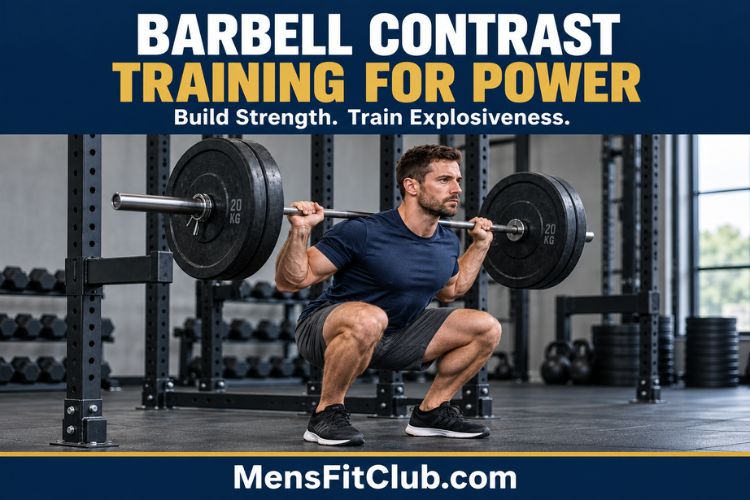
Perform two to three back squat repetitions. Set your stance, brace your trunk, and descend to a depth you can control without losing position. Drive upward with the intention of moving the bar quickly while maintaining balance. The load may limit actual bar speed, but the repetition should not become a prolonged struggle.
Rack the bar and rest four to five minutes. Then perform three vertical jumps, resetting your stance and balance between each repetition. Use a natural countermovement and arm swing, jump with strong intent, and land with controlled hip and knee flexion. Pause approximately ten to twenty seconds between jumps so each repetition begins from a deliberate setup.
After the jump set, recover for approximately three minutes before beginning the next squat set. Take longer if needed. Two rounds provide four to six working squat repetitions and six jumps; three rounds provide six to nine squat repetitions and nine jumps. This deliberately modest volume helps you focus on power instead of accumulating fatigue.
Why Vertical Jumps Are the Default Choice
Vertical jumps require minimal equipment and allow you to reset easily between attempts. They also avoid the temptation to chase a taller box by pulling your knees higher. A higher box does not necessarily mean a more powerful takeoff, and missed box jumps introduce an avoidable obstacle into the exercise.
If you choose box jumps because you already perform them confidently, use a stable, moderate-height box and step down after each repetition. Do not add depth jumps or repeated rebound jumps simply to make the pairing harder. Those exercises increase technical and impact demands without being necessary for this introductory contrast workout.
Pairing Two: Barbell Bench Press and Explosive Incline Push-Up
Perform two to three bench press repetitions with a controlled descent and a strong upward press. Maintain a stable upper back, consistent foot position, and a grip you can use comfortably. Use appropriate safeties or a competent spotter. Stop the set before you need assistance or lose the position established on the first repetition.
Rest four to five minutes, then complete three explosive incline push-ups using a secure elevated surface. Maintain a straight body line and push away rapidly. A brief release of the hands is optional and suitable only when you can land with control; the essential feature is fast, coordinated pushing. Reset between repetitions rather than bouncing immediately into the next one.
Recover for about three minutes before repeating the bench press set. Complete two or three rounds. Choose an incline high enough to allow clear speed without shoulder discomfort. If even that version feels awkward, use a light medicine-ball chest pass in a safe throwing space instead, with three throws and a full reset after each.
Keep the Barbell Under Control
Do not release a free barbell during bench presses or attempt improvised barbell throws. The explosive component comes from the push-up or medicine ball, not from throwing the loaded bar. Similarly, this plan does not require jumping with a barbell on your back. More complicated ballistic barbell exercises require their own skill development and coaching.
Optional Hinge Pairing for a Different Session
Once you tolerate the main workout well, you can rotate in a deadlift and standing broad jump pairing on another training day. Use it instead of the squat pairing rather than automatically adding a third heavy contrast block. This keeps the session manageable and allows you to judge your response to the new combination.
Perform two controlled deadlift repetitions, resetting fully on the floor between them. Rest four to five minutes, then perform two standing broad jumps with a complete reset between attempts. Land in balance and choose distance based on control, not desperation. Rest approximately three minutes before the next round, and begin with two rounds total.
Accessory Work After the Contrast Blocks
After the primary pairings, complete a small amount of supporting work. One practical option is two sets of chest-supported rows for eight to ten repetitions and two sets of controlled split squats for six repetitions per side. Keep a few repetitions in reserve and use comfortable ranges of motion.
Choose accessories according to what your wider program already includes. If pulling volume is low, emphasize rows. If you need additional trunk work, use a modest amount of a familiar exercise. The accessories should support the plan without turning a focused power session into a long, exhausting bodybuilding workout.
Six-Week Barbell Contrast Training Progression
Use the following progression to build familiarity before increasing demands. It is a practical coaching framework, not a research-validated six-week protocol. Start with one contrast session each week while maintaining your other strength work, and adjust the total workload if soreness or performance indicates that you need more recovery.
Weeks One and Two: Learn the Sequence
Complete two rounds per pairing. Use two repetitions for each barbell set and three repetitions for each explosive set. Choose conservative loads and prioritize consistent rest periods. Record the weight, perceived effort, recovery time, and whether your jumps or push-ups looked and felt similar across rounds.
Keep the exercise choices unchanged during these weeks. Repeated practice makes it easier to separate normal variation from a poor response to the pairing. If explosive performance consistently suffers after the heavy exercise, reduce the load or lengthen recovery. You can also move power practice ahead of lifting rather than forcing the contrast format.
Weeks Three and Four: Add a Round if Ready
Increase from two to three rounds only if technique and speed remain dependable. Keep the barbell load stable when adding that round so you change one major variable at a time. Continue using two or three heavy repetitions and three explosive repetitions, with full recovery throughout.
If the third round becomes noticeably slower, return to two rounds. More volume is useful only when it adds quality training. Avoid increasing barbell weight, explosive repetitions, jump difficulty, and weekly frequency together. That makes it difficult to identify what caused fatigue or declining performance.
Week Five: Make a Small Load Adjustment
If the existing barbell load feels comfortably controlled, increase it by the smallest practical increment. Keep the explosive exercise and repetition count unchanged. The new load should still leave repetitions in reserve and allow consistent positions. A heavier weight that produces grinding repetitions is outside this workout’s intended effort range.
Progress can also mean cleaner technique, better landing control, or more consistent explosive repetitions at the same load. You do not have to add weight each week to make the block worthwhile. Use your records to judge whether the training is improving the qualities you actually want.
Week Six: Reduce Volume and Review
Return to two rounds per pairing and avoid chasing new loads. This lighter week gives you room to assess the training block with less accumulated fatigue. Review your notes, compare movement quality, and consider whether the contrast structure suited your schedule and recovery.
If you measure jumps, use the same warm-up, surface, footwear, and measurement method each time. Compare multiple controlled attempts rather than one unusually good repetition. Small changes can reflect normal measurement variation, so look for a consistent trend before declaring that the program improved power.
How to Fit Contrast Training Into Your Week
Place contrast training on a day when you can arrive reasonably fresh. For example, perform the full session on Monday, conventional strength work on Thursday, and easier conditioning or walking on other days. Avoid putting a demanding lower-body contrast workout directly after hard running intervals or a high-volume leg session.
Once you have demonstrated good recovery, two shorter weekly sessions may suit you better: a squat-based session early in the week and an upper-body session later. Leave at least a couple of days between demanding sessions for the same muscles, and account for sport practice, running, and other jumping work when estimating total stress.
Common Barbell Contrast Training Mistakes That Reduce Power Quality
The most common mistake is using too much weight. Contrast training does not require maximal lifting, and fatigue from a near-limit set can undermine the next exercise. Choose resistance that challenges you without changing the repetition into a slow technical struggle. Save maximum-strength testing for a separate, appropriately planned occasion.
Another mistake is chasing repetitions. Ten tired jumps do not serve the same purpose as three crisp jumps. Stop an explosive set when height, speed, or control clearly deteriorates. If successive rounds continue to decline despite sufficient rest, end that block rather than completing the written volume automatically.
Avoid Poor Pairings and Constant Exercise Changes
Pair exercises with a clear movement relationship, such as a squat with a jump or a press with a chest pass. Unrelated exercises may work in other training formats, but they do not provide the same movement-specific contrast. Start with simple combinations before considering advanced variations.
Keep those combinations stable long enough to evaluate them. Changing every exercise each week makes progress difficult to interpret and repeatedly introduces new coordination demands. Consistent practice also helps you notice whether a particular heavy exercise improves, preserves, or reduces the quality of the explosive movement that follows.
Build Power Through Consistent, High-Quality Practice
A barbell contrast training workout for power can give experienced lifters a structured way to combine strength work with explosive movement practice. Start with two simple pairings, moderate overall volume, and generous recovery. Progress only when barbell technique, jump control, and movement speed remain dependable.
Keep the goal clear each time you train: produce strong, controlled repetitions and express force quickly without letting fatigue take over. Over the six-week block, your training notes should guide decisions about load, rest, and volume. That patient approach gives you a more useful foundation for explosive performance than chasing heavier weights or harder jumps every session.
Build the foundation for your barbell contrast training workout with our 4 Week Barbell Technique Program, then explore the Barbell Back Squat Workout and Bench Press Strength Guide for the heavy lifts used in your contrast pairings. For broader strength programming, read the Full Body Barbell Compound Lifts Workout and 8 Week Barbell Progressive Overload Program to plan gradual progression alongside your explosive training.


Most Recommended

Subscribe to our Newsletter
Stay up to date on the latest men’s health, fitness and lifestyle trends and tips.
About Us
Men’s Fit Club was started with the goal of empowering men to get the most out of their lives. This meant going beyond exercise and diet tips to really address the broad range of issues that men face on a daily basis – topics like recreation, finding love, sexual health and even sound fashion advice.
Quick Links
© COPYRIGHT MEN'S FIT CLUB 2026. All Rights Reserved