

Sled-Free HYROX Workout Without Equipment at Home

Barbell Contrast Training Workout for Explosive Power

4 Week Beginner HYROX Strength Training Plan
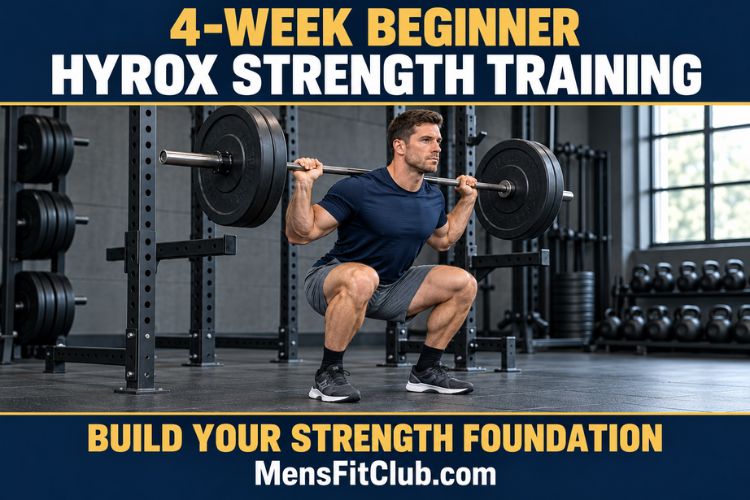
Starting HYROX training can feel overwhelming when you see athletes pushing heavy sleds, carrying kettlebells, and completing lunges between running intervals. You might wonder whether you need to become a strong lifter before starting or whether every workout should resemble a race. For beginners, the most useful first step is a manageable program that develops basic strength, teaches the movements, and leaves enough energy for consistent practice. This 4 week beginner HYROX strength training plan gives you that starting point. It combines three weekly strength sessions with one easy aerobic session, gradually introducing carries, sled work, wall balls, and short exercise transitions. The emphasis is on controlled repetitions and repeatable effort. You will develop the ability to squat, hinge, push, pull, and carry before attempting demanding combinations of those movements.
Four weeks is a foundation phase, not a guarantee of race readiness. Your starting fitness, running experience, equipment access, and chosen event determine how much preparation you need afterward. However, a structured first month can help you establish useful habits and identify the areas that deserve more attention.
What Is HYROX Strength Training?
HYROX combines eight 1-kilometer runs with eight workout stations. The stations follow a set sequence: SkiErg, sled push, sled pull, burpee broad jumps, rowing, farmers carry, sandbag lunges, and wall balls. Strength training supports your ability to perform these movements while the running adds a substantial endurance demand.
For a beginner, HYROX strength training means building the physical qualities behind those stations. Squats develop leg strength, hinges train the hips and posterior chain, rows strengthen pulling muscles, and carries challenge grip and trunk control. Station practice then teaches you to apply those qualities to the equipment and movement patterns used in the event.
Strength and Station Practice Serve Different Purposes
A set of goblet squats helps you practice producing force with stable alignment. A short wall-ball set adds timing, catching, and throwing to a squat pattern. Both are useful, but they are different tasks. Increasing your squat strength does not automatically teach you to hit the target consistently, just as completing many wall balls does not replace every benefit of structured lifting.
This program includes both approaches. The first two sessions emphasize strength and technique, while the third introduces controlled combinations. That structure allows you to learn without making every workout an exhausting circuit.
Who Should Follow This Beginner HYROX Training Plan?
This plan suits generally healthy adults who are new to HYROX and can tolerate basic resistance exercise. It also works for recreational runners who need a clearer strength routine or gym beginners who want an introduction to hybrid training. You should be able to walk comfortably and complete simple bodyweight movements without pain before adding loaded work.
If you are completely new to exercise, begin with two weekly strength sessions and walking, adding the third session when recovery feels manageable. Someone returning after a long break may also need to repeat the first week. The calendar provides structure, but your ability to recover determines the appropriate pace.
Set a Realistic First-Month Goal
Aim to complete your sessions consistently, improve exercise technique, and establish sensible starting loads. You might finish the month carrying heavier dumbbells, performing more controlled lunges, or recovering more comfortably between exercises. Those are meaningful outcomes even if your running remains slow.
Avoid choosing a race deadline that forces you to accelerate every part of training simultaneously. If your event is approaching quickly and you have little running or lifting experience, consider whether a later date or a shared-workload division better matches your preparation.
Equipment for the 4 Week Beginner HYROX Training Plan
The main workouts use dumbbells or kettlebells, a sturdy bench or box, and a cable station or resistance band. Access to a sled, medicine ball, rowing machine, and SkiErg allows more specific practice, but you can start building general strength without all of them. Choose clear walking lanes for carries and stable surfaces for step-ups.
A commercial gym is convenient, although the strength exercises can be adapted to a small training space. Equipment limitations mainly affect station specificity. General strength alternatives develop useful qualities, but they cannot fully reproduce the feel, resistance, or judging standards of race equipment.
How to Choose Your Starting Weights
Select a load that allows you to finish each set with approximately three good repetitions still available. Your last repetition should resemble your first: controlled, balanced, and free of compensations. If you have to twist, bounce, or rush to finish, reduce the weight.
For carries, start with a pair of weights you can hold while walking upright for the prescribed distance. For lunges and wall balls, bodyweight or a light ball may be appropriate initially. Race loads are reference points for later preparation, not mandatory beginner training loads.
Your Weekly Beginner HYROX Training Plan Schedule
Train Session A on Monday, complete an easy aerobic session on Tuesday, and take Wednesday as a rest or gentle mobility day. Perform Session B on Thursday, rest Friday, and complete Session C on Saturday. Keep Sunday available for recovery or relaxed walking. This arrangement separates the strength sessions and makes the week easier to sustain.
Sessions A and B usually take 40–55 minutes, including preparation and rest. Session C should take roughly 30–45 minutes. Tuesday’s aerobic work begins at 15–20 minutes and progresses only if you tolerate it well. A beginner may need shorter sessions, and that is an acceptable adjustment.
Keep the Aerobic Session Easy
Walk briskly, jog gently, or alternate short jogging periods with walking. Use an effort that allows you to speak in full sentences. If running is new, try one minute of easy jogging followed by two minutes of walking and repeat within your planned session time.
Cycling or rowing can build aerobic fitness when running is not currently comfortable, but they do not replace the need for gradual running exposure if you intend to race. Avoid turning this session into sprint training. Its purpose is to build consistency without undermining the strength workouts.
Warm Up Before Every Beginner HYROX Training Plan Session
Spend eight to ten minutes preparing. Begin with three minutes of easy walking, cycling, or rowing. Follow with six bodyweight squats, six unloaded hip hinges, five reverse lunges per side, and eight light rows. Keep the movements smooth and use a comfortable range of motion.
Then perform one or two lighter practice sets of your first loaded exercise. Before sled work, practice with an easy load; before wall balls, rehearse the squat and throw with a light ball. Preparation should leave you feeling ready rather than tired.
Use the Warm-Up to Assess Readiness
Notice whether your movement improves as you warm up. Mild stiffness may settle with practice, while sharp pain or worsening discomfort is a reason to stop that exercise. If your legs feel unusually heavy or your coordination is poor, reduce the day’s load or volume.
You do not have to force the written progression when recovery is lagging. Matching the session to your current capacity helps preserve useful training across the entire month.
Session A: Lower-Body Strength and Carries
Session A develops the squat, hinge, and carrying patterns. Complete each exercise’s sets before moving to the next rather than rushing through a circuit. Rest 90–120 seconds between the main lifts and 60–90 seconds between carries or core sets. Take longer when needed to restore good technique.
Goblet Squat
Hold a dumbbell or kettlebell close to your chest and stand with a comfortable foot position. Sit down between your hips while maintaining whole-foot pressure, then stand smoothly. Keep your knees moving in line with your feet and use a depth you can control without pain.
Start with two sets of eight repetitions in week one. Progress to three sets of eight in week two, then three sets of ten in week three if technique remains sound. In week four, return to two sets of eight using a comfortable load. Use a box as a depth guide if it helps you stay consistent.
Dumbbell Romanian Deadlift
Hold the weights near your thighs, soften your knees, and move your hips backward. Lower the weights close to your legs until you feel tension through the hamstrings without losing trunk control. Stand by driving through your feet and extending your hips.
Perform two sets of eight in week one, three sets of eight in week two, and three sets of ten in week three. Complete two sets of eight in week four. You do not need to reach the floor; the appropriate bottom position depends on your mobility and control.
Reverse Lunge
Step backward and lower under control, then return to standing through the front leg. Begin without weights and use a stable support if balance limits the movement. Keep your steps consistent and avoid rushing through the return.
Complete two sets of six repetitions per side in week one, two sets of eight in week two, and three sets of eight in week three. Reduce to two sets of six in week four. Add a small load only when bodyweight repetitions feel steady.
Farmers Carry and Dead Bug
For farmers carries, walk with a weight in each hand, shoulders comfortable and torso upright. Complete three carries of 20 meters in week one, three of 25 meters in week two, and four of 25 meters in week three. Return to three of 20 meters in week four. If space is limited, use controlled turns or 20–30-second holds.
Finish with two sets of six dead bugs per side throughout the program. Move slowly, extending opposite limbs only as far as you can maintain trunk control. Keep this exercise precise rather than increasing repetitions simply to feel fatigued.
Session B: Pulling, Pushing, and Sled Technique
Session B develops upper-body strength and introduces manageable sled practice. Complete the resistance exercises with 90 seconds of rest between sets. For sled efforts, allow 90–120 seconds or enough time to repeat the movement without straining or losing position.
Dumbbell Floor Press or Incline Push-Up
Choose a dumbbell floor press or a push-up against a securely positioned elevated surface. During presses, lower under control and keep your wrists stacked over your forearms. For push-ups, select an incline that lets you maintain a straight, stable body position.
Perform two sets of eight in week one, three sets of eight in week two, and three sets of ten in week three. Use two sets of eight in week four. Stay with the same variation for the month so you can judge progress clearly.
Cable Row or Supported Dumbbell Row
Pull with a steady torso, bringing your elbows backward without jerking the weight. Allow a controlled return and avoid repeatedly shrugging your shoulders. A supported dumbbell row can make it easier to maintain position while learning.
Complete two sets of ten in week one, three sets of ten in week two, and three sets of twelve in week three. Reduce to two sets of ten in week four. For a one-arm version, perform the prescribed repetitions on each side.
Low Step-Up
Use a sturdy, low box that allows you to step up without hopping or pushing strongly from the trailing foot. Keep the working foot planted, stand tall, and lower slowly. Begin with bodyweight and increase the load only after the movement is balanced.
Perform two sets of six per side in week one, two sets of eight in week two, and three sets of eight in week three. Return to two sets of six in week four. This exercise complements lunges by developing controlled single-leg strength.
Sled Push and Sled Pull Practice
Use a light sled and a clear lane. Complete two 10-meter pushes and two 10-meter pulls in week one. Increase to three efforts of each in week two and four in week three, keeping the load manageable. In week four, return to two efforts of each.
For pushing, maintain a stable trunk and take deliberate steps. For pulling, follow the facility’s setup guidance and learn the hand-over-hand technique with light resistance. Sled friction varies considerably across surfaces, so adding identical plates does not create identical difficulty everywhere.
If a sled is unavailable, perform two sets of eight additional goblet squats and two sets of ten cable or band rows in weeks one and four. Use three sets of each in weeks two and three. These are general strength substitutes, not exact sled replacements; arrange equipment practice later if racing is your goal.
Session C: Beginner HYROX Strength-Endurance Practice
Session C introduces short transitions while keeping the effort controlled. One round consists of two minutes of easy jogging or brisk walking, eight goblet squats, six reverse lunges per side, a 20-meter farmers carry, and six light wall balls. Move carefully between exercises and rest two minutes after each round.
Complete two rounds in weeks one and two. Increase to three rounds in week three only if you are recovering well and maintaining technique. Return to two rounds in week four, using the same loads and movement choices as week one to create a useful comparison.
Learn Wall-Ball Timing
Practice a smooth squat followed by a coordinated throw, using leg drive to help move the ball. Start with a light ball and an achievable target while learning. Catch with control and reset when necessary rather than rushing into uneven repetitions.
A light dumbbell squat-to-press can serve as a general alternative where wall-ball equipment is unavailable. It develops a related pattern but does not teach throwing accuracy or catching. Before competing, review the current HYROX rulebook and practice your division’s required movement standards.
Optional Erg Technique
If a SkiErg or rower is available, add five minutes of easy technique work after the circuit. Choose one machine per session. On the rower, practice a smooth sequence of leg drive, torso movement, and arm pull; on the SkiErg, coordinate a controlled hip hinge with the downward pull.
Keep this optional work easy. Beginners do not need extra fatigue merely because equipment is available. Omit it if the main session already challenges your recovery.
How to Progress Across All Four Weeks
Week one establishes your baseline. Keep the loads conservative and record which variations you used. Note whether balance, breathing, grip, or muscle fatigue limits each exercise. Those observations are more useful than comparing your numbers with experienced racers.
Week two adds sets to selected movements while keeping most loads unchanged. Week three increases repetitions or rounds. Because the written plan already raises volume, avoid simultaneously adding substantial weight, faster running, and shorter rests.
Increase Weight Only When the Work Feels Manageable
If you complete all prescribed repetitions with consistent technique and several repetitions available, a small load increase may be reasonable. Keep that increase modest and consider holding repetitions steady that day. If the next weight jump is too large, continue practicing with your existing load.
Week four reduces volume so you can consolidate the skills and assess progress. It is not a competition week or a full race simulation. Repeat the shortened Session C under similar conditions and compare control, perceived effort, and recovery rather than trying to set an all-out time.
Recovery and Common Beginner Mistakes
Allow recovery days to remain easy. Regular meals, adequate fluids, and consistent sleep support your ability to train repeatedly. Avoid deliberately under-fueling demanding sessions in pursuit of rapid weight loss. If soreness changes your walking or exercise technique, reduce the next session and reconsider the previous increase.
Common mistakes include selecting race weights too early, removing rest periods, and turning every strength workout into cardio. Another is adding frequent hard runs to a program that already contains unfamiliar leg exercises. Build one challenge at a time and protect the quality of your main lifts.
Adjust for Your Starting Point
Older beginners and anyone returning after a break can use the same movement patterns while starting with fewer sets, lighter loads, and longer rests. Age alone does not determine the correct exercise; current capacity and recovery are more useful guides. Persistent pain deserves individual assessment rather than repeated attempts to train through it.
Track Progress Without Testing Maximums
Keep a brief training log with your weights, repetitions, carry distances, and a sentence about how each session felt. Record the height of your push-up surface or step-up box, too. These details make comparisons more meaningful because changing the setup can change the exercise difficulty even when the repetition count stays the same.
You do not need a maximum deadlift, a timed kilometer, or a full HYROX simulation to evaluate your first month. Look for smoother movement, fewer unplanned breaks, and better control at the same workload. If your performance declines across several sessions, hold the progression and examine recovery before adding more training. Consistency is the main target during this introductory block. Finishing a manageable week and returning ready for the next one builds a more useful foundation than completing one impressive workout that leaves you unable to train normally afterward.
What to Do After This Beginner HYROX Program
After four weeks, decide whether to repeat the foundation phase or progress into a longer training block. Repeat it if technique remains inconsistent, the weekly schedule is difficult to sustain, or running exposure is still minimal. Progress when you can complete the sessions with stable form and recover comfortably between them.
Your next block can gradually build running duration, introduce burpee broad-jump technique, and expand race-specific station practice. Increase one demand at a time. This 4 week beginner HYROX strength training plan succeeds when it gives you a reliable starting routine, stronger movement patterns, and a clearer understanding of what to develop next.
Build a stronger foundation for your 4 week beginner HYROX strength training plan with our 30 Minute Beginner Strength Workout, and learn How to Choose Dumbbell Weight For Every Exercise to keep your lifting controlled. Develop grip and carrying strength with these 15 Loaded Carry Workouts, support your recovery with our Rest Day Mobility Routine, and explore the 8 Week HYROX Training Plan when you are ready for more advanced preparation.


Most Recommended

Subscribe to our Newsletter
Stay up to date on the latest men’s health, fitness and lifestyle trends and tips.
About Us
Men’s Fit Club was started with the goal of empowering men to get the most out of their lives. This meant going beyond exercise and diet tips to really address the broad range of issues that men face on a daily basis – topics like recreation, finding love, sexual health and even sound fashion advice.
Quick Links
© COPYRIGHT MEN'S FIT CLUB 2026. All Rights Reserved