


Sled-Free HYROX Workout Without Equipment at Home

Barbell Contrast Training Workout for Explosive Power

8 Week HYROX Training Plan for Strength and Endurance
Training for HYROX requires more than being a good runner or a strong lifter. The event rewards athletes who can run efficiently, perform functional exercises under fatigue and control their effort from the opening kilometer to the final wall ball. That combination makes preparation exciting, but it also makes random workouts a poor strategy. You need a structured hyrox training plan that develops the right qualities in the right order.
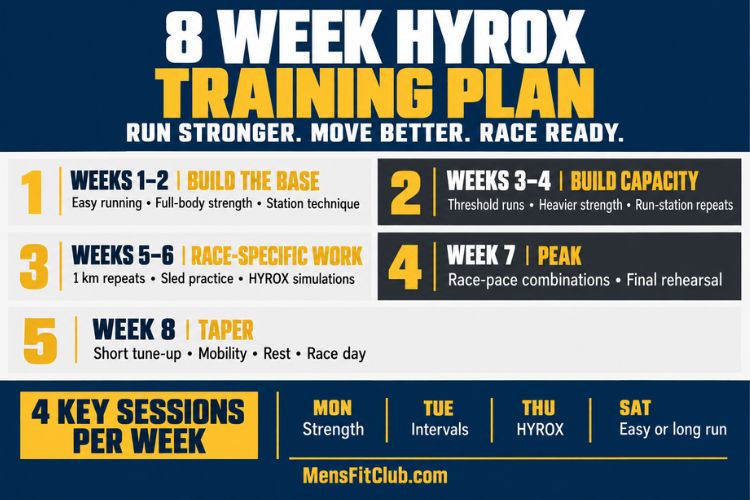
This 8 week HYROX training plan is designed for men who already exercise consistently and want a practical route toward their first race or a stronger return performance. It combines running, strength training, station practice and race-specific conditioning without turning every session into an exhausting simulation. The plan uses four main training days, one optional recovery session and at least one complete rest day each week. It can therefore fit around work, family and normal life while still providing enough volume to produce meaningful progress.
The goal is not to win every workout. It is to reach race day healthy, technically confident and prepared to maintain a sustainable pace when running and functional movements begin to compete for the same energy.
What Is a HYROX Race Training Plan?
The standard HYROX format alternates eight 1-kilometer runs with eight functional workout stations. Athletes complete the stations in a fixed order: 1,000 meters on the SkiErg, a 50-meter sled push, a 50-meter sled pull, 80 meters of burpee broad jumps, 1,000 meters of rowing, a 200-meter farmers carry, 100 meters of sandbag lunges and 100 wall balls. This creates a total of 8 kilometers of running plus a demanding full-body workload.
Exact loads, standards and division requirements can change by category or season, so confirm the current official rulebook for your event before selecting training weights. Open, Pro, Doubles and Relay competitors do not all face the same demands. Nevertheless, the movement patterns and overall sequence give every athlete a clear training target.
HYROX is sometimes described as a running race with workout stations, and that description highlights an important point: running occupies a large portion of the event. Strong station performance cannot compensate fully for inefficient running. At the same time, running speed alone is not enough if the sleds destroy your legs or wall-ball technique collapses. A successful plan must train both parts and, increasingly, teach you to combine them.
Who Should Use This 8 Week HYROX Training Plan?
This plan suits an intermediate recreational athlete who can run continuously for roughly 30 minutes, strength trains with sound technique and tolerates four workouts per week. You do not need prior HYROX experience, but you should understand basic movements such as squats, lunges, deadlifts, carries and burpees.
If you are completely new to running or resistance training, spend four to eight weeks building a basic foundation before beginning. If you have a medical condition, a recent injury or persistent pain, seek appropriate professional guidance. Eight weeks is enough time to sharpen existing fitness; it is not enough time to rush years of adaptation safely.
Experienced competitors can also use the framework by increasing appropriate loads, running volume or pace. However, more is not automatically better. Adjust only one major variable at a time and protect the quality of your key race-specific sessions.
The Training Priorities That Drive HYROX Performance
Aerobic Endurance
Your aerobic system supports every run and helps you recover while moving between harder efforts. Easy running may feel less specific than sled work, but it improves your ability to hold pace without accumulating fatigue too early. Most easy sessions should be conversational, controlled and genuinely easier than race pace.
Running Under Fatigue
Fresh running and compromised running are different skills. After lunges, sleds or burpees, your stride can become short and tense while your breathing rises sharply. The plan gradually introduces station-to-run combinations so you learn to relax, regain rhythm and avoid sprinting simply because a transition creates adrenaline.
Functional Strength HYROX Training Plan
Strong legs, hips, back, shoulders and trunk make each station less expensive. Squats and split squats support lunges and wall balls. Deadlift and rowing patterns assist sled pulls and carries. Pressing strength helps with sled pushing and wall-ball durability. Strength work should be challenging, but most sets should stop with one to three good repetitions still available.
Movement Economy
Small technical improvements can save energy across hundreds of repetitions and many minutes of work. Efficient SkiErg and rowing strokes, secure carry posture, consistent lunge steps and repeatable wall-ball rhythm matter. Early in the plan, practice these movements while relatively fresh. Later, demonstrate the same technique under controlled fatigue.
Pacing and Transitions
A common mistake is attacking the first run and SkiErg as though the race lasts 15 minutes. The cost appears later, often during burpees, lunges or wall balls. Training should teach you to begin slightly conservatively, move purposefully through transitions and leave each station able to run rather than stagger.
Weekly Schedule for the 8 Week HYROX Training Plan
Use the following structure throughout the program:
- Monday: Strength and station technique
- Tuesday: Running intervals or tempo work
- Wednesday: Rest or gentle mobility
- Thursday: HYROX conditioning session
- Friday: Rest
- Saturday: Easy or long run plus optional technique
- Sunday: Full rest or 20 to 30 minutes of easy recovery work
The order can change to suit your schedule, but avoid placing the hardest sessions on consecutive days. If Saturday must be your conditioning day, move the easy run to Thursday and keep Friday light. Consistency matters more than matching the calendar perfectly.
Warm up for 8 to 12 minutes before every session with easy aerobic work, dynamic mobility and movement-specific preparation. Cool down until breathing settles, then record useful notes such as pace, load, perceived effort and any technical problems.
Weeks 1 and 2: Establish the Foundation
The opening phase builds movement quality and introduces manageable training volume. Keep most work around a perceived effort of 6 or 7 out of 10. You should finish knowing you trained, but not needing several days to recover.
Monday: Strength and Technique HYROX Training Plan
Complete goblet squats for 4 sets of 8, Romanian deadlifts for 4 sets of 8, dumbbell bench presses for 3 sets of 10, one-arm dumbbell rows for 3 sets of 10 per side and walking lunges for 3 sets of 12 steps per leg. Finish with three rounds of a 30- to 40-meter farmers carry and 10 controlled wall balls. Rest 60 to 120 seconds as needed to preserve form.
If you have sled access, replace the final carries every other week with four light 12.5-meter sled pushes and pulls. Focus on body angle, short forceful steps and continuous rope tension rather than speed.
Tuesday: Controlled Running Intervals
After an easy warm-up, run 5 repetitions of 3 minutes at a comfortably hard effort with 2 minutes of easy jogging between repetitions. The fast segments should be consistent. If the last interval is dramatically slower than the first, you began too aggressively. Cool down for 10 minutes.
In week two, progress to 6 repetitions without increasing speed. This builds repeatability and introduces faster running without excessive impact.
Thursday: Introductory HYROX Circuit Training Plan
Complete three rounds of a 600-meter run, 500-meter SkiErg, 12 burpees, a 30-meter farmers carry and 15 wall balls. Rest for 2 minutes between rounds. Use moderate loads and treat this as technique under light fatigue. Week two can use four rounds if recovery from week one was good.
Saturday: Easy Endurance Run
Run easily for 40 minutes in week one and 45 minutes in week two. You should be able to speak in complete sentences. If your heart rate or breathing keeps climbing, slow down or use short walking breaks. Optional: perform 10 minutes of easy rowing technique after the run.
Weeks 3 and 4: Build Strength and Work Capacity
This phase increases the amount of useful work while retaining control. Loads become moderately heavier, runs become longer and the conditioning session starts to resemble the demands of the event.
Monday: Progressive Full-Body Strength HYROX Training Plan
Perform front squats for 4 sets of 6, trap-bar or conventional deadlifts for 4 sets of 5, overhead presses for 3 sets of 8, pull-ups or lat pulldowns for 3 sets of 8 to 10 and Bulgarian split squats for 3 sets of 8 per leg. Finish with four 40-meter heavy farmers carries and 3 sets of 15 wall balls.
Increase weight only if every repetition remains clean. HYROX preparation benefits from strength, but grinding repetitions and failed lifts create fatigue without improving race-specific execution.
Tuesday: Threshold Development
Warm up, then complete 3 repetitions of 8 minutes at a strong, sustainable effort with 3 minutes of easy jogging between repetitions. In week four, use 2 repetitions of 12 minutes at approximately the same intensity. The objective is controlled discomfort rather than an all-out time trial.
Thursday: Run-Station Repeats
In week three, complete four rounds of an 800-meter run followed by one station: 750 meters SkiErg, 20 meters sled push plus 20 meters sled pull, 40 meters burpee broad jumps, and 750 meters rowing. Rest 90 seconds after each station.
In week four, complete five 800-meter runs, placing a different station after each run. Add a 100-meter farmers carry as the fifth station. Use race-style movements but approximately 70 to 80 percent of intended race load or volume. Aim for similar run splits from beginning to end.
Saturday: Longer Easy Run HYROX Training Plan
Run 50 minutes in week three and 55 minutes in week four at an easy pace. Finish with four relaxed 15-second strides, taking full walking recovery between them. Strides reinforce smooth mechanics without turning the day into another hard workout.
Weeks 5 and 6: Develop Race-Specific Fitness
These are the hardest developmental weeks. More sessions combine running with stations, and you will practice competition pacing. Recovery habits become especially important. If performance drops for several sessions, reduce optional work before adding effort.
Monday: Strength Maintenance and Sled Focus
Complete back or front squats for 4 sets of 5, Romanian deadlifts for 3 sets of 6, push presses for 3 sets of 6, chest-supported rows for 3 sets of 8 and reverse lunges for 3 sets of 10 per leg. Then perform 5 to 6 short sled pushes and pulls at or near your intended division load, resting enough to maintain technique. Finish with 2 sets of 20 wall balls.
If you lack a sled, use heavy step-ups, treadmill pushes only if the equipment permits them, heavy backward drags with suitable equipment or additional carries. These alternatives can strengthen relevant patterns, but obtain real sled practice before race day whenever possible.
Tuesday: Kilometer Repeats HYROX Training Plan
Run 5 repetitions of 1 kilometer at your planned HYROX run pace, taking 2 minutes of easy recovery. In week six, complete 6 repetitions. Your target pace should reflect what you can sustain after stations, not your standalone 5K pace. Even splits are the primary goal.
Thursday: HYROX Simulation Session
Week five uses six rounds of a 1-kilometer run plus one station. Perform the first six stations in official order, but use roughly 60 to 75 percent of full station volume. Move continuously and record your running splits and transition time.
Week six uses all eight runs and all eight station patterns at approximately half station volume. This is a rehearsal, not a race. For example, perform 500 meters on each erg, 25 meters of each sled movement, 40 meters of burpee broad jumps, a 100-meter farmers carry, 50 meters of sandbag lunges and 50 wall balls. Adjust loads to your experience and facility. Keep the entire session controlled enough that technique remains recognizable.
Saturday: Easy Run With Compromised Practice
Complete 45 to 55 minutes of easy running. Every 10 minutes, stop for 10 bodyweight squats and 5 burpees, then return immediately to an easy rhythm. These interruptions teach you to settle your breathing without making the session excessively demanding.
Week 7: Peak Specificity Without Recklessness
Week seven is your final substantial training week. It should increase confidence, not leave you exhausted. Avoid the temptation to prove fitness by completing a maximal race simulation.
Monday: Reduced Strength
Perform squats for 3 sets of 5, deadlifts for 3 sets of 5, presses for 3 sets of 6, rows for 3 sets of 8 and walking lunges for 2 sets of 10 steps per leg. Use roughly 75 to 80 percent of the load you could manage for these repetitions. Finish with a few short sled efforts and 20 to 30 smooth wall balls.
Tuesday: Race-Pace Running HYROX Training Plan
Complete 4 repetitions of 1 kilometer at planned race pace. Between runs, perform one moderate station block, rotating through 400 meters SkiErg, a 50-meter farmers carry, 20 meters of lunges and 10 wall balls. Rest 90 seconds after each complete pairing. Concentrate on recovering your stride during the first 200 meters of every run.
Thursday: Final Race Rehearsal
Complete approximately 65 to 75 percent of the full event volume. Use the official sequence and realistic loads where safe, but cap the effort around 8 out of 10. Practice your warm-up, shoes, clothing, hydration and pre-session meal. Move efficiently through transitions and avoid standing around after stations.
This session should reveal pacing and equipment issues. It should not produce severe soreness lasting into the following week.
Saturday: Easy Aerobic Reset HYROX Training Plan
Run or cycle easily for 30 to 40 minutes. Add light mobility, but skip demanding station work. You have completed the main training block.
Week 8: Taper and Race Preparation
Fitness is built before race week. The final days reduce fatigue while preserving coordination and confidence. Cutting volume will not make you unfit; it allows the adaptations you earned to become more visible.
Monday: Short Full-Body Session
Complete 2 sets each of 5 squats, 5 Romanian deadlifts, 6 presses, 8 rows and 8 lunges per leg using comfortable loads. Add 2 easy rounds of 250 meters SkiErg, 10 wall balls and a short carry. Finish feeling fresh.
Tuesday or Wednesday: Running Tune-Up
After an easy warm-up, run 3 repetitions of 3 minutes at planned race pace with 3 minutes easy between efforts. Add four short relaxed accelerations if your legs feel good. Total training time should remain under 40 minutes.
Final Days Before the Race
Take at least one full rest day and use another day for a 15- to 20-minute easy shakeout if desired. Avoid new exercises, hard massage, heavy lifting and last-minute fitness tests. Prepare your kit, confirm arrival details and review official movement standards.
How to Choose Training Loads and Intensity
Use perceived effort to make the plan responsive. Easy endurance work should feel like 3 to 4 out of 10. Tempo and threshold running should sit near 7 to 8. Strength work should leave one to three repetitions in reserve. Race-specific conditioning can reach 8 out of 10 during the hardest weeks, but most sessions should not become maximal.
Train station loads progressively. Beginners may start well below official race weight to learn mechanics. As the event approaches, include brief exposure to the correct division load, especially for sleds and carries. Do not compensate for a lack of technique by forcing heavy volume.
Facility surfaces affect sled resistance dramatically. A load that moves smoothly on one turf can feel much heavier on another. Judge sled preparation through movement quality, effort and familiarity rather than assuming plates alone provide an exact comparison.
Technique, Nutrition and Recovery
Efficient technique saves energy. On the SkiErg, use the trunk and hips instead of pulling only with the arms. Push the sled with a stable torso and short, forceful steps; pull it with steady rope tension. Row with strong leg drive, carry with tall posture and make burpee broad jumps consistent rather than unnecessarily long. During sandbag lunges, control every step. Break wall balls before your technique fails because short planned pauses usually cost less than no-reps and long recovery stops.
Support the program with sufficient food, protein across regular meals and carbohydrate around demanding sessions. Practice your pre-race meal before a simulation and use only foods that digest comfortably. Begin training normally hydrated and adjust fluid intake for the conditions rather than forcing a universal target.
Protect sleep and at least one complete rest day. Persistent soreness, unusually high effort, irritability or declining performance can signal that recovery is falling behind. Reduce optional work or station volume before abandoning the key running and strength sessions.
Avoid full simulations every week. They generate considerable fatigue and can undermine the training that actually develops your fitness. Do not neglect easy running, and do not use heavy race loads before you can control the movements. Finally, learn current standards: a no-rep wastes both time and energy.
The 8 Week HYROX Training Plan
HYROX success comes from balanced preparation. You need enough running fitness to cover 8 kilometers efficiently, enough strength to control the stations, enough technique to avoid wasted movement and enough restraint to distribute effort across the full race.
Follow this eight-week progression with patience. Record your sessions, adjust volume when recovery demands it and use the final simulation to refine pacing rather than prove toughness. Arrive at the start line rested, familiar with the standards and confident in the work you completed. When the race becomes difficult, return to the fundamentals: controlled breathing, efficient movement and one sustainable effort at a time.
More HYROX Strength and Conditioning Workouts
Build the strength, engine and movement efficiency needed for race day with MensFitClub’s Barbell Strength and Zone 2 Cardio Weekly Workout Plan for balanced aerobic and strength development. Add the 30 Minute Kettlebell Conditioning Workout to improve full-body work capacity, use the Farmers Carries Workout Guide to strengthen your grip and loaded-carry technique, and try the 45 Minute Full Body Strength and Conditioning Workout for additional hybrid training. Beginners can also develop a stronger movement base with this 30 Minute Full Body Functional Workout Routine before progressing to harder HYROX simulations.


Most Recommended

Subscribe to our Newsletter
Stay up to date on the latest men’s health, fitness and lifestyle trends and tips.
About Us
Men’s Fit Club was started with the goal of empowering men to get the most out of their lives. This meant going beyond exercise and diet tips to really address the broad range of issues that men face on a daily basis – topics like recreation, finding love, sexual health and even sound fashion advice.
Quick Links
© COPYRIGHT MEN'S FIT CLUB 2026. All Rights Reserved