

Rucking Workout for Men Over 50: Beginner Plan

Progressive Overload Calisthenics Without Weights
Upper Body Barbell Giant Set Workout for Muscle Growth
300-Rep Kettlebell Challenge Workout: Full-Body Plan
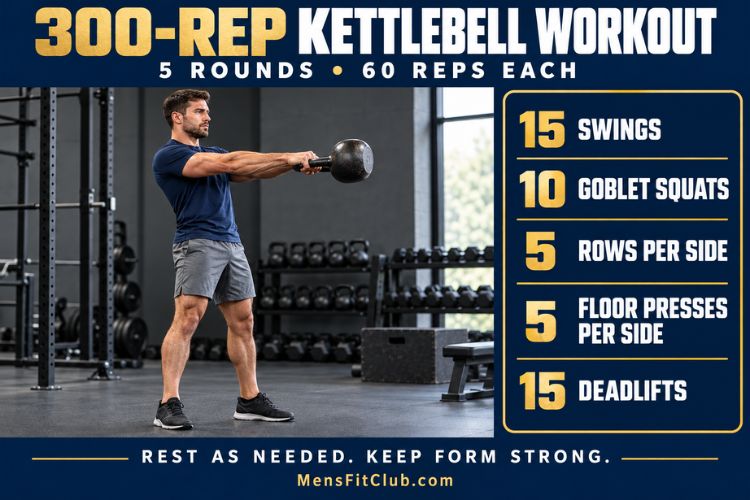
A 300-rep kettlebell challenge workout gives you a clear training target, a compact exercise selection, and a demanding full-body session without requiring a gym full of equipment. Using kettlebell swings, goblet squats, rows, floor presses, and deadlifts, this workout combines repeated muscular effort with conditioning. The objective is to finish 300 controlled repetitions while keeping your technique consistent from the first round to the last.
The number is a target rather than a requirement for every fitness level. Three hundred repetitions can be a substantial workload, especially when you are unfamiliar with kettlebell training. Your starting point, exercise skill, available weights, and recovery should determine whether you complete the full challenge or begin with a shorter version.
This guide explains the complete workout, how to count each repetition, how much to rest, and how to adjust the session. You will also learn how to place the challenge within a weekly routine and measure progress without turning every workout into an exhausting race.
What Is a 300-Rep Kettlebell Challenge Workout?
A 300-rep kettlebell challenge is a workout in which the prescribed exercises add up to 300 repetitions. There is no single official exercise combination. Some versions emphasize swings, while others use several movements to distribute the workload across different muscles.
The version below uses five rounds of 60 repetitions. Each round includes 15 two-handed swings, 10 goblet squats, five rows per arm, five floor presses per arm, and 15 kettlebell deadlifts. The rows contribute 10 repetitions and the presses contribute another 10. That makes the calculation straightforward: 15 plus 10 plus 10 plus 10 plus 15 equals 60, and five rounds equal 300.
You can use one kettlebell if its weight suits every exercise, but two or more weights often make the session easier to scale. A weight that works for deadlifts may be too heavy for single-arm presses. Choose the appropriate load for each movement instead of forcing one weight to fit the entire workout.
Who Should Try This Challenge?
The full version suits exercisers who already perform the selected movements confidently and tolerate moderate-volume resistance training. You should understand the hip hinge, be able to brace your trunk, and know how to put the kettlebell down safely before fatigue becomes excessive.
If you are new to exercise, returning after a long break, or still learning swings, begin with the reduced-volume option later in this guide. Get qualified instruction if you cannot distinguish a hip hinge from a squat. Existing injuries or medical conditions may require individualized exercise choices before attempting a demanding session.
Benefits of the 300-Rep Kettlebell Workout
The value of this challenge comes from the movements, effort, and consistency you bring to it. Completing an arbitrary repetition total does not automatically produce better results than a shorter, well-designed workout. However, a clear target can make training easier to organize and progress easier to record.
Full-Body Muscular Endurance
Repeated squats, hinges, rows, and presses challenge your ability to produce useful force across several sets. Your legs and hips perform much of the work, while your upper body contributes pushing, pulling, gripping, and stabilization. With manageable loads, the workout emphasizes muscular endurance more than maximal strength.
The session can complement a strength program, but it does not replace heavier training if increasing your one-repetition maximum is the main objective. Likewise, it is not a complete muscle-building plan by itself. Weekly exercise selection, challenging sets, progression, nutrition, and recovery still matter.
Conditioning With Limited Equipment
Moving through repeated rounds can raise your breathing rate and create a meaningful conditioning challenge. The swings add an explosive element, while the other movements keep several muscle groups working throughout the session. Rest intervals determine how continuous the effort becomes.
General activity guidelines recommend a combination of aerobic activity and muscle-strengthening work during the week. This challenge can contribute to a broader routine, but one session should not be assumed to satisfy every recommendation. Walking, cycling, and other aerobic activities remain useful alongside resistance training.
A Repeatable Training Benchmark
Because the workout has a fixed structure, you can compare sessions using the same exercises, loads, and rest approach. Improvement might mean cleaner presses, less breathlessness, better control during squats, or completing the same work with fewer unplanned breaks.
Completion time is only one measurement. A slower session with better technique can represent more useful progress than a faster workout with shortened range of motion. Record how the workout felt as well as how long it took.
How to Prepare for the Kettlebell Challenge
Place your kettlebells on a stable surface with enough space to swing freely and move to the floor. Keep other people, pets, and loose objects outside the movement area. Have water nearby and use a simple checklist to track completed rounds.
Choose a Manageable Kettlebell Weight
Use loads that allow controlled repetitions with a few good reps left in reserve during the early rounds. The final repetitions can feel challenging, but grinding, twisting, or losing control indicates that the load or volume is too high.
Avoid choosing weight solely from age, body weight, or sex. Experience and movement proficiency are more useful guides. If the bell is suitable for swings but too heavy for presses, use a lighter bell for pressing. If you only have one heavy kettlebell, modify the pressing exercise rather than struggling through unsafe repetitions.
Complete a Five- to Eight-Minute Warm-Up
Start with two minutes of brisk walking or marching. Follow with controlled bodyweight squats, unloaded hip hinges, shoulder circles, and a few easy rows or presses. The purpose is to rehearse the movements and check how your body feels before accumulating volume.
Perform several light kettlebell deadlifts before practicing a short set of swings. If the hinge feels unfamiliar, use deadlifts in place of swings for the session. Warm-up repetitions are separate from the 300 working repetitions. You do not need to make the warm-up tiring to make it useful.
The Complete 300-Rep Kettlebell Challenge Workout
Complete five rounds of the following sequence: 15 two-handed kettlebell swings, 10 goblet squats, five supported single-arm rows on each side, five single-arm floor presses on each side, and 15 kettlebell deadlifts. Each round contains 60 repetitions, giving you 300 working repetitions after five rounds.
Rest approximately 30 to 60 seconds between exercises when needed and 90 to 120 seconds between rounds. These are starting guidelines, not limits. Take longer when your breathing, grip, or movement control has not recovered. Floor transitions also take time, so allow yourself to get into position carefully.
Expect the complete session to take roughly 30 to 45 minutes including preparation and cooldown, although some people will need longer. Do not force the workout into an unrealistic time cap. Your first attempt should establish an appropriate pace rather than a personal speed record.
Exercise One: Two-Handed Kettlebell Swing — 15 Reps
Stand with your feet around shoulder width and place the kettlebell slightly ahead of you. Hinge at your hips, grip the handle with both hands, and hike the bell backward between your legs. Drive your hips forward to stand tall, allowing that force to send the bell upward.
Keep your arms relatively relaxed and let the bell float to a comfortable height, usually around chest level or lower. You do not need to lift it overhead. At the top, finish upright with your ribs controlled rather than leaning backward. As the bell returns, hinge to receive it and repeat.
The swing is an explosive hip hinge. ACE’s technique guidance emphasizes learning that hinge before progressing to the swing. If you start lifting mainly with your shoulders, rounding your back, or losing the timing, stop the set. Break 15 repetitions into smaller sets or substitute controlled deadlifts.
Exercise Two: Goblet Squat — 10 Reps
Hold the kettlebell close to your chest with both hands. Set your feet at a comfortable width, brace your trunk, and bend your hips and knees together. Lower to a depth you can control while keeping your feet stable and your knees moving in line with your toes.
Stand by pushing through your feet and extending your hips and knees. Keep the bell near your body instead of letting it drift forward. Choose a comfortable range of motion; you do not need to force depth if it causes pain or makes you lose position.
If balance or fatigue becomes limiting, squat to a sturdy chair or box. Touch the surface lightly and stand again without dropping onto it. A lighter kettlebell or bodyweight squat is also a useful way to preserve the movement pattern as you build capacity.
Exercise Three: Supported Single-Arm Row — Five Reps Per Side
Support one hand on a sturdy bench or another stable surface that will not move. Hinge forward and hold the kettlebell in the opposite hand. Keep your torso steady as you pull your elbow toward your hip, then lower the bell under control.
Perform five repetitions on one side and five on the other. Each arm repetition counts once, producing 10 rows per round and 50 rows across the workout. Let the working shoulder move naturally without shrugging aggressively or rotating your trunk to lift the weight.
The supported version reduces the demand of holding an unsupported bent-over position during a workout that already contains considerable hinging. If no stable support is available, use a lighter unsupported row only if you can maintain a comfortable, controlled position.
Exercise Four: Single-Arm Floor Press — Five Reps Per Side
Sit on the floor and use both hands to help position the kettlebell before lying back. Bend your knees, plant your feet, and hold the bell with your wrist aligned over your forearm. Keep the working elbow at a comfortable angle from your torso.
Press upward until your arm is extended without forcing the shoulder. Lower slowly until your upper arm gently reaches the floor. Avoid bouncing your elbow or letting the wrist fold backward. Complete five repetitions per side for 10 presses per round.
Set the kettlebell down under control and use both hands when changing position if needed. Do not pass a heavy bell over your face to switch sides. If you cannot safely get into or out of the floor press, replace it with 10 controlled incline push-ups against a stable surface.
Exercise Five: Kettlebell Deadlift — 15 Reps
Place the kettlebell between your feet. Push your hips back and bend your knees enough to reach the handle while keeping your trunk braced. Stand by pushing through the floor and extending your hips, holding the bell close to your body.
Lower by reversing the movement and return the bell to the floor under control. Finish each repetition upright without leaning backward. The deadlift should feel deliberate, even when your breathing is elevated after the previous exercises.
This movement adds another hinge, so the workout contains substantial posterior-chain volume. Use a moderate load and assess how your lower back and hamstrings respond. If hinging becomes uncomfortable, end the round instead of forcing repetitions to reach a number.
How to Pace All Five Rounds of 300 Kettlebell Rep Workout
Start the first round at a pace you believe you could maintain through the fifth. Your breathing should increase, but you should still feel in control. Beginning with maximal effort often makes the later rounds slower and less consistent.
Break Sets Before Technique Breaks
You may divide the 15 swings into eight and seven, or the 15 deadlifts into three sets of five. These breaks do not invalidate the challenge. They make it possible to accumulate the prescribed repetitions while maintaining a useful movement standard.
Keep your working sets away from complete muscular failure. If a row or press becomes a grinding repetition, reduce the load or stop that set. Leave enough capacity to handle the bell safely when getting up, changing sides, and returning it to the floor.
Use Breathing and Grip as Feedback
Before starting another exercise, check whether you can brace your trunk and maintain a secure grip. If your hands are slipping or your breathing makes positioning difficult, rest longer. A timer should never pressure you to pick up the kettlebell before you are ready.
Stop for sharp pain, dizziness, chest discomfort, or unusual breathlessness. Seek appropriate medical care for concerning symptoms. Ordinary effort and fatigue can occur during a challenge, but they should not be used to dismiss signs that something is wrong.
Beginner Modifications for the 300 Kettlebell Rep Workout
A scaled workout is the best starting point when the full session exceeds your current capacity. Keep the same exercise order while reducing the number of rounds. This gives you practice with the routine and a clear path toward completing it.
Start With 120 or 180 Reps
Two rounds equal 120 repetitions, and three rounds equal 180. Choose the version that allows steady technique and manageable recovery. Remain at that volume for several sessions if needed, especially when the movements are new.
Replace the 15 swings with 15 controlled deadlifts until you have learned the swing. This substitution creates 30 deadlifts per round, so reduce the rounds or repetitions further if the repeated hinge work becomes excessive. The replacement is a learning option, not a reason to ignore fatigue.
Build Toward Five Rounds Gradually
Move from two rounds to three, then four, then five when the current version feels repeatable and you recover well. Four rounds equal 240 repetitions. There is no requirement to add a round every week; the appropriate pace depends on your response.
You can also reduce every round to 30 repetitions: eight swings, five squats, three rows per side, three floor presses per side, and five deadlifts. Five rounds then equal 150 repetitions. Track the version you perform so comparisons remain meaningful.
How Often Should You Do This 300 Kettlebell Rep Workout?
Begin with one challenge session per week. It can serve as a conditioning-focused resistance workout alongside other strength sessions and easy aerobic activity. Because the workout includes repeated squatting, hinging, pressing, and pulling, count it as meaningful training volume.
Fit the Challenge Around Strength Training
For example, perform a conventional full-body strength session on Monday, the kettlebell challenge on Thursday, and another moderate strength session on Saturday. Use other days for comfortable walking, mobility, or rest according to your recovery.
Avoid placing the challenge immediately before an important heavy squat or deadlift session if it leaves your legs, grip, or back fatigued. If your existing program is already demanding, replace a conditioning session with the challenge rather than adding it on top of everything else.
Allow Recovery Between Attempts
Leave at least 48 hours before another demanding session for the same muscles as a practical starting point, and take longer when needed. Soreness, sleep, everyday energy, and performance during warm-ups can help you judge readiness.
Some experienced exercisers may tolerate two scaled or moderate sessions per week, but that is not necessary to benefit. If the challenge repeatedly reduces the quality of your other workouts, lower its volume, reduce its frequency, or choose a less demanding conditioning option.
Common 300 Kettlebell Rep Workout Mistakes That Reduce Workout Quality
The most common mistake is treating 300 repetitions as a test of willpower regardless of movement quality. The challenge should help you train consistently. It should not encourage poor repetitions, unsafe transitions, or loads that become unmanageable halfway through.
Racing Through the Exercises
Rushing often shortens squats, turns rows into twisting movements, and makes floor presses bounce. Use a controlled tempo for strength movements and a crisp hip drive for swings. Let improvements in efficiency develop over time instead of manufacturing speed through shortcuts.
Count repetitions honestly and write down each completed round. If you lose count, a simple tally sheet is more useful than trying to remember everything while fatigued. The goal is a repeatable workout you can evaluate accurately.
Progressing Everything at Once
Increasing weight, adding rounds, and shortening rest together can create a large jump in difficulty. Change one variable at a time. First establish that you can complete the intended volume, then consider a small load increase or a modest adjustment to rest.
Also remember that equal repetition counts do not create equal stress. A heavier bell, deeper squat, or stricter press can make the same 300 repetitions substantially harder. Record these details so you understand why a session feels different.
Recovery and Progress Tracking 300 Kettlebell Rep Workout
After the final round, walk slowly for a few minutes and allow your breathing to settle. Use gentle mobility if it feels helpful. You do not need an elaborate cooldown, but avoid jumping directly from intense effort into another demanding task.
Eat regular meals that support your activity, include protein sources, and drink according to thirst and conditions. Avoid treating the challenge as punishment for eating or assuming that it guarantees a particular calorie burn. Energy expenditure varies, and sustainable fat loss depends on habits across time.
Record the kettlebell weights, completed rounds, substitutions, approximate rest, total time, and overall effort. Note how you feel the next day. Progress means doing suitable work more confidently while recovering well enough to continue your routine.
Frequently Asked Questions About the 300-Rep Kettlebell Workout Challenge
Can This Workout Help With Fat Loss?
It can contribute to physical activity and energy expenditure, but it does not guarantee weight loss. Combine training with sustainable eating habits, adequate recovery, and regular movement. Choose a workload you can repeat consistently instead of relying on occasional exhausting sessions.
Is the Challenge Suitable for Men Over 50?
Age alone does not determine suitability. Exercise experience, balance, joint tolerance, medical history, and recovery matter more. Start with fewer rounds and controlled movements if needed. Men aged 65 and older should also include balance activities within their wider routine, consistent with general activity guidance.
Can You Complete It With One Kettlebell?
Yes, provided the weight suits every movement. If your bell is too heavy for floor presses, use incline push-ups or obtain a lighter weight. If it is light for deadlifts, maintain deliberate technique rather than rushing to make the movement feel harder.
Should You Do 300 Kettlebell Rep Workout Every Day?
Daily completion is unnecessary and may interfere with recovery, particularly for beginners. Start with one weekly session and assess how it affects your other training. A balanced routine usually benefits from variation in workload and days devoted to easier activity.
Make Every 300 Kettlebell Rep Workout Count
The 300-rep kettlebell challenge workout offers a straightforward way to train your whole body with limited equipment. Five rounds combine swings, squats, rows, floor presses, and deadlifts into a clearly counted session that you can scale and repeat.
Start at a volume that matches your ability, select appropriate weights, and rest whenever movement quality needs it. Build toward 300 repetitions through consistent practice. Completing the challenge is satisfying, but the lasting benefit comes from developing a workout you can perform well and recover from reliably.
Build toward the 300-Rep Kettlebell Challenge Workout with our 3-Week Kettlebell Workout Plan for Beginners, and refine your hip-hinge technique with Kettlebell Swings for Beginners. For additional training options, explore our 30-Minute Beginner Full Body Kettlebell Workout, try the Full Body Kettlebell Complex for Strength and Muscle Definition, or choose the 25-Minute Full Body Kettlebell HIIT Workout as an alternative conditioning session.


Most Recommended

Subscribe to our Newsletter
Stay up to date on the latest men’s health, fitness and lifestyle trends and tips.
About Us
Men’s Fit Club was started with the goal of empowering men to get the most out of their lives. This meant going beyond exercise and diet tips to really address the broad range of issues that men face on a daily basis – topics like recreation, finding love, sexual health and even sound fashion advice.
Quick Links
© COPYRIGHT MEN'S FIT CLUB 2026. All Rights Reserved