
Shoulder Mobility Workout for Bench Press: A Practical Warm-Up
Barbell Workout for Men With Limited Gym Time | MensFitClub

How Men Can Layer Cologne Deodorant and Body Wash
3-Week Kettlebell Workout Plan for Beginners
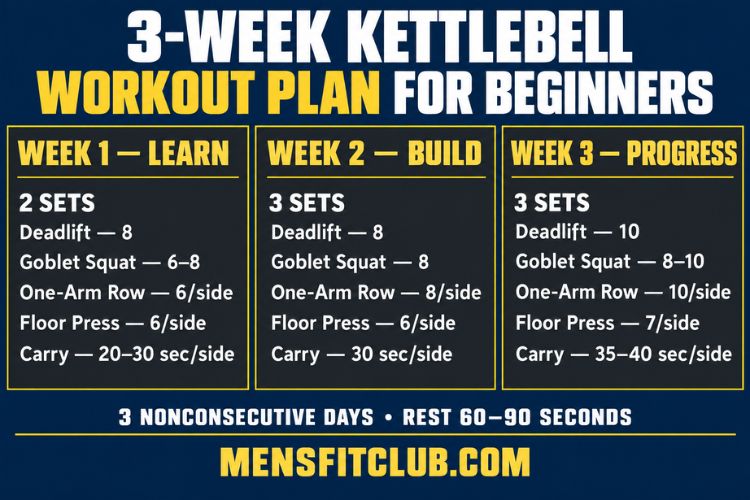
A kettlebell can train nearly every major muscle group without requiring a room full of equipment. With one carefully selected weight and a small amount of floor space, you can squat, hinge, press, row, carry, and condition your entire body. The challenge for a beginner is not finding enough kettlebell exercises. It is knowing which movements to learn first, how much work to perform, and how to progress without allowing fatigue to ruin technique. This 3-week kettlebell workout plan for beginners provides that structure. You will train three nonconsecutive days per week, using simple full-body sessions that develop fundamental movement patterns. The first week emphasizes control and consistency. The second week adds training volume. The third week improves work capacity by gradually increasing repetitions or reducing rest while preserving good form.
Three weeks will not transform a complete beginner into an advanced kettlebell athlete, but it is enough time to establish a routine, improve coordination, and create a foundation for longer programs. Treat this plan as an introduction rather than a test. The goal is to finish each workout feeling that you trained productively and could repeat the session with equally good technique.
Why Kettlebell Training Works Well for Beginners
Kettlebells are useful because the same tool can support strength, muscle, balance, grip, and cardiovascular training. A goblet squat strengthens the legs and teaches an upright squat position. A kettlebell deadlift develops the hips, hamstrings, glutes, back, and grip. Rows and presses train the upper body, while loaded carries challenge posture and trunk stability. Once the hip hinge is reliable, kettlebell swings can add efficient conditioning and explosive hip power.
The offset position of the load is another benefit. Unlike a dumbbell, the kettlebell’s center of mass sits below its handle. Your hands, wrists, shoulders, and core must continually stabilize the bell. That does not make every kettlebell exercise automatically superior, but it does provide a distinct training stimulus with relatively little equipment.
Beginners also benefit from the way a simple kettlebell program limits unnecessary complexity. You do not need a different exercise for every individual muscle. A small selection of repeatable compound movements makes it easier to practice technique and measure progress. Consistency with six basic exercises is usually more productive than frequently changing among dozens of unfamiliar drills.
What You Need for This Three-Week Plan
You need one kettlebell, comfortable training clothes, supportive footwear, water, and a clear area where the bell cannot strike furniture or another person. A mat is optional for floor exercises. Training barefoot or in flat shoes can provide a stable base, but choose the option that is safe and comfortable for you.
The ideal kettlebell weight depends on your current strength, injury history, movement skill, and the exercise being performed. A load that feels appropriate for a deadlift may be too heavy for an overhead press. If possible, have access to two kettlebells: a lighter bell for presses and technique practice, and a moderately heavier bell for squats, deadlifts, rows, and carries.
If you are buying only one kettlebell, prioritize control over ego. Select a weight you can goblet squat for approximately 10 controlled repetitions and press overhead for at least five repetitions per side without leaning backward. If pressing that bell is not yet comfortable, substitute a two-handed floor press or perform a half-kneeling press with a lighter dumbbell.
How Heavy Should a Beginner Kettlebell Be?
There is no single correct starting weight for every man. Common starting suggestions can offer a rough reference, but technique should decide. During strength exercises, the final two repetitions should feel challenging while still looking similar to the first repetition. You should be able to maintain a neutral spine, steady breathing, controlled speed, and a secure grip.
Use the rate of perceived exertion scale to guide your choice. Most working sets in this plan should feel like a 6 or 7 out of 10, meaning you finish with roughly three or four good repetitions still available. Avoid grinding, shaking, holding your breath excessively, or changing body position just to complete a repetition. Those are signs that the weight or repetition target is too aggressive.
Beginner Kettlebell Exercises to Learn
The plan centers on foundational movements rather than advanced skills. Spend a few minutes learning each exercise before beginning the timed or prescribed work. If possible, ask a qualified coach to review your form, especially for the hip hinge and swing.
Kettlebell Deadlift
Stand with the bell on the floor between your feet. Push your hips backward while keeping your ribs stacked over your pelvis and your spine neutral. Grip the handle, brace your abdomen, and drive your feet into the floor as you extend your hips and knees. Stand tall without leaning backward. Reverse the movement by sending the hips back and placing the bell down with control.
Goblet Squat
Hold the kettlebell close to your chest by the horns. Set your feet in a comfortable squat stance, brace your trunk, and sit down between your hips. Keep your entire foot connected to the floor and allow your knees to follow the direction of your toes. Descend only as far as you can maintain balance and posture, then drive through the floor to stand.
One-Arm Kettlebell Row
Use a split stance or support your free hand on a sturdy bench. Keep the torso stable, draw the working elbow toward the hip, and avoid twisting your shoulders. Pause briefly near the top before lowering the bell under control. Complete all repetitions on one side and then switch.
Kettlebell Floor Press
Lie on your back with bent knees and the bell held securely in one hand. Keep the wrist straight and the forearm nearly vertical. Press the bell upward until the arm is extended, then lower until the upper arm gently touches the floor. Keep the shoulder controlled rather than allowing it to roll forward.
Suitcase Carry
Hold the bell at one side as if carrying a suitcase. Stand tall and walk with short, controlled steps. Resist leaning toward or away from the weight. The exercise trains grip, posture, and the lateral core. Make sure your walking path is clear before beginning.
Two-Hand Kettlebell Swing
The swing is a fast hip hinge, not a squat or a front raise. Hike the bell behind the hips, forcefully extend the hips, and allow the bell to float forward. Keep the arms relaxed and stop the bell around chest height. Guide it back between the legs as the hips move behind you. Beginners who cannot maintain a crisp hinge should continue with deadlifts until they receive appropriate instruction. Swinging is optional in this plan, and a kettlebell deadlift or marching carry is an effective substitute.
Weekly Schedule for the 3-Week Kettlebell Workout Plan
Train on three nonconsecutive days so your muscles, joints, grip, and nervous system have time to recover. Monday, Wednesday, and Friday work well, but Tuesday, Thursday, and Saturday are equally effective. Avoid squeezing all three sessions into consecutive days.
Use Workout A for fundamental strength, Workout B for unilateral strength and posture, and Workout C for full-body strength with beginner conditioning. Each session should take approximately 30 to 40 minutes, including the warm-up. On the days between workouts, rest or perform easy activity such as walking and gentle mobility work.
| Day | Session | Main Emphasis |
|---|---|---|
| Monday | Workout A | Hinge, squat, push, and carry |
| Tuesday | Recovery | Easy walk or mobility |
| Wednesday | Workout B | Single-side strength, row, and core stability |
| Thursday | Recovery | Rest or light movement |
| Friday | Workout C | Full-body circuit and conditioning |
| Weekend | Recovery | Rest, walking, and preparation for the next week |
Warm-Up Before Every Kettlebell Workout
Complete this five- to eight-minute warm-up before each session. Move smoothly and use the warm-up to assess how your body feels. Start with one minute of relaxed marching in place. Perform eight bodyweight hip hinges, eight bodyweight squats to a comfortable depth, six alternating reverse lunges per side, eight wall or elevated push-ups, and five slow shoulder circles in each direction.
Finish with one or two light practice sets of the first kettlebell exercise. These sets do not need to create fatigue. They help you rehearse your stance, grip, breathing, and range of motion before the work sets begin.
Week 1: Learn the Movements and Build Consistency
During Week 1, perform two sets of most exercises and rest for 60 to 90 seconds between sets. Move deliberately, stop well before muscular failure, and write down the weight and repetitions completed. Your first objective is to create repeatable technique.
Workout A: Beginner Full-Body Strength Kettlebell Plan for Beginners
Perform two sets of 8 kettlebell deadlifts, followed by two sets of 6 to 8 goblet squats. Complete two sets of 6 floor presses per arm, then finish with two 20- to 30-second suitcase carries per side. Rest 60 to 90 seconds after each set and longer if your breathing prevents you from maintaining control.
Keep the deadlift slow enough to feel your hips moving backward. During goblet squats, use a range of motion that allows your heels to remain down. The floor press should feel stable at the wrist and shoulder. During carries, imagine balancing a glass of water on your head and avoid leaning.
Workout B: Unilateral Strength and Stability
Perform two sets of 6 supported one-arm rows per side, two sets of 6 reverse lunges per side while holding the bell in a goblet position, and two sets of 5 half-kneeling presses per side. Finish with two sets of 8 slow kettlebell deadlifts and a 20-second front plank.
If loaded reverse lunges are too difficult, perform bodyweight reverse lunges or split squats while lightly holding a wall. If overhead pressing is uncomfortable, use the floor press from Workout A. Exercise substitutions should preserve pain-free movement rather than force your body into a position it is not ready to control.
Workout C: Technique Circuit Kettlebell Workout Plan for Beginners
Complete two rounds of the following circuit: 8 kettlebell deadlifts, 6 goblet squats, 6 one-arm rows per side, 6 floor presses per side, and a 30-second suitcase carry per side. Rest as needed between exercises and take up to two minutes between rounds.
This is not a race. Set the bell down safely before changing position, and begin the next exercise only when your breathing is under control. Record how long the session takes, but do not try to beat the time during Week 1.
Week 2: Add Volume and Build Strength
In Week 2, perform three sets instead of two for the primary exercises. Keep the same kettlebell unless Week 1 felt unusually easy and every repetition was technically sound. Adding a set is already a meaningful increase in workload, so you do not need to increase weight simultaneously.
Workout A: Three-Set Strength Session Kettlebell Workout Plan for Beginners
Perform three sets of 8 kettlebell deadlifts, three sets of 8 goblet squats, and three sets of 6 floor presses per side. Finish with three 30-second suitcase carries per side. Rest approximately 60 to 90 seconds between sets. If grip fatigue becomes the limiting factor, extend the rest period rather than allowing the bell to become insecure.
Workout B: Controlled Single-Side Training
Perform three sets of 8 one-arm rows per side, three sets of 6 reverse lunges per side, and three sets of 5 to 6 half-kneeling presses per side. Finish with two sets of 10 deadlifts and two 20- to 30-second front planks. Continue using bodyweight lunges or floor presses if those modifications suit your current ability.
Unilateral training can reveal a difference between sides. Begin with the less coordinated side, match those repetitions on the stronger side, and avoid adding extra work to create immediate symmetry. Consistent, technically sound training generally allows the weaker side to improve over time.
Workout C: Three-Round Kettlebell Circuit Beginner Workout Plan
Complete three rounds of 8 deadlifts, 8 goblet squats, 8 one-arm rows per side, 6 floor presses per side, and a 30-second suitcase carry per side. Rest 30 to 60 seconds between exercises when needed and 90 seconds between rounds.
Beginners who have demonstrated a reliable hip hinge may replace the 8 deadlifts with 10 two-hand swings in the first two rounds. Stop the swing set immediately if the lower back begins to round, the bell pulls you forward, or the movement turns into a squat. Technique matters more than completing the prescribed number.
Week 3: Improve Work Capacity and Confidence
Week 3 keeps the volume manageable while making the sessions slightly denser. Use the same weight and aim to complete the prescribed work with 45 to 75 seconds of rest. If shorter rest causes form to deteriorate, return to the longer interval. Progress is earned by better performance, not by following the clock at any cost.
Workout A: Strength With Gradual Progression Kettlebell Workout Plan for Beginners
Perform three sets of 10 deadlifts, three sets of 8 to 10 goblet squats, and three sets of 7 floor presses per side. Finish with three 35- to 40-second suitcase carries per side. Use a controlled lowering phase on the squats and presses. If 10 repetitions exceed your technical limit, remain at the Week 2 target.
Workout B: Unilateral Strength Progression
Perform three sets of 10 one-arm rows per side, three sets of 7 reverse lunges per side, and three sets of 6 half-kneeling presses per side. Finish with two sets of 12 deadlifts and two 30-second front planks. Rest 45 to 75 seconds between movements, but take additional time before exercises that require more setup or balance.
Workout C: Beginner Kettlebell Fitness Test Workout Plan
Complete three controlled rounds of 10 deadlifts or 10 two-hand swings, 8 goblet squats, 8 one-arm rows per side, 7 floor presses per side, and a 40-second suitcase carry per side. Rest when required and record your total time without sacrificing technique.
Compare this session with your Week 1 circuit. Useful progress may appear as smoother movements, more repetitions, a slightly faster completion time, less rest, better breathing control, or greater confidence handling the bell. The result does not need to be dramatic to be meaningful.
How to Progress Without Getting Hurt
Change one training variable at a time. You can add repetitions, add a set, use a heavier bell, increase range of motion, improve exercise control, or reduce rest. Increasing several variables at once makes it difficult to identify why a workout suddenly feels excessive.
Use a simple repetition rule after this program. When you can complete the top of the target range for every set with stable technique and approximately three good repetitions in reserve, consider using the next available kettlebell. Return to the lower end of the repetition range after increasing the weight.
Muscle fatigue and elevated breathing are normal during training. Sharp pain, numbness, sudden weakness, dizziness, chest pain, or joint pain are not signals to push through. Stop the session and seek appropriate medical guidance when symptoms warrant it. Anyone with an injury, medical condition, or extended period of inactivity should consult a qualified healthcare professional before starting a new exercise program.
Recovery, Nutrition, and Rest Days For Kettlebell Workout Plan for Beginners
Training creates the stimulus, but recovery allows adaptation. Aim for consistent sleep, eat enough total food to support your goal, and include a useful source of protein in meals throughout the day. Carbohydrates can support training energy, while fruits, vegetables, and minimally processed foods provide fiber and micronutrients. Hydrate regularly rather than trying to compensate immediately before a workout.
On recovery days, easy walking can reduce stiffness and build general activity without competing with strength training. You do not need aggressive stretching or another difficult workout. If soreness changes your movement mechanics, use a lighter bell, reduce the number of sets, or take another recovery day.
Your workout log should include kettlebell weight, sets, repetitions, rest periods, and a short note about technique and effort. These details are more useful than relying on memory. They also show progress that the mirror or scale may not reveal during a short three-week program.
Continue Your Kettlebell Training
Once you have completed this three-week schedule, continue building your foundation with the Best Kettlebell Workout Plan For Beginners or practice a compact 30 Minute Beginner Full Body Kettlebell Workout. On busy days, the 15 Minute Full Body Kettlebell Workout provides a shorter option, while the Kettlebell Deadlift Guide can help you strengthen your hip-hinge technique. When you are ready for a more demanding session, progress to the 30 Minute Kettlebell Conditioning Workout to develop greater strength, power, and work capacity.
The 3-Week Kettlebell Workout Plan for Beginners
The best beginner program is one you can perform safely, repeat consistently, and progress gradually. This three-week plan gives you three full-body sessions each week without overwhelming you with advanced exercises or exhausting daily workouts. Focus on the deadlift, squat, row, press, and carry before making the swing a priority.
Record your sessions, leave several good repetitions in reserve, and allow technique to determine the pace of progression. At the end of three weeks, you should have more than a collection of completed workouts. You should understand how to choose an appropriate load, recognize good repetitions, and build the next phase of your kettlebell training on a solid foundation.


Most Recommended

Subscribe to our Newsletter
Stay up to date on the latest men’s health, fitness and lifestyle trends and tips.
About Us
Men’s Fit Club was started with the goal of empowering men to get the most out of their lives. This meant going beyond exercise and diet tips to really address the broad range of issues that men face on a daily basis – topics like recreation, finding love, sexual health and even sound fashion advice.
Quick Links
© COPYRIGHT MEN'S FIT CLUB 2026. All Rights Reserved