
Shoulder Mobility Workout for Bench Press: A Practical Warm-Up
Barbell Workout for Men With Limited Gym Time | MensFitClub

How Men Can Layer Cologne Deodorant and Body Wash
Barbell Workout for Men With Limited Gym Time | MensFitClub
A packed calendar does not mean you need to abandon strength training. If you have access to a barbell and roughly half an hour, you can train the major movement patterns, build muscle, and track measurable progress. The key is to spend your limited gym time on a few productive lifts instead of trying to squeeze an entire bodybuilding split into every visit. This barbell workout for men with limited gym time uses two alternating full-body sessions. You can complete the core work in about 30 minutes, extend it when you have 45 minutes, or use a shorter 20-minute version on exceptionally busy days. The plan works best when you repeat it consistently, leave enough recovery between challenging sessions, and add weight only when your technique remains solid.
Why Barbell Workouts For Men Works Well When Time Is Tight
A barbell makes progressive overload straightforward. You can adjust the load in small steps, repeat the same movement under similar conditions, and see whether your strength is improving. Squats, hinges, presses, and rows involve several muscle groups at once, so a small exercise menu can cover much of your body without demanding a long list of equipment changes.
Efficiency is not the same as rushing. Your working sets still need appropriate rest, particularly on squats and deadlifts. Save time by choosing the right number of exercises, preparing the bar and plates before each block, and following a written plan. An honest 30-minute workout with six to nine focused working sets can be more useful than an unfocused hour that changes every week.
This approach also removes a common scheduling problem. A body-part split may leave a muscle group untouched for another week if you miss its designated day. With alternating full-body workouts, each completed session moves the whole program forward. If you train twice this week and three times next week, simply continue the A-B sequence.
What You Need and How to Set Up Barbell Workouts For Men
The ideal setup includes a barbell, plates, a power rack with correctly placed safety pins, and an open area for deadlifts or rows. A bench is helpful for bench pressing, but you can use a standing overhead press or floor press where appropriate. Keep a log on your phone or in a notebook so you know the load, reps, and effort from your last visit.
Before loading the bar, check that collars and plates are secure, the rack height lets you unrack without standing on your toes, and the safety pins are positioned to catch a failed squat or bench press. Avoid a heavy bench press without suitable safeties or a competent spotter. Use a load you can control through a comfortable range of motion; the first week is for establishing repeatable technique, not finding a maximum.
If you are new to barbell lifts, start with an empty bar or a lighter training bar. Have a qualified coach check your setup if you are unsure about a lift, and substitute a movement you can perform confidently. Sharp pain, dizziness, or symptoms that feel unusual are reasons to stop the session and seek appropriate medical guidance.
The 30-Minute Barbell Workouts For Men Plan
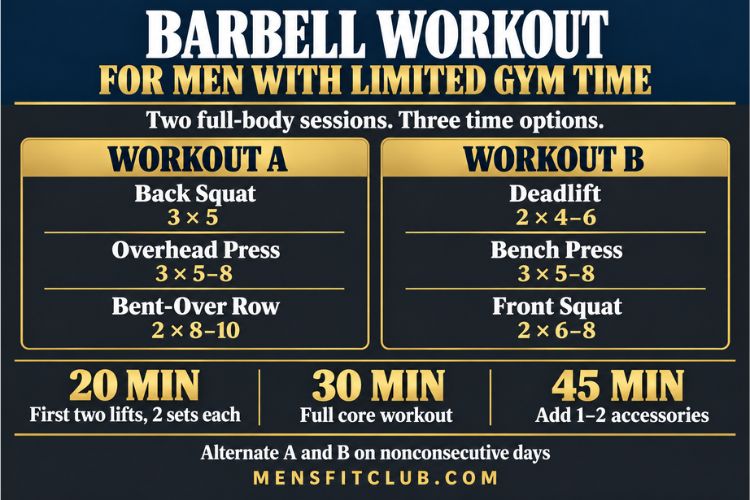
Alternate Workout A and Workout B on nonconsecutive days. A three-day week might be A-B-A, followed by B-A-B the next week. If you only have two days, perform A-B and pick up with A the following week. Allow at least one day between demanding sessions whenever possible.
Each workout has a five-minute warm-up, two primary lifts, and one shorter accessory block. The listed sets are working sets; take a few lighter practice sets before your first heavy squat, deadlift, or press. Use roughly two to three minutes of rest after challenging squats and deadlifts, and about 60 to 90 seconds after moderate presses and rows. If the clock is strict, reduce accessory work before reducing the rest needed to keep your main lifts safe and technically sound.
Workout A: Squat, Press, and Row
Start with the barbell back squat for 3 sets of 5 reps. Brace your torso, keep the bar balanced over the middle of your foot, and descend as far as your mobility and control permit. Warm up with lighter sets, then use a working weight that leaves about two repetitions in reserve on the first set. Rest two to three minutes between working sets. If back squats do not fit your current skill or equipment, use a front squat or another squat variation you can set up safely.
Next, perform the standing barbell overhead press for 3 sets of 5 to 8 reps. Squeeze your glutes, keep your ribs stacked over your pelvis, and move your head slightly out of the bar’s path before pressing upward. Avoid turning the lift into a standing backbend. Rest approximately 90 seconds between sets, or a little longer if your form deteriorates.
Finish with the barbell bent-over row for 2 sets of 8 to 10 reps. Hinge at the hips, hold a stable torso position, and pull the bar toward your lower ribs without jerking it upward. Rest 60 to 90 seconds. If your lower back is fatigued after squatting, use a lighter load, a chest-supported row if available, or a cable row. The goal is quality pulling work, not proving how much weight you can swing.
Workout B: Deadlift, Press, and Front Squat Barbell Workouts For Men
Begin with the conventional or sumo deadlift for 2 sets of 4 to 6 reps. Set the bar above the middle of your feet, take the slack out, brace, and push the floor away while keeping the bar close. Lower each rep under control and reset when necessary. Perform two or three lighter ramp-up sets first, then rest two to three minutes between working sets. If technique becomes inconsistent, do one challenging set after the warm-ups and reserve the remaining time for the other lifts.
Follow with the barbell bench press for 3 sets of 5 to 8 reps. Keep your feet planted, shoulder blades stable, and wrists stacked over your forearms. Bring the bar down under control and press without bouncing it off your chest. Use rack safeties or a spotter. If neither is available, replace the bench press with a barbell floor press where you can set up and exit safely, or use the overhead press again with a different rep range.
Complete the session with the barbell front squat for 2 sets of 6 to 8 reps. Keep your elbows high enough to support the bar and your torso upright as you descend. Because deadlifts already tax your posterior chain, this should be a moderate, controlled squat rather than another maximal effort. If you cannot front rack comfortably, use a light back squat or split squat variation instead.
A Sample Weekly Schedule Barbell Workouts For Men
On Monday, complete Workout A; on Wednesday, complete Workout B; and on Friday, repeat Workout A. The following Monday, begin with Workout B. Tuesday and Thursday can be rest days, walks, or brief mobility sessions. If your schedule changes, move the workout rather than trying to cram two hard barbell sessions into the same day. Training twice per week is still a workable baseline when you consistently perform the main lifts.
The Five-Minute Warm-Up
A short warm-up should prepare you for the exact movements you are about to perform. Spend one or two minutes walking briskly, cycling, or moving through comfortable bodyweight squats and hip hinges. Then do several easy reps of the first lift with an empty bar. Add weight over two or three small jumps before your first working set. For example, if your work sets use 135 pounds, you might perform 8 reps with the empty bar, 5 reps at 95 pounds, and 3 reps at 115 pounds.
The warm-up is not a separate conditioning workout. Keep it focused on finding your positions, checking that the rack is set correctly, and making your first working set feel familiar. Heavier lifters may need more ramp-up sets, while beginners working near an empty bar may need fewer. Do one lighter preparation set when switching to a new lift if its movement pattern feels different.
How to Fit the Workout Into 20 Minutes
When only 20 minutes are available, keep the session’s identity and trim the exercise count. Spend three or four minutes warming up, then do 2 working sets of the first lift and 2 working sets of the second lift. For Workout A, that means squat and overhead press. For Workout B, that means deadlift and bench or floor press. Skip the third lift and log what you completed.
Choose a load you can move cleanly without long, exhausting grinders. Time pressure is never a reason to rush a deadlift setup, ignore squat safeties, or cut every rest period to 30 seconds. If a rack is occupied for most of your window, use another safe barbell lift that matches the day’s movement pattern and return to the normal plan next time. One shortened session is far better than turning a busy day into a missed week.
How to Use 45 Minutes
When you have 45 minutes, perform the full plan and add one or two useful accessories. After Workout A, try Romanian deadlifts for 2 sets of 8 and, if time permits, planks for 2 sets of 30 to 45 seconds. After Workout B, add barbell rows for 2 sets of 8 to 10 or a pulling exercise such as assisted pull-ups. Keep the extras moderate so they do not compromise your next session.
You can also use the additional time for more gradual warm-up sets, longer rest between heavy efforts, or mobility work that helps you reach comfortable positions. More volume is optional. If your strength is improving and you recover well from the basic 30-minute plan, there is no need to fill every available minute with another exercise.
How Heavy Should the Barbell Workouts For Men Bar Be?
Start with a weight you could lift for roughly two more reps than the prescribed target while maintaining good form. For a set of five, your fifth rep should feel purposeful but should not look like a maximum attempt. For sets of eight to ten, stop when another clean rep or two seems possible. This effort level gives you room to learn the movement, accumulate useful training, and recover for your next visit.
Record your actual reps and a brief note about difficulty. If you meet the top of the rep range on every set with consistent technique, add a small amount of weight next time: often 2.5 to 5 pounds for upper-body lifts and 5 to 10 pounds for lower-body lifts, depending on the plates available and your experience. If the next weight jump is too large, keep the same load and improve your control or add reps within the assigned range.
A missed target is information, not failure. Repeat the weight at your next exposure if you fell short by one rep or had an unusually stressful week. If you miss it for two or three consecutive exposures, reduce the load by about 5% to 10% and rebuild. Never sacrifice your position simply to claim a heavier barbell in the log.
Progressing the Barbell Workouts For Men Plan Over Eight Weeks
During weeks one and two, focus on finding starting weights and making every repetition look similar. End most sets with about two reps in reserve. Learn how long your equipment changes actually take, then adjust the exercise order only when the gym layout requires it. This initial period should feel manageable enough that you are ready to repeat the sessions.
In weeks three through six, add load gradually when all prescribed reps are solid. Keep the same core exercises so the log reflects meaningful progress. Some weeks you may increase only one lift. That is normal, especially if you are also running, playing sports, sleeping less than usual, or managing a demanding work schedule. Consistency matters more than forcing every lift upward on every visit.
In week seven, evaluate your recovery. If your joints feel good and performance is climbing, continue. If the bar feels unusually heavy across several sessions, take a lighter week: reduce the working load by around 10% to 15% and perform one fewer working set per exercise. Week eight can then return to normal loading. At the end of the cycle, compare your starting and finishing weights at the same rep targets, along with your technique and adherence.
Can This Barbell Workouts For Men Plan Build Muscle as Well as Strength?
Yes, particularly for beginners and men returning after a break. The core lifts train large amounts of muscle, and progressive increases in reps or load provide a clear stimulus. Muscle growth also depends on adequate food, protein, sleep, and sufficient weekly training volume. More experienced lifters may eventually need extra sets or targeted accessory work for lagging muscle groups.
For a muscle-building emphasis, use the upper end of each prescribed rep range on presses, rows, and front squats while maintaining the heavier sets of five on the primary squat. Add one accessory set when 45-minute sessions are available and you recover comfortably. If strength is the main goal, keep the primary lifts crisp and give them enough rest to preserve performance.
The best plan is one that fits the time you can repeatedly protect. A theoretically perfect five-day program has little value if you can only attend twice. Two or three sessions that you can sustain for months give your body repeated chances to adapt, and the training log will show whether that investment is working.
Frequently Asked Questions About Barbell Workouts For Men
Is two barbell workouts per week enough?
Two well-planned full-body workouts can build a solid foundation, especially if you are a beginner or returning to training. The plan alternates major movement patterns and gives you a chance to progress. A third session offers more practice and weekly volume when your schedule supports it, but two consistent sessions are a useful starting point.
Can I do this workout on consecutive days?
The main sessions are best separated by at least one day because squats, deadlifts, and presses can create overlapping fatigue. If consecutive days are your only option, reduce the second day’s loads or volume and avoid pushing both days close to failure. Resume the normal spacing whenever possible.
What if I cannot overhead press or front squat?
Use a comfortable alternative that trains a similar pattern. A landmine press or dumbbell shoulder press can replace the overhead press. A lighter back squat, goblet squat, or split squat can replace the front squat. Your goal is to train regularly through a controlled range of motion, not to force a particular lift despite discomfort or limited equipment.
Should I add cardio after the barbell workout?
You can add an easy 10-minute walk or bike ride if you have time and recover well. Hard intervals immediately after heavy lifting are optional and may interfere with the quality of your next session if you overdo them. Put your main strength work first and choose a realistic amount of cardio across the week.
How long should I follow this plan?
Run it for at least eight weeks, adjusting loads and substitutions as needed. You can continue longer while your performance improves and the exercises suit you. Change the program when progress stalls despite sensible adjustments, your goals shift, or you have enough time to support more training volume.
More Barbell Workouts For Men From MensFitClub
If your schedule changes from week to week, use our 20 Minute Barbell Workout on your shortest days and the 30 Minute Full Body Barbell Workout when you have a standard training window. For extra volume, try the 45 Minute Full Body Barbell Workout. You can also review the key exercises in our Full Body Barbell Compound Lifts Guide or organize a tight weekly schedule with the 2 Hour Per Week Strength Workout Plan.
The Bottom Line
A barbell workout for men with limited gym time does not require a complicated exercise list. Alternate two full-body sessions, prioritize a squat or hinge and a press, add a pull when time permits, and track your working weights. Warm up for the lifts you will perform, rest enough to keep your form reliable, and progress in small steps. Twenty minutes can maintain the habit, 30 minutes can cover the essentials, and 45 minutes gives you room for a little more volume. The results come from repeating those useful sessions over time.


Most Recommended

Subscribe to our Newsletter
Stay up to date on the latest men’s health, fitness and lifestyle trends and tips.
About Us
Men’s Fit Club was started with the goal of empowering men to get the most out of their lives. This meant going beyond exercise and diet tips to really address the broad range of issues that men face on a daily basis – topics like recreation, finding love, sexual health and even sound fashion advice.
Quick Links
© COPYRIGHT MEN'S FIT CLUB 2026. All Rights Reserved