
Shoulder Mobility Workout for Bench Press: A Practical Warm-Up
Barbell Workout for Men With Limited Gym Time | MensFitClub

How Men Can Layer Cologne Deodorant and Body Wash
Shoulder Mobility Workout for Bench Press: A Practical Warm-Up
The bench press looks simple: lie down, lower a bar, and press it back up. Yet the movement asks your shoulders, upper back, rib cage, elbows, and wrists to work together under load. If you arrive at the bench after hours at a desk and immediately load your working weight, the first few sets can feel stiff and awkward. A focused shoulder mobility workout for bench press gives you a chance to move through comfortable ranges, find a stable setup, and build toward your heavier sets.
The goal is not to make your shoulders as loose as possible. Bench pressing calls for enough motion to reach your chosen touch point without forcing the joint, plus enough control to keep the upper arm and shoulder blade organized. This guide gives you a 12-minute routine, a shorter version for busy days, a separate plan for improving mobility over time, and adjustments for common sticking points. Use the drills as preparation, not as a way to push through pain.
Why Shoulder Mobility Workout Matters for the Bench Press
During a barbell bench press, your upper arms move away from and toward your torso while your shoulder blades rest against the bench. Your upper back position, grip width, elbow path, and the height of your touch point all influence how much shoulder motion you need. A lifter with limited comfortable range may feel a pinch near the bottom, flare the elbows to reach the chest, or lose a consistent bar path. Another lifter may have plenty of range but struggle to keep a stable position under load.
These situations require different responses. A brief warm-up may improve how ready you feel today. Lasting improvements in movement and strength take repeated practice across weeks. And a painful shoulder may need assessment instead of a longer list of stretches. Shoulder conditioning generally combines range-of-motion work with strengthening of the muscles that support the joint; the American Academy of Orthopaedic Surgeons also advises choosing exercises with a clinician when recovering from injury.
Mobility, Flexibility, and Stability Are Different Shoulder Mobility Workout
Flexibility describes how far tissues can be moved. Mobility includes your ability to move actively and control a usable range. Stability is your ability to manage position as force rises. For bench pressing, a successful warm-up touches all three without exhausting the small muscles around the shoulder. Gentle upper-back movement and chest opening can help you find your setup; light rotation and scapular drills let you rehearse control; progressively heavier bench sets prepare the exact lift.
Do not judge the workout by whether you can force your hands farther behind your body. Judge it by whether you can lower a manageable weight smoothly, maintain a comfortable elbow path, and repeat the same setup from set to set.
Check Your Bench Press Setup Before Adding More Stretches
A mobility routine cannot solve every technique issue. Set your eyes under the bar, keep your feet planted, and position your upper back firmly against the pad. Draw your shoulder blades gently together and down enough to create a steady base, without trying to clamp them so hard that you cannot breathe or control the bar. Maintain a natural, manageable arch and keep your hips on the bench.
Choose a grip that allows vertical forearms near the bottom when viewed from the front, then adjust for your proportions and comfort. Lower the bar under control toward a consistent point around the lower chest or sternum rather than aiming high toward the collarbones. Your elbows need not be pinned against your ribs or forced straight out to the sides. A moderate angle that keeps your forearms aligned and shoulders comfortable is a useful starting point. Keep wrists stacked over forearms and use a full thumb-around grip.
If the bottom position causes discomfort, shorten the range temporarily with a floor press or a suitable board or pin setup, or try a neutral-grip dumbbell press. Reduce load while you identify a comfortable pattern. Persistent pain is a reason to consult a qualified clinician, not a signal to stretch harder.
The 12-Minute Shoulder Mobility Workout for Bench Press
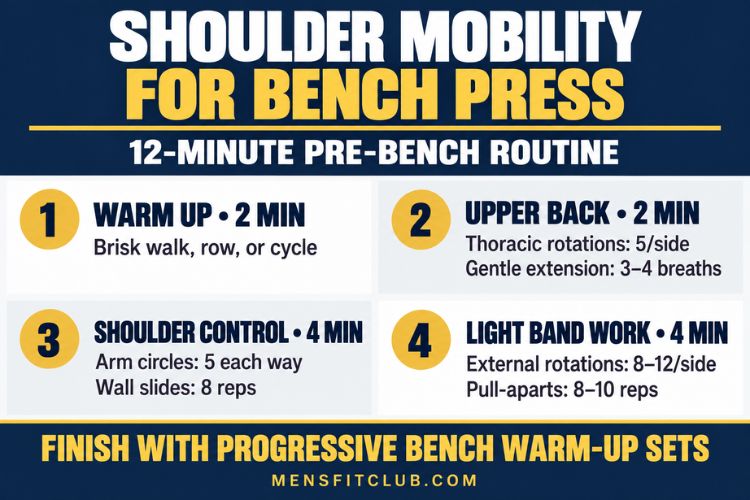
Move through the following sequence before your first barbell warm-up set. The times are guides, not a race. Keep every repetition easy and controlled. You need a light resistance band, a wall or bench, and optionally a foam roller. If a drill produces sharp pain, tingling, or increasing symptoms, stop that drill.
Minutes 0–2: Raise Your Temperature
Walk briskly, pedal lightly, or row at an easy pace for two minutes. Let your arms swing naturally and gradually increase your breathing. This is preparation, not conditioning. If you came straight from another active part of your workout, one minute may be enough. Begin the shoulder drills once you feel warm and alert rather than using a cold stretch as your first movement.
Minutes 2–4: Thoracic Rotation and Extension
Start on all fours with one hand behind your head. Turn your upper back so your elbow points toward the opposite wrist, then rotate open toward the ceiling as far as you can without twisting your lower back. Complete five slow repetitions per side. Breathe out as you rotate open and keep your hips relatively still.
Next, place a foam roller across your upper back, support your head with both hands, and gently extend over the roller for three or four breaths at two positions. No roller? Sit tall on a bench with your hands behind your head and gently extend through your upper back over the top edge of the backrest. The aim is to explore comfortable upper-back movement, not to crank your neck backward or turn the lower back into a deep arch.
Minutes 4–6: Controlled Shoulder Circles Mobility Workout
Stand with your ribs stacked above your pelvis. Make five slow arm circles forward and five backward on each side, gradually increasing the size only while the movement stays smooth. Then perform three controlled shoulder rotations per side: raise a straight arm forward, reach it overhead, and rotate it behind you within your available range. Move slowly enough to notice where you compensate by flaring your ribs or twisting your trunk.
You do not need a perfect overhead arc to bench press. These circles simply let you check how your shoulder feels today. If an overhead path pinches, work through a smaller, pain-free arc rather than chasing a full circle.
Minutes 6–8: Wall Slides or Serratus Reaches
Stand facing a wall with your forearms against it. Gently press into the wall and slide your arms upward for eight controlled repetitions, letting your shoulder blades move around your rib cage while keeping your neck relaxed. Stop before your lower back arches or the front of your shoulder pinches. As an alternative, lie on your back with very light dumbbells or no weight and reach both fists toward the ceiling, lifting the shoulder blades slightly off the floor. Lower with control for ten repetitions.
Your shoulder blades will be supported by the bench during the press, but learning to move and control them off the bench is useful training. These drills should feel like easy coordination work, not a workout to failure.
Minutes 8–10: Light Band External Rotation Shoulder Mobility Workout
Anchor a light band at elbow height. Stand sideways to it with your working elbow near your torso and bent about 90 degrees. Slowly rotate your forearm outward and return without twisting your body. Do eight to twelve easy repetitions on each side. A small towel between elbow and ribs can help you avoid flaring the arm. Choose resistance that lets every repetition look alike; you are preparing the shoulder, not trying to exhaust it.
If you do not have a band, lie on your side and perform the same motion with no weight or a very light dumbbell. The AAOS shoulder program includes external-rotation strengthening with light loads and pain-free progression, but its rehabilitation prescriptions are not a one-size-fits-all pre-lift warm-up.
Minutes 10–12: Band Pull-Aparts and Press Rehearsal
Hold a very light band in front of your chest with straight but unlocked elbows. Pull it apart until your arms form a wide, comfortable line, then return slowly. Perform eight to ten repetitions without shrugging or throwing your ribs forward. If the band pull-apart bothers the front of your shoulder, replace it with eight slow prone shoulder-blade squeezes on an incline bench.
Finish with six empty-hand press repetitions while lying on the bench. Set your feet, upper back, grip width, and intended elbow path. Move your hands down to the range you expect to use, pause briefly, then press upward. This bridges general mobility work and your actual bench press technique.
Follow the Shoulder Mobility Workout With Bench-Specific Warm-Up Sets
The 12-minute sequence is only the first part of preparation. Put an empty bar in your hands and complete eight to ten smooth repetitions. Rest briefly and repeat for five or six reps if you need another chance to find your touch point. Add weight in sensible steps while reducing reps: for example, five reps at roughly 40 percent of your planned working weight, three around 60 percent, and one or two around 75 to 85 percent. These percentages are examples, not rules. A very heavy single may call for more intermediate sets; a light hypertrophy session may need fewer.
Keep warm-up sets comfortably short of failure. The purpose is to rehearse the lift and judge readiness without using up your best repetitions. If your first loaded set feels unusually stiff, repeat an easy weight or take a smaller jump. If the pain increases as you add plates, do not assume one more stretch will fix it. Change the lift, reduce the range or load, or end pressing for the day according to your symptoms.
A Five-Minute Version for Busy Days
When time is tight, perform 30 to 60 seconds of brisk movement, five thoracic rotations per side, eight wall slides, eight light external rotations per side, and eight band pull-aparts or easy scapular squeezes. Then perform your barbell warm-up sets. This version covers the main checkpoints without pretending that five minutes can correct a long-standing restriction.
Choose Drills Based on What Feels Limited
If you feel restricted across the front of your chest, use a gentle doorway chest stretch after training or on a separate mobility day. Place your forearm on the frame below shoulder height, step forward slightly, and hold a mild stretch for 20 to 30 seconds. Do not force the arm behind your torso immediately before a heavy press. In your warm-up, spend more time on controlled shoulder circles and practice the bottom position with a lighter bar.
If the upper back feels rigid, give thoracic rotation and extension another minute, then check that your bench setup gives you a stable upper back without an exaggerated low-back arch. If your shoulders feel loose but unstable, shorten passive stretching and emphasize wall slides, light rotation, and deliberate warm-up sets. If only one side feels different, compare grip, wrist position, elbow travel, and bar contact before assuming you have a mobility deficit.
The Bottom Position Is a Useful Test Shoulder Mobility Workout
Use an empty bar and pause about an inch above your touch point. Ask whether both elbows travel smoothly, your wrists remain stacked, and you can breathe while keeping a firm upper-back base. If you must flare one elbow, shift your torso, or bounce to reach the chest, lighten the bar and adjust your grip or touch point. Some lifters’ body proportions make a slightly shorter range or a different pressing implement more comfortable. A bar touching the chest is not worth forcing when the shoulder cannot tolerate the position.
Build Shoulder Mobility and Control Between Bench Sessions
A warm-up improves readiness for one session. To develop a more reliable range, practice a small amount of shoulder and upper-back work two or three times per week, preferably after training or on a separate day. Complete one or two easy sets of thoracic rotations, wall slides, and light external rotations. Add a controlled row variation and a light rear-delt movement to support balanced upper-body training. Progress gradually when repetitions are smooth and symptoms stay settled.
You can also train pressing skill with a lighter dumbbell bench press, neutral-grip press, or push-up variation that fits your shoulder. Lower under control and pause briefly in a range you own. Avoid treating a single grip width or elbow angle as universally correct. Your structure, training history, and current comfort determine which variation gives you productive work.
A Simple Two-Week Progression Shoulder Mobility Workout
During week one, perform the 12-minute routine before both bench sessions, note which drills feel useful, and keep your main press at a manageable effort. Record grip width, touch point, and whether either shoulder feels different during the warm-up and the next morning. On two non-bench days, do five minutes of easy thoracic rotation, wall slides, and band rotations.
During week two, repeat the plan but remove any drill that changes nothing or creates irritation. If pressing remains comfortable and your technique is consistent, increase the working load modestly or add one or two reps within your planned program. If discomfort is persistent, spreading, or worsening, hold the progression and seek an assessment. A simple log helps you distinguish a productive adjustment from a random good day.
Common Shoulder Mobility Workout Mistakes Before Bench Press
The first mistake is stretching aggressively into pain. A strong sensation does not mean a drill is improving your bench press. Choose controlled movement that leaves the shoulder feeling ready for load. Another mistake is doing so many band repetitions that the rotator cuff and upper back are already fatigued. A few clean reps are enough before a heavy session; put serious strengthening work later in the workout.
Lifters also sometimes do a thorough general warm-up and then jump straight to their working weight. Keep the progressive bench sets. They allow you to practice the exact grip, bar path, and shoulder position you will use when the weight matters. Finally, avoid blaming mobility for every uncomfortable rep. A grip that is too wide for you, an inconsistent touch point, excessive load, or poor control can all create problems even when range of motion is adequate.
Should You Bench Press With Shoulder Pain?
Pain is information, not a test of commitment. Stop a set when you feel sharp pain, a sudden pop with weakness, numbness, or a rapidly worsening symptom. Seek urgent medical care for a major injury, visible deformity, or concerning new weakness. For recurring pain, pain that affects sleep, or symptoms that do not settle with reduced loading and a comfortable variation, speak with a qualified healthcare professional or physical therapist. They can assess causes that a general article cannot diagnose.
On a day when a particular press hurts, you might still be able to train lower body or use another upper-body exercise that is comfortable. Do not use this article as a rehabilitation protocol after an injury or surgery. The right exercise and dosage depend on the condition and stage of recovery.
Frequently Asked Questions
How long should a shoulder mobility workout take before bench press?
For many lifters, five to twelve minutes of easy movement followed by progressive barbell sets is practical. Use the shorter end when you already feel warm and your technique is consistent. Use more time when you have been sitting all day, need to rehearse a new setup, or are working toward a heavier top set. More drills are not automatically better.
Should I stretch my chest before a heavy bench press?
Gentle movement through a comfortable range can be useful. Long, intense passive stretches immediately before a heavy attempt are rarely necessary for the goal of getting ready to press. Try light shoulder circles, wall slides, controlled rotations, and gradually heavier bench sets. Put longer chest stretches after training or on another day if they help your overall range and feel comfortable.
Are band pull-aparts enough to warm up shoulders?
Band pull-aparts can help you practice upper-back control, but they do not replace a complete warm-up or solve every shoulder issue. Combine a few easy repetitions with upper-back movement, light external rotation if tolerated, and bench-specific warm-up sets. If a pull-apart itself irritates your shoulder, skip it.
What if my shoulder clicks during warm-up?
A painless sound alone does not identify a problem. Pay attention to whether it comes with pain, catching, weakness, or loss of movement. If it does, or if the sound is new and concerning, stop forcing the range and seek an individual assessment. Do not try to diagnose a click from a warm-up video or article.
Can I use this routine before dumbbell bench press?
Yes. Complete the same easy mobility and control drills, then warm up with lighter dumbbells before your working sets. A neutral grip and a controlled depth may feel more comfortable for some lifters. Keep the range and grip that allow smooth repetitions rather than lowering the weights as far as possible.
Make the Warm-Up Serve the Workout
An effective shoulder mobility workout for bench press leaves you moving comfortably and pressing with a repeatable setup. Start with a little general movement, explore your upper-back and shoulder range, rehearse control with a light band, and then build through several easy barbell sets. Keep the drills that improve how you move, make technique adjustments when the bottom position feels forced, and treat persistent pain as a reason to get individual guidance. The best warm-up is one you can repeat consistently and that prepares you to train well today.
Related MensFitClub Guides
To build on this shoulder mobility workout, review these Dynamic Warm Up Exercises for more ways to prepare before lifting, then add Dumbbell Rows For Bench Press Stability to your accessory work. Once your setup feels consistent, use the Progressive Overload Bench Press Guide to plan gradual increases or follow a structured 3 Day Bench Press Program. If you train alone, read the guide to Bench Pressing Without a Spotter before adding heavier sets.


Most Recommended

Subscribe to our Newsletter
Stay up to date on the latest men’s health, fitness and lifestyle trends and tips.
About Us
Men’s Fit Club was started with the goal of empowering men to get the most out of their lives. This meant going beyond exercise and diet tips to really address the broad range of issues that men face on a daily basis – topics like recreation, finding love, sexual health and even sound fashion advice.
Quick Links
© COPYRIGHT MEN'S FIT CLUB 2026. All Rights Reserved