

Morning or Evening Workouts After 50: Which Is Better?

Strength Training Sleep and Testosterone for Men

Heavy Weight Low Reps vs Light Weight High Reps
4 Week Compound Lift Workout for Men Over 40
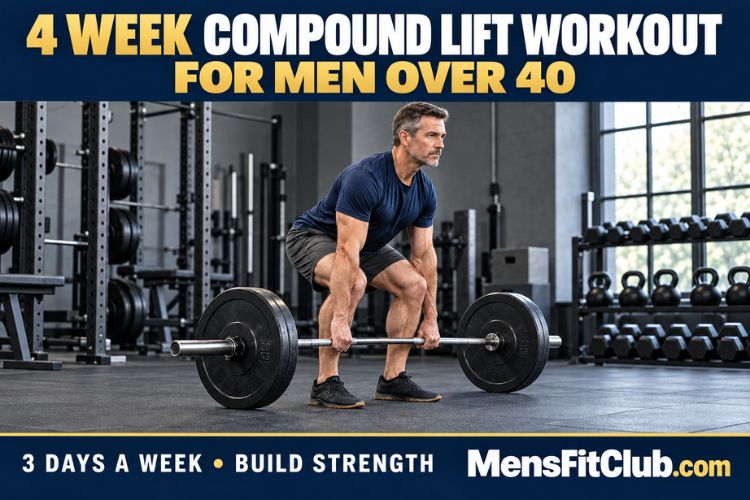
Building strength after 40 does not require spending every evening in the gym. A focused program built around compound exercises can train your major muscle groups, improve lifting confidence, and make productive use of limited workout time. The challenge is choosing enough work to progress while leaving room to recover between sessions. This 4 week compound lift workout for men over 40 provides that structure. You will train three days each week, repeat a manageable selection of exercises, and increase the challenge when your performance supports it. Squats, hinges, presses, rows, and single-leg movements form the foundation. Each session also includes a carry or trunk exercise to round out the routine.
Four weeks is a starting block, not a promise of a dramatic transformation. Better technique, improved consistency, and more repetitions with familiar weights are useful early outcomes. Those improvements create a foundation for longer-term strength and muscle development.
Why Compound Lifts Workout Work Well for Men Over 40
Compound lifts involve movement at more than one joint and recruit several muscle groups. During a squat, for example, the hips and knees move while the trunk stabilizes the load. A dumbbell bench press trains the chest, shoulders, and triceps together. A row combines upper-back work with elbow flexion and shoulder movement.
This makes compound exercises efficient. Instead of assembling a long session of individual muscle exercises, you can cover much of your body with a few well-chosen movements. That efficiency is valuable when work, family commitments, and other responsibilities limit your training schedule.
Strength Training After 40 Starts With Compound Lifts Workout Consistency
Turning 40 does not create a sudden dividing line between effective and ineffective training. Your exercise history, current fitness, sleep, health, and previous injuries matter more than a birthday alone. A trained 48-year-old and an inactive 41-year-old may need very different starting loads.
The American College of Sports Medicine’s 2026 resistance-training guidance emphasizes regular participation and training all major muscle groups at least twice weekly. It also highlights individualizing the program rather than pursuing unnecessary complexity. This three-day routine applies those broad principles; it is an original sample plan, not a protocol specifically tested in men over 40.
Compound Exercises Are a Foundation, Not a Requirement
Barbells are useful, but they are not mandatory. Dumbbells, cables, resistance machines, and bodyweight variations can support a productive strength routine. Choose exercises that let you train the intended muscles with a comfortable range of motion and repeatable technique.
Isolation exercises can also be useful when you want additional arm, calf, or shoulder work. This block prioritizes compound movements because time is limited, not because every other exercise is ineffective. Establish consistency with the main program before adding optional work.
How the Four-Week Compound Lifts Workout Plan Is Organized
Train on three nonconsecutive days, such as Monday, Wednesday, and Friday. Complete Workout A on Monday, Workout B on Wednesday, and Workout C on Friday each week. Keep Tuesday, Thursday, and the weekend available for walking, manageable cardio, mobility, and recovery.
Each workout includes four primary exercises followed by a carry or trunk movement. Allow approximately 45 to 60 minutes, including your warm-up. Beginners using fewer sets may finish sooner. Take the rest you need rather than rushing to meet an arbitrary time limit.
Who Should Use This Compound Lifts Workout Program?
This routine suits generally healthy men over 40 who have basic familiarity with resistance exercise or access to coaching. It can also serve returning lifters who are prepared to begin conservatively. Completely new lifters should use the beginner adjustments and get help learning unfamiliar exercises.
If an existing condition or injury affects exercise choices, obtain appropriate individualized guidance. Sharp or worsening pain is a reason to stop and reassess, not push through the scheduled repetitions. Age alone does not require medical clearance, but your symptoms and health circumstances may warrant it.
Sets, Repetitions, and Effort
The prescriptions below are the standard working-set targets for Weeks 2 through 4. During Week 1, perform two working sets for every primary exercise. Warm-up sets do not count toward these totals. Beginners may stay at two working sets throughout the entire block.
Use a weight that leaves approximately three repetitions in reserve during Week 1. In later weeks, usually finish with two or three repetitions in reserve. That means you estimate you could complete another two or three controlled repetitions before reaching failure. The last repetitions should require effort without becoming an uncontrolled grind.
Rest two to three minutes between sets of demanding compound lifts. For carries and trunk work, rest approximately 60 to 90 seconds. Extend the break when breathing, grip, or concentration has not recovered enough for the next set.
Warm Up Before Every Compound Lift Workout
Begin with three to five minutes of easy walking, cycling, or rowing. Follow with a few comfortable bodyweight squats, unloaded hip hinges, and gentle shoulder movements. Your warm-up should prepare the movements you will perform without creating fatigue.
Use Exercise-Specific Preparation Sets
Before your first squat, hinge, or press, perform two or three progressively heavier practice sets. For example, do an easy set of eight repetitions, a somewhat heavier set of five, and a final preparation set of three if needed. All should feel comfortably below your working effort.
Later exercises may need only one light preparation set, depending on the movement and load. Use these sets to check your stance, grip, range of motion, and comfort. If a familiar exercise suddenly feels painful, change the setup or choose a suitable alternative instead of adding weight.
Workout A: Squat, Horizontal Push, and Row Compound Lifts Workout
Workout A establishes a straightforward full-body session. Complete each exercise’s sets before moving to the next. Use a goblet squat initially, or substitute a familiar barbell squat variation if you already have reliable technique and appropriate equipment.
Goblet Squat: Three Sets of Six to Ten Repetitions
Hold one dumbbell close to your chest and stand in a comfortable stance. Lower between your hips while keeping your feet firmly planted. Descend only as far as you can control comfortably, then stand with a steady effort.
Avoid forcing a particular depth or allowing the weight to pull you forward. If balance or mobility limits the exercise, use a box as a depth reference. When the goblet hold becomes more limiting than your legs, a suitable machine or coached barbell variation may be a better progression.
Dumbbell Bench Press: Three Sets of Six to Ten Repetitions Compound Lifts Workout
Lie on a stable bench with your feet supported. Begin with the dumbbells above your chest and lower them under control. Use a grip and elbow angle that feel comfortable, then press upward without bouncing or losing your position.
For solo training, choose weights you can safely get into and out of position. A dumbbell floor press or chest-press machine is a practical substitute. If using a barbell, set suitable safety supports or use a competent spotter.
Chest-Supported Dumbbell Row: Three Sets of Eight to Twelve Repetitions
Support your chest on an incline bench and let your arms hang naturally. Pull the dumbbells toward your lower ribs while keeping your chest against the support. Lower until your arms comfortably lengthen, then repeat without throwing your torso upward.
Chest support reduces the need to hold a bent-over position throughout the set. This can make it easier to focus on the upper back when your lower back already works during squats and hinges. A seated cable row is another useful option.
Dumbbell Romanian Deadlift: Two Sets of Eight to Ten Repetitions
Stand with the dumbbells close to your thighs and your knees slightly bent. Move your hips backward while keeping the weights close to your legs. Stop when you reach a controlled hamstring stretch or before you lose your trunk position, then return to standing.
The dumbbells do not need to touch the floor. Your available range depends on your anatomy, mobility, and control. Keep this hinge moderately challenging because Workout B includes a more demanding deadlift pattern.
Farmer Carry: Two Carries of Twenty to Thirty Seconds Compound Lifts Workout
Hold a dumbbell in each hand and walk with short, controlled steps. Keep your torso upright and your shoulders comfortable. Choose a clear route and set the weights down before grip fatigue disrupts your posture.
Progress by improving control or adding a little time within the prescribed range before increasing weight. If space is limited, perform a standing farmer hold for the same duration.
Workout B: Hinge, Vertical Push, and Pull
Workout B places the main hip hinge first, while you are fresh. The remaining exercises train the shoulders, back, and legs without repeating every movement from Workout A. Keep the session controlled rather than treating it as a test of maximum strength.
Trap-Bar Deadlift: Three Sets of Five to Eight Repetitions Compound Lifts Workout
Stand centered inside the trap bar, brace your trunk, and grip the handles. Push through your feet to stand, keeping the load balanced. Lower under control and reset your position between repetitions.
Use the high handles if they suit your setup, but do not assume a trap bar automatically makes deadlifting safe. Load, technique, and individual tolerance still matter. Without a trap bar, use a familiar kettlebell deadlift or dumbbell Romanian deadlift for three sets of six to ten repetitions instead.
Seated Dumbbell Overhead Press: Three Sets of Six to Ten Repetitions
Sit on a stable bench with back support and feet planted. Press the dumbbells overhead through a comfortable range without lifting your ribs or excessively arching your lower back. Lower slowly enough to maintain control.
Do not force overhead range if it produces discomfort. A landmine press can be a suitable alternative when overhead pressing is poorly tolerated. Choose the variation you can repeat consistently throughout the four weeks.
Lat Pulldown: Three Sets of Eight to Twelve Repetitions Compound Lifts Workout
Use a comfortable grip and pull the handle toward your upper chest. Keep the movement smooth and allow your arms to lengthen overhead on the return. Avoid pulling behind your neck or swinging your torso to finish repetitions.
An assisted pull-up is a reasonable substitute if you can control the movement. Select enough assistance to stay within the repetition range while preserving the intended effort. More difficult is not automatically more productive.
Supported Split Squat: Two Sets of Eight to Ten Repetitions Per Side
Stand in a split stance and use a rack or stable support for balance. Lower with control, keeping the front foot planted, then press through that foot to rise. Start with bodyweight and add dumbbells only when the movement is steady.
Complete both sides to count one set. Begin with the less capable side and match its repetitions on the other side. Support allows you to challenge the legs without having balance end every set prematurely.
Dead Bug: Two Sets of Six to Eight Repetitions Per Side Compound Lifts Workout
Lie on your back with your arms raised and hips and knees bent. Slowly extend one arm and the opposite leg while maintaining a comfortable, controlled trunk position. Return and alternate sides.
Use a shorter reach if your lower back arches or control disappears. This is trunk-control work, not a compound lift, and it complements the main exercises. Count controlled repetitions rather than trying to finish quickly.
Workout C: Full-Body Strength With Moderate Loads
Workout C completes the week with another squat, press, row, and hip-extension pattern. Use manageable loads and consistent technique. The goal is another productive training exposure without turning Friday into a workout that disrupts the entire weekend.
Goblet Squat or Leg Press: Three Sets of Eight to Twelve Repetitions Compound Lifts Workout
Repeat the goblet squat with a slightly higher repetition range, or choose the leg press. On the leg press, use a comfortable stance and lower only as far as you can without your pelvis rolling away from the pad.
Choose one option and keep it consistent for this block. Record it separately from Monday’s squat because the repetition target differs. There is no requirement to use a new exercise simply because it is a different training day.
Incline Dumbbell Press: Three Sets of Eight to Twelve Repetitions
Set the bench at a modest incline and plant your feet. Lower the dumbbells under control and press with a comfortable grip. Avoid using a steep angle that makes the movement difficult to distinguish from your overhead press.
If a bench is unavailable, use elevated push-ups with your hands on a stable surface. Adjust the surface height so you can complete the target repetitions with two or three repetitions remaining. Record the height to keep future comparisons meaningful.
One-Arm Supported Row: Three Sets of Eight to Twelve Repetitions Per Side
Support one hand on a bench or rack and establish a stable stance. Pull the dumbbell toward your hip without rotating your whole torso. Lower under control and keep the setup consistent on both sides.
Complete both sides before counting the set as finished. If holding the position is uncomfortable, repeat the chest-supported row or use a cable row. Maintaining a comfortable position takes priority over including extra exercise variety.
Hip Thrust or Glute Bridge: Two Sets of Eight to Twelve Repetitions Compound Lifts Workout
Choose a hip thrust with secure upper-back support or a floor glute bridge. Raise your hips by contracting the glutes and finish without excessively arching your lower back. Start with bodyweight if the movement is unfamiliar.
Use padding and a stable setup when adding weight. Hip extension complements the week’s squats and deadlifts, but you do not need to chase the heaviest possible load. Controlled repetitions are the priority during this introductory block.
Suitcase Carry: Two Carries of Twenty Seconds Per Side
Hold one dumbbell at your side and walk slowly without leaning toward or away from it. Switch hands and repeat. Finish both sides to complete one round, resting before the next round as needed.
A standing suitcase hold works when walking space is unavailable. Use a load that challenges your grip and trunk while allowing normal, controlled breathing. Stop before posture noticeably changes.
How to Progress Across the Four Weeks Compound Lifts Workout
Progression is earned through repeatable performance. Keep the same exercise variations so your training log compares similar sessions. Increase one variable at a time and avoid raising sets, repetitions, and weight simultaneously.
Week 1: Establish Technique and Starting Loads
Perform two working sets per primary exercise, using the lower end of each repetition range. Keep carries and dead bugs at two sets. Finish with about three repetitions in reserve and record how each movement feels.
Do not deliberately search for soreness. If your first session leaves you struggling with ordinary movement several days later, reduce the remaining week’s work. An appropriate starting point allows you to return for the next session with reasonable readiness.
Week 2: Build the Planned Workload
Move to the listed three sets for the first three exercises in each workout if Week 1 was manageable. Keep the fourth exercise and final carry or trunk movement at two sets. Retain your starting weights while adapting to the additional work.
Beginners or returning lifters who remain unusually sore should keep two sets. Completing less work consistently is more useful than adding sets that make subsequent sessions deteriorate. The standard prescription is an option, not a deadline.
Week 3: Add Controlled Repetitions
With set counts stable, add a repetition to one or more sets where technique and effort allow. You might move a press from three sets of eight to nine, eight, and eight. You do not have to increase every set or exercise.
Keep most work at two or three repetitions in reserve. If repetitions decrease sharply across sets, consider more rest or a lighter load. Progress should reflect improved performance rather than increasingly strained technique.
Week 4: Increase Weight When Ready
When every set reaches the top of its repetition range with the intended reserve, increase to the smallest practical weight increment at the next session. Return toward the lower end of the range. If the available jump is too large, keep the weight and consolidate your repetitions.
For example, after completing three controlled sets of ten bench-press repetitions, increase the dumbbells slightly and aim for six to eight repetitions. If you have not reached the upper target, continue building repetitions instead. There is no mandatory weight increase or maximum-lift test in Week 4.
Recovery and Adjustments for Busy Men
The schedule leaves a day between lifting sessions, but readiness still varies. Poor sleep, demanding work, and unfamiliar activity can affect performance. Use your warm-up and early sets to judge whether the day’s planned workload is appropriate.
Reduce Work When Performance Drops
If the usual load feels markedly harder, reduce it slightly or omit one working set. When time is limited, keep two sets of the first four exercises and omit the final carry or trunk drill. Preserve warm-up time and adequate rest.
If you miss a workout, resume the A-B-C sequence on the next available training day. Do not cram sessions together to repair the calendar. When fatigue persists across several workouts, repeat the current week or temporarily reduce sets before progressing.
Support Training With Everyday Habits
Aim for consistent sleep and regular meals that include protein sources, produce, carbohydrates, and enough overall food to support your goals. Keep water available during training. Aggressive dieting can make recovery more difficult when you are simultaneously increasing your workload.
Walking and comfortable aerobic exercise can fit around lifting. Avoid suddenly adding demanding intervals or long endurance sessions while learning this routine. Judge additional activity by whether you continue arriving at strength sessions able to perform well.
What to Do After the Four-Week Compound Lifts Workout Program
Review your log for completed sessions, improved repetitions, comfortable movement, and manageable fatigue. Visible muscle changes may be limited after one month. Four weeks is more useful for establishing a reliable process than judging your ultimate potential.
If the routine is working, repeat another block with your current exercise choices and the same progression rules. Start from a workload you tolerate, rather than automatically increasing volume. If recovery is slipping, take an easier week with fewer sets before continuing.
A successful compound lift workout for men over 40 should fit your life well enough to continue. Train with intent, record your performance, and make small adjustments you can recover from. The twelve planned sessions are the beginning of a sustainable strength habit.
Support your 4 week compound lift workout for men over 40 with our guide to the Best Compound Lifts For Men Over 40, and explore the 3 Day Barbell Strength Workout Program for another structured training option. Learn how to increase repetitions and resistance with our Progressive Overload Guide For Beginners, complement your lifting with a Kettlebell Mobility Flow For Men Over 40, and consider the 8 Week Barbell Progressive Overload Program when you are ready for a longer training block.


Most Recommended

Subscribe to our Newsletter
Stay up to date on the latest men’s health, fitness and lifestyle trends and tips.
About Us
Men’s Fit Club was started with the goal of empowering men to get the most out of their lives. This meant going beyond exercise and diet tips to really address the broad range of issues that men face on a daily basis – topics like recreation, finding love, sexual health and even sound fashion advice.
Quick Links
© COPYRIGHT MEN'S FIT CLUB 2026. All Rights Reserved