

Morning or Evening Workouts After 50: Which Is Better?

Strength Training Sleep and Testosterone for Men
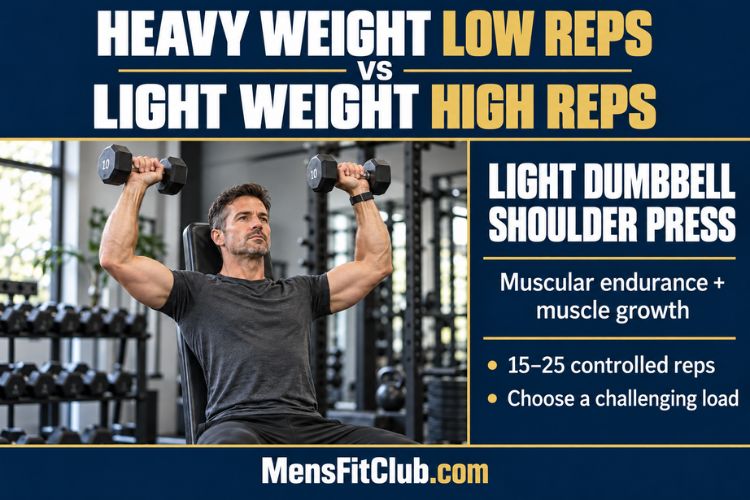
Heavy Weight Low Reps vs Light Weight High Reps
Heavy Weight Low Reps vs Light Weight High Reps
Heavy weight low reps vs light weight high reps is one of the most common debates in strength training. Walk into almost any gym and you will see both approaches: one man performing five challenging barbell repetitions, another completing twenty repetitions on a machine. Both may be training hard, but their workouts emphasize different abilities.
The clearest answer is that heavier weights generally work better for improving maximum strength, while lighter weights and higher repetitions can build muscle when sets are sufficiently challenging. Neither approach automatically produces better results for every goal. Your exercise selection, effort, progression, and ability to recover all influence what you gain from training.
For men who want more muscle, useful strength, and a routine they can maintain, combining rep ranges often makes practical sense. Understanding the differences helps you choose weights deliberately instead of copying the strongest person in the gym or chasing the biggest muscle burn.
What Counts as Heavy Weight Low Reps?
Heavy weight low reps means using a load that allows relatively few repetitions before another clean repetition becomes difficult. In everyday programming, this usually describes sets of approximately three to six repetitions. Singles and doubles also fit the category, although they are generally more relevant to experienced lifters practicing maximal strength.
Heavy is relative to your current ability and the exercise. A dumbbell that feels heavy during a lateral raise may be easy during a row. The number printed on the weight does not tell you how demanding it is for your body. Your technique and remaining repetition capacity provide more useful information.
Understanding One-Repetition Heavy Weight Low Reps Maximum
A one-repetition maximum, or 1RM, is the greatest load you can lift once with acceptable technique on a particular exercise. Heavy training is often described using percentages of this number. Loads around 80 percent of 1RM or higher commonly fall into lower repetition territory, but the relationship varies between individuals and movements.
You do not need to test a true maximum to train effectively. Most recreational lifters can select weights by using a target rep range and estimating how many additional clean repetitions they could perform. That approach also makes it easier to adjust training when sleep, stress, or fatigue changes your performance.
What Counts as Light Weight High Reps?
Light weight high reps typically means using a lower load for sets of approximately fifteen to thirty repetitions. Some programs use even higher numbers, but very long sets can become uncomfortable and time consuming. For most people, moderate and higher rep ranges provide enough variety without turning every exercise into an endurance event.
Light weight does not necessarily mean easy training. Twenty challenging repetitions can require substantial effort. The distinction is between the external load and the difficulty of the set: a relatively light dumbbell can feel extremely demanding near the end of a long set.
Why Effort Changes the Comparison Heavy Weight Low Reps
Imagine two men each performing twenty curls with the same dumbbells. One could complete another twenty repetitions, while the other could manage only two more. Their repetition counts match, but the sets create very different demands. A rep target is useful only when paired with a suitable weight and consistent execution.
This is why comparing heavy and light training without considering effort can be misleading. Low effort high rep sets should not be treated as equivalent to challenging low rep sets. To make a fair comparison, consider how hard each set is for the person performing it.
Heavy Weight Low Reps vs Light Weight High Reps for Muscle Growth
Muscle growth, also called hypertrophy, can occur across a broad range of training loads. The traditional idea that low reps only build strength and high reps only build endurance creates an overly rigid picture. Both heavier and lighter resistance training can increase muscle size under appropriate training conditions.
Research comparing low and high loads has found similar average hypertrophy outcomes in many settings, particularly when sets were performed to muscular failure. However, comparable average results do not mean every weight or routine works equally well for every person. Effort, exercise choice, and study conditions matter.
Why Moderate Reps Are Often Practical
For many men, sets of roughly six to fifteen repetitions offer a useful balance between loading, set duration, and fatigue. These ranges make it relatively easy to accumulate challenging work without the long rest periods associated with very heavy lifting or the discomfort of extremely long sets.
That does not make eight to twelve repetitions a special growth switch. It makes moderate reps a convenient starting point. You can build an effective hypertrophy routine around moderate repetitions while using lower reps on selected compound lifts and higher reps on exercises that feel better with lighter loading.
Muscle Growth Requires More Than a Heavy Weight Low Reps Range
A successful muscle building program needs repeatable training that challenges the target muscles and becomes more demanding as your ability improves. Repeating an easy workout indefinitely is unlikely to produce the same results as gradually improving repetitions, load, or movement quality.
Recovery also affects whether you can sustain productive training. Even an excellent rep range becomes less useful if the routine leaves you too exhausted to train consistently. Choose loading strategies that let you complete good work today and return ready for the next planned session.
Which Approach Builds More Strength? Heavy Weight Low Reps
If your goal is to improve the heaviest weight you can lift once, heavier training generally has an advantage. You are practicing the specific demands of moving heavy loads, including maintaining position, coordinating the lift, and producing high force. A research review found higher loads produced greater improvements in 1RM strength even when training volume load was matched.
Lighter training can still improve strength, especially for people who are new to resistance exercise. However, becoming better at twenty repetitions does not fully replace practicing heavier repetitions when maximum lifting strength is the priority. Your training should reflect the ability you want to develop.
Strength Training Does Not Require Constant Maximal Attempts
Heavy training can mean several controlled sets of four or five repetitions while leaving additional clean repetitions available. It does not require grinding through a personal record every workout. Frequent all out attempts can make performance inconsistent and leave less energy for the rest of your program.
For most recreational lifters, technically sound submaximal work provides a manageable way to practice heavier loading. You can challenge yourself while maintaining control, recording progress, and avoiding the habit of turning every working set into a test.
Which Approach Improves Muscular Endurance? Heavy Weight Low Reps
Muscular endurance is your ability to repeat or sustain muscular effort. Higher repetition training gives you practice performing longer sets, making it useful when your goal includes repeated work with relatively light resistance. Examples include lengthy bodyweight sets or activities requiring repeated lifting at a manageable load.
Endurance is also specific to the task. High rep leg extensions will not perfectly reproduce hiking uphill, and repeated curls will not replace rowing practice. Use resistance training to support the activity you care about, then practice that activity when improving its performance is the main objective.
Strength and Endurance Can Complement Each Other
Increasing strength can make a fixed everyday load represent a smaller fraction of your capacity. Improving endurance can help you repeat efforts more comfortably. A balanced routine may therefore include both heavier work and longer sets, with the proportions determined by your goals and available training time.
Does Light Weight High Reps Burn More Fat?
High rep workouts often create more sweating and a stronger burning sensation, but those feelings do not demonstrate greater fat loss. Body fat reduction depends largely on maintaining an energy deficit over time. Resistance training supports that process by helping you train and retain muscle while losing weight.
Choosing the right rep range during a fat loss phase means preserving useful training performance while managing recovery. You do not need to replace every heavy exercise with thirty repetition sets. Keep a manageable mixture of loads, maintain consistent activity, and adjust food intake to support your weight management goal.
High Reps Do Not Create a Separate Type of Toned Muscle Heavy Weight Low Reps
The appearance commonly described as toned reflects muscle development and the amount of body fat covering it. Light weights do not shape muscle into a different texture. If you want more visible definition, use resistance training to develop muscle and a sustainable nutrition approach to manage body fat.
How Close to Failure Should You Train With Heavy Weight Low Reps?
Repetitions in reserve, or RIR, describe how many more clean repetitions you believe you could complete before reaching muscular failure. Finishing a set with two repetitions in reserve means you estimate that two additional repetitions were possible with similar technique. This gives your rep targets a useful measure of effort.
As a practical starting point, many working sets can finish around one to three repetitions in reserve. Beginners may initially leave more room while learning technique. This is a programming guideline rather than a universal threshold, and estimates become more useful as you gain experience with an exercise.
Higher Rep Sets Need Honest Effort Estimates
During long sets, discomfort may convince you to stop before the target muscles are close to their limit. If you perform twenty repetitions but could have completed ten more, the set may be easier than intended. Select a slightly heavier load or gradually add repetitions rather than assuming a burning sensation proves sufficient effort.
Heavy compound exercises require a different judgment. Stop when another repetition would demand a substantial technique change or create a situation you cannot safely control. Failure training is an optional tool, and it is easier to manage on suitable machines or isolation movements than under a heavily loaded barbell.
Choosing Rep Ranges for Different Exercises
The best rep range depends partly on how an exercise behaves under fatigue. Stable movements often tolerate longer sets well. Complex lifts may become limited by balance, breathing, grip, or position before the intended muscles receive the work you wanted.
Compound Exercises Heavy Weight Low Reps
Squats, presses, rows, and hinge movements can be trained with different loads, but heavier or moderate sets are often convenient. A twenty five repetition squat set might challenge your breathing so much that you struggle to judge leg effort. A set of six to ten may be easier to repeat and track.
Choose the exercise variation that lets you maintain control. A chest supported row may work better for longer sets than a bent over row if your lower back tires first. Matching the variation to the rep range improves the quality of the workout without requiring more exercises.
Isolation Exercises
Lateral raises, curls, triceps extensions, leg curls, and calf raises often fit moderate or higher rep ranges. These movements can become awkward when the load is so heavy that you need momentum or shortened repetitions. Reducing weight may make it easier to challenge the intended muscle through a consistent range.
For example, twelve to twenty controlled lateral raises may be more useful than five repetitions completed with substantial swinging. The heavier dumbbell only represents progress if you can still perform the exercise in a way that serves its purpose.
Heavy vs Light Weights for Beginners and Men Over 40
Beginners benefit from developing reliable movement skills before pursuing extreme rep ranges. Starting with moderate loads and manageable sets makes it easier to learn positions, understand effort, and recognize progress. You can introduce heavier or longer sets as technique becomes more repeatable.
Being over forty does not automatically require avoiding heavy lifting. Your training history, current capacity, joint comfort, and recovery matter more than an age label alone. Returning after a long break calls for gradual rebuilding, while an experienced lifter may already tolerate heavier work well.
Joint Comfort Should Guide Heavy Weight Low Reps Adjustments
Lighter weights are not automatically comfortable when repetitions become excessive, and heavy weights are not automatically problematic when selected appropriately. Consider the entire exercise: load, range of motion, technique, set length, and total workload. Adjust one variable at a time so you can identify what improves your training experience.
Sharp or escalating pain is a reason to stop and reassess rather than push toward a rep target. Persistent symptoms warrant professional assessment. For ordinary exercise selection, choose variations that you can perform comfortably and progressively instead of forcing a movement because it appears in someone else’s program.
A Sample Workout Combining Heavy and Light Training
The following three day routine illustrates how different rep ranges can coexist. It suits someone with basic lifting experience and access to a gym. Perform the sessions on nonconsecutive days, choose manageable starting loads, and begin with two working sets per exercise if three would exceed your current capacity.
Warm up with brief easy movement and progressively heavier practice sets for the first main lift. Warm up sets prepare you for the working weight and do not need to approach failure. For working sets, generally leave about two clean repetitions available and use consistent technique throughout.
Day One: Lower Reps on Main Lifts
Perform a squat variation for three sets of four to six repetitions, followed by a bench press or dumbbell press for three sets of five to eight. Add a chest supported row for two sets of eight to twelve, a leg curl for two sets of twelve to fifteen, and a calf raise for two sets of fifteen to twenty.
Rest approximately two to three minutes between demanding compound sets, extending that time when necessary to maintain performance. Use roughly one to two minutes for smaller exercises, also adjusting as needed. The goal is to repeat quality sets rather than race through the session.
Day Two: Moderate Reps for Muscle Building
Perform a Romanian deadlift for two sets of six to ten repetitions, an incline dumbbell press for three sets of eight to twelve, and a pulldown for three sets of eight to twelve. Finish with split squats for two sets of eight to twelve per leg and lateral raises for two sets of twelve to twenty.
This session places most work in moderate ranges while using longer sets for the shoulders. Keep hinge repetitions controlled and stop before fatigue changes your back position. If split squat balance limits the set, use light support so your legs can perform the intended work.
Day Three: Higher Reps on Stable Exercises
Perform a leg press for three sets of ten to fifteen repetitions, a machine chest press for two sets of ten to fifteen, and a cable row for three sets of ten to fifteen. Add leg curls for two sets of fifteen to twenty, then curls and triceps pressdowns for two sets each of twelve to twenty.
This is not an easy day simply because the loads are lighter. Select weights that make the final repetitions demanding without losing control. The stable exercises provide a way to practice longer sets while keeping fatigue related balance and positioning demands relatively manageable.
How to Progress Without Changing Your Routine Constantly
Double progression offers a straightforward method for both heavy and light training. Choose a repetition range, keep the load consistent, and gradually increase completed repetitions while maintaining the intended effort. Increase weight once you reach the upper end across your working sets with reliable technique.
For example, a press programmed for three sets of eight to twelve might begin at ten, nine, and eight repetitions. Over several sessions, build toward twelve repetitions on all three sets. Then use the smallest practical weight increase and accept that repetitions may return toward the lower end.
Track More Than the Weight
Record exercise variation, load, repetitions, and a rough effort estimate. These details help distinguish genuine improvement from using more momentum or stopping farther from failure. A heavier lift with dramatically reduced range of motion is not directly comparable to your previous full range performance.
Progress does not need to happen every session. Keep the main exercises stable long enough to recognize trends. If several workouts decline, review sleep, scheduling, and total workload before adding more training. Sometimes reducing fatigue makes existing strength easier to express.
Common Heavy Weight Low Reps Mistakes in the Heavy vs Light Debate
One frequent mistake is treating heavy weights as proof that a workout is effective. If loading prevents you from controlling the exercise, adding weight can reduce its usefulness. Another is assuming high repetitions compensate for a load that never challenges you. Both errors distract from the quality of the working set.
Changing rep ranges every week can also make progression difficult to interpret. Variety has a place, but your training log should tell a clear story. Use stable rep targets for a block of training, then make adjustments when your goal, comfort, equipment, or progress provides a reason.
Avoid Adding Every Method at Once
Heavy sets, high rep finishers, drop sets, and extra exercises all contribute to workload. Combining them without considering the total can create more fatigue than you can recover from. Add a small amount of new work, observe the effect, and keep it only if it improves the program.
Frequently Asked Questions About Heavy Weight Low Reps
Can You Build Muscle With Light Dumbbells?
Yes, if the exercises remain sufficiently challenging and allow progression. You can add repetitions, choose harder variations, or use unilateral movements. Eventually, some exercises may become too easy or require impractically long sets, making access to heavier resistance helpful.
Are Five Reps Enough to Build Muscle?
Five repetition sets can contribute to muscle growth when performed with appropriate effort and enough manageable training. They are particularly useful when strength is also a priority. Moderate and higher rep accessory work can complement them without making every exercise heavily loaded.
Should You Use Both Heavy and Light Weights Low Reps?
Many men can benefit from using both. Emphasize heavier work when maximum strength matters most, and choose a broad mix of challenging loads for muscle building. Start with a manageable workout routine, track your progress, and let results and recovery guide the balance.
To put the heavy weight low reps vs light weight high reps comparison into practice, start with our guide on How to Choose Dumbbell Weight For Every Exercise. Explore the 8-Week Barbell Progressive Overload Program for structured strength training, or try the Light Dumbbell High Rep Workout for longer sets with lighter resistance. Our Muscle Endurance Workout Guide offers additional endurance-focused options, while When to Reduce Sets Reps or Weight During a Workout helps you adjust your training when fatigue affects performance.


Most Recommended

Subscribe to our Newsletter
Stay up to date on the latest men’s health, fitness and lifestyle trends and tips.
About Us
Men’s Fit Club was started with the goal of empowering men to get the most out of their lives. This meant going beyond exercise and diet tips to really address the broad range of issues that men face on a daily basis – topics like recreation, finding love, sexual health and even sound fashion advice.
Quick Links
© COPYRIGHT MEN'S FIT CLUB 2026. All Rights Reserved