

Morning or Evening Workouts After 50: Which Is Better?

Strength Training Sleep and Testosterone for Men
Heavy Weight Low Reps vs Light Weight High Reps
Strength Training Sleep and Testosterone for Men
Strength training, sleep and testosterone are closely connected topics in men’s fitness. When energy drops, workouts stall or recovery becomes harder, many men wonder whether their hormones are responsible. Others start lifting weights because they have heard that heavy squats and deadlifts will dramatically increase testosterone. Sleep often enters the conversation later, even though an exhausting training schedule built around short nights can be difficult to sustain.
The useful approach is to understand what each part contributes. Resistance training builds physical capacity. Sleep supports recovery and daily functioning. Testosterone participates in normal male physiology, but a blood test cannot summarize your fitness, discipline or overall health. Improving your routine may help you feel and perform better without producing a large change in your testosterone level.
This guide explains how to combine sensible strength training with consistent sleep, avoid common recovery mistakes and recognize when symptoms deserve medical attention. The goal is a stronger, healthier body supported by habits you can maintain.
How Strength Training, Sleep and Testosterone Fit Together
A workout creates a demand for adaptation. You challenge your muscles, practice movement skills and gradually develop the ability to handle more work. Recovery allows you to return prepared for another productive session. When training repeatedly competes with sleep, meals and other responsibilities, the program can become harder than your available recovery allows.
Think about a man who adds five demanding gym sessions to a stressful week while sleeping only six hours. He may initially feel motivated, but maintaining that workload can become difficult. A shorter routine with adequate rest may produce more consistent progress because he can complete it repeatedly. That improvement does not establish that testosterone increased; it demonstrates that the training schedule became more manageable.
Hormone Health Is Broader Than Gym Performance
A disappointing workout is not a testosterone test. Strength varies with technique, motivation, recent meals, accumulated fatigue and the difficulty of the exercise. Likewise, feeling tired after a demanding week does not identify a hormone disorder. These observations are useful clues about your routine, but they need context.
Avoid judging your health through a single symptom or comparing your laboratory results with someone else’s online. A productive fitness plan focuses on controllable behaviors and measurable performance. Medical evaluation becomes appropriate when persistent symptoms suggest a problem that lifestyle adjustments alone may not explain.
Does Strength Training And Sleep Increase Testosterone?
Some workouts produce a temporary increase in circulating testosterone. However, an immediate response after exercise is different from a lasting increase in resting levels. A review of randomized trials involving insufficiently active, generally healthy men found that exercise training had a negligible overall effect on resting testosterone. Those findings do not mean lifting is ineffective; they mean its benefits should not be marketed as a guaranteed hormone boost.
This distinction changes how you choose a program. You do not need to turn every session into an exhausting collection of heavy compound exercises to chase a laboratory response. Choose movements that suit your ability, train them consistently and increase the challenge gradually. Your progress can be worthwhile even if your resting testosterone remains similar.
Choose Compound Exercises for Their Practical Benefits
Squats, presses, rows, hinges and lunges are useful because they train several muscles and make efficient use of limited gym time. They also provide clear opportunities to track progress. A goblet squat may develop into a heavier goblet squat, while a dumbbell row can improve through additional repetitions or better control.
Equipment choice should reflect access and comfort. Barbells, dumbbells, machines and bodyweight exercises can all belong in a strength program. A supported machine row may be a better choice than a bent-over barbell row when your lower back is already fatigued. No equipment category needs to be labeled the essential testosterone tool.
Do Not Confuse Exhaustion With Effectiveness: Strength Training And Sleep
Sweating heavily, shortening every rest period and finishing with shaky legs can make a session feel intense. Those sensations do not prove that you have created a superior stimulus. If fatigue prevents you from maintaining technique or repeating good work next week, the session may be poorly matched to your needs.
For most recreational lifters, the useful question is whether training is producing repeatable progress. Are your repetitions becoming more controlled? Can you handle slightly more weight? Are you recovering well enough to train again? Those answers guide programming more effectively than trying to maximize a temporary hormonal response.
How Sleep Relates to Testosterone in Men
Testosterone has a daily rhythm that is linked with sleep and waking. However, the relationship between reduced sleep and measured testosterone is more complicated than popular headlines suggest. Controlled studies have produced differing results, including research that did not find clinically meaningful reductions under the sleep restriction conditions tested. Study size, sleep timing and blood sampling can influence interpretation.
The practical conclusion is to protect sleep without promising a specific hormone increase. Better sleep is valuable even when a testosterone measurement does not change. You also cannot calculate your hormone level from last night’s sleep duration or assume that one restless night has erased your training progress.
How Much Sleep Should Men Aim For When Strength Training?
The CDC recommends at least seven hours for adults ages 18–60, seven to nine hours for ages 61–64 and seven to eight hours for adults 65 and older. These ranges are general guidance, rather than a testosterone prescription. Sleep quality and whether you feel refreshed also matter.
Start by assessing your actual sleep opportunity. If your alarm is set for 6:00 a.m. and you usually get into bed at midnight, you have left little room for an adequate night. Moving bedtime earlier can be more useful than adding another recovery product. Allow time to settle down rather than assuming every minute in bed will be spent asleep.
Consistency Makes Sleep Easier to Plan
A reasonably consistent bedtime and wake time give your week a predictable structure. They also help you see whether workouts, late meals or evening commitments are crowding out rest. Aim for a pattern you can maintain on most days instead of a perfect routine that collapses whenever life becomes busy.
For men working rotating shifts, the same clock time may be impossible. Focus on protecting a reliable sleep window when your schedule allows, reducing interruptions and explaining your rest needs to the household. Persistent difficulty sleeping despite adequate opportunity deserves attention rather than being accepted as an unavoidable consequence of work.
A Strength Training Plan That Leaves Room For Sleep & Recovery
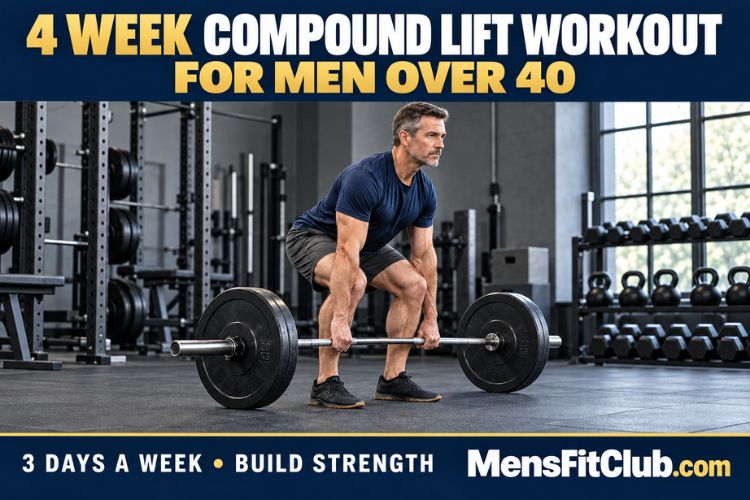
A practical starting point is two or three full-body workouts each week, with a day between sessions when possible. This is an example routine for generally healthy adults who can perform the movements comfortably. It is designed to make strength training manageable, not to treat testosterone deficiency or produce a particular blood test result.
Begin each session with five to ten minutes of easy movement and lighter practice sets. Choose loads that allow controlled repetitions, and finish most working sets with approximately two or three repetitions still available. Rest long enough to repeat good technique, often around two minutes for demanding exercises and a little less for smaller movements.
Monday: Full-Body Workout A
Perform a goblet squat for two or three sets of eight to ten repetitions, followed by a dumbbell bench press for two or three sets of eight to twelve. Add a chest-supported row for the same number of sets and repetitions. These movements provide a straightforward combination of lower-body training, pressing and pulling.
Finish with two sets of a dumbbell Romanian deadlift for eight to ten repetitions and two comfortable rounds of a suitcase carry. For the carry, walk slowly with a weight in one hand, remain upright and switch sides. Start with a short distance that allows steady posture. The session should fit within roughly 35–50 minutes without rushing.
Wednesday: Full-Body Workout B : Strength Training And Sleep
Start with a supported split squat or leg press for two or three sets of eight to twelve repetitions. Follow with a comfortable overhead press variation for two sets of eight to ten, then a lat pulldown or assisted pull-up for two or three sets of eight to twelve. Select an alternative press if overhead movement is uncomfortable.
Complete the workout with two sets of a hip thrust or glute bridge for ten to twelve repetitions and two controlled sets of a dead bug. Prioritize comfortable movement and steady breathing. You can begin with fewer exercises if you are returning after a long break, then expand the session as your tolerance improves.
Friday: Repeat With Modest Progression
Repeat Workout A on Friday, then begin the next week with Workout B. This creates an alternating pattern across successive weeks. If three sessions are unrealistic, complete Workout A and Workout B on two nonconsecutive days. A schedule you reliably finish is more useful than a demanding plan you repeatedly abandon.
Use a simple progression rule. When you reach the upper end of a repetition range on every set with good control, increase the load by the smallest practical amount. Return toward the lower end of the range and build again. Avoid adding weight, sets and extra training days simultaneously, because it becomes harder to identify what changed your recovery.
Adjusting Your Strength Training Workout After Poor Sleep
One short night does not automatically require canceling your workout. Evaluate how you feel and how you move during the warm-up. If you are alert, coordinated and comfortable, you may be able to train with modest adjustments. If you are struggling to stay awake or your technique is unusually unstable, choose rest or easy activity.
An adjustment should make the session easier to complete safely. You might remove one set from each exercise, select lighter loads or replace a demanding free-weight movement with a supported alternative. Keep the session familiar and avoid using a sleep-deprived day to test a new maximum.
Use Your Warm-Up as a Practical Check
Compare the first few practice sets with your usual experience. Does a normally comfortable weight feel unexpectedly difficult? Are you having trouble concentrating on basic instructions? These observations can help you decide how much work to do. They are programming signals, not evidence that your testosterone has fallen.
After several poor nights, look beyond today’s workout. Rearrange your training time, simplify the week or remove optional conditioning. Trying to rescue every tired session with a larger dose of caffeine may leave the underlying scheduling problem unresolved. Make space for recovery before demanding more effort from yourself.
Build an Evening Routine That Supports Sleep
A useful evening routine begins before you enter the bedroom. Decide when work, strenuous training and stimulating entertainment will finish. Prepare clothes or meals for tomorrow so those tasks do not keep expanding into bedtime. A short, repeatable sequence is easier to maintain than an elaborate ritual.
Keep the bedroom quiet, dark and comfortably cool. If scrolling repeatedly delays sleep, place your phone beyond easy reach. Reading, a warm shower or a few minutes of relaxed breathing can create a clear transition into rest. Choose activities you find calming instead of turning the routine into another performance challenge.
Review Caffeine and Alcohol Habits: Strength Training And Sleep
Caffeine can make late workouts feel easier while making bedtime harder for some people. Review coffee, energy drinks and pre-workout products together, since their effects can overlap. If you suspect a problem, move your last caffeine serving earlier and observe whether your sleep improves over the next several days.
Alcohol is also worth reviewing when your evenings consistently include drinks. The CDC advises avoiding alcohol before bedtime, along with avoiding caffeine in the afternoon or evening. These are sensible sleep habits, not guaranteed methods for increasing testosterone.
Choose Training Times That Fit Your Life: Strength Training And Sleep
Morning workouts can be convenient, but they lose their appeal when they consistently require cutting sleep short. Evening workouts can also be practical, provided your schedule leaves enough time to wind down. Choose the option that allows you to train regularly while preserving adequate sleep opportunity.
Experiment with one change at a time. Move a session earlier, shorten it or reduce an optional finisher, then compare your experience. Keep notes about bedtime and how rested you feel. Personal patterns can guide scheduling without implying that you have discovered a universal rule about exercise timing and hormones.
Nutrition Should Support the Work You Are Doing
Training and recovery are easier to organize when meals are regular and adequate for your activity. Include protein-containing foods across the day, along with carbohydrates, dietary fats, fruit and vegetables. You do not need a special testosterone menu to begin building a sensible eating pattern.
A practical meal could combine chicken, beans or tofu with potatoes or rice and vegetables. Breakfast might include eggs or yogurt, fruit and oats. Adapt these examples to your preferences and medical needs. The purpose is to make meals reliable enough that demanding workouts are not routinely followed by skipped food and late-night hunger.
Avoid Aggressive Changes All at Once
If fat loss is a goal, resist combining a severe diet with extra lifting, daily intervals and reduced sleep. Even without knowing your hormone levels, that arrangement may become difficult to sustain. Begin with manageable changes and monitor whether your strength, energy and ability to recover remain acceptable.
Do not assume that every low-energy day requires supplements or that increasing one nutrient will correct low testosterone. Persistent symptoms deserve an assessment of the whole situation. A qualified clinician or dietitian can help when medical conditions, restrictive eating or complicated weight-management needs affect your choices.
Know When Sleep Problems Need Evaluation
More time in bed does not resolve every sleep problem. Loud snoring, witnessed pauses in breathing, gasping during sleep and significant daytime sleepiness are symptoms that can occur with sleep apnea. The National Heart, Lung, and Blood Institute also identifies fatigue and related daytime difficulties among possible symptoms. Discuss these patterns with a healthcare professional.
Treat evaluation as part of your health plan rather than a distraction from fitness. If sleep is repeatedly unrefreshing, adding harder workouts may make the week more demanding without addressing the cause. Do not assume that sleep apnea treatment will automatically normalize testosterone; the immediate reason to seek help is the sleep and breathing problem itself.
Persistent Insomnia Deserves Attention Too
Difficulty falling asleep, repeated awakenings or long periods awake can interfere with daily life even when you reserve enough time for bed. Keep a brief record of the pattern and discuss ongoing problems with a healthcare professional. Include medications, supplements, caffeine use and your work schedule in that conversation.
Wearables may help you notice trends, but their sleep scores cannot diagnose a disorder or measure testosterone. Use them as optional tracking tools. Avoid changing your entire training week because one device assigns a poor score when your own experience and functioning suggest otherwise.
When Should Men Discuss Testosterone Testing?
Persistent changes in sexual function, reduced libido or other concerning symptoms warrant medical discussion. Fatigue alone has many possible explanations. The Endocrine Society recommends diagnosing hypogonadism only when compatible symptoms and signs occur alongside consistently, clearly low testosterone measurements, with repeat morning fasting testing to confirm the finding.
Tell your clinician about recent illness, sleep problems, medications, exercise habits and any supplements or hormone products you use. If you work nights, explain your sleep schedule so testing can be interpreted appropriately. Avoid relying on a single result or an online threshold without clinical context.
Lifestyle Habits Complement Medical Care
Strength training and better sleep are worthwhile habits, but they are not substitutes for investigating confirmed testosterone deficiency. Its cause matters. A clinician can determine whether further evaluation or treatment is appropriate instead of assuming the answer is more squats, additional supplements or an earlier bedtime.
Testosterone treatment also requires individualized decisions and monitoring. The Endocrine Society advises against starting therapy in men planning fertility in the near term and in certain other circumstances. If treatment is being considered, discuss fertility goals and health history openly.
Track Progress Through Habits and Performance
For four weeks, record your completed workouts, weights, repetitions, approximate sleep duration and general energy. Keep the process brief enough to use consistently. Look for patterns across several days rather than reacting to isolated fluctuations. A difficult Monday followed by normal sessions may not require a major program change.
At the end of the month, ask whether you are completing training more consistently, progressing on familiar exercises and allowing enough time for sleep. Those outcomes give your routine a practical direction. They do not confirm a testosterone increase, but they can show that your daily habits are becoming more effective.
Frequently Asked Questions About Strength Training, Sleep and Testosterone
Can You Build Muscle Without Increasing Resting Testosterone?
Yes. Training progress does not require demonstrating a rise in your resting testosterone measurement. Focus on consistent resistance exercise, sensible progression and recovery. If symptoms suggest an underlying medical problem, pursue evaluation alongside your fitness routine rather than treating gym progress as a diagnostic test.
Should You Sleep Longer or Add Another Workout?
If an extra workout would regularly reduce sleep below an adequate amount, protect sleep and make your existing sessions more efficient. Two or three manageable workouts can provide a useful structure. More sessions become worthwhile when your schedule and recovery support them, rather than when you feel pressured to train daily.
Which Exercise Is Best for Testosterone?
There is no single exercise that reliably guarantees a lasting testosterone increase. Choose a balanced routine with lower-body movements, presses, pulls and appropriate trunk work. The best exercise choices are ones you can perform comfortably, improve over time and fit into a consistent schedule.
Build a Strength Training And Sleep Routine You Can Keep
Strength training, sleep and testosterone for men are best approached through clear priorities. Train consistently, progress gradually, eat regularly and reserve enough time for rest. Adjust difficult weeks instead of turning every session into a test of determination. Seek medical evaluation when persistent symptoms or sleep problems need an explanation.
Start with two or three realistic training appointments and a bedtime that supports your wake time. Repeat that structure, observe your response and make small improvements. A stronger body and a more manageable routine are valuable results in their own right, regardless of whether your testosterone number changes.
To put these strength training, sleep and testosterone principles into practice, explore our Minimum Effective Dose Strength Training Guide for a manageable workout routine, and HRV and Strength Training: When to Train Hard for interpreting recovery trends. Learn How to Adjust Your Workout Using a Readiness Score when poor sleep affects your training, review Strength Training While Losing Weight: Sets and Reps to balance lifting with fat loss, and discover How to Build Strength for Longevity for a sustainable approach to staying strong as you age.


Most Recommended

Subscribe to our Newsletter
Stay up to date on the latest men’s health, fitness and lifestyle trends and tips.
About Us
Men’s Fit Club was started with the goal of empowering men to get the most out of their lives. This meant going beyond exercise and diet tips to really address the broad range of issues that men face on a daily basis – topics like recreation, finding love, sexual health and even sound fashion advice.
Quick Links
© COPYRIGHT MEN'S FIT CLUB 2026. All Rights Reserved