


High Protein Beef and Pumpkin Chili: A Hearty Recipe
When to Reduce Sets Reps or Weight During a Workout
How to Adjust Your Workout Using a Readiness Score
Your workout plan says heavy squats, but your fitness tracker says you need recovery. Should you train anyway, reduce the weight, or take the day off? Learning how to adjust your workout using a readiness score starts with understanding what that number can tell you—and where its usefulness ends.
A readiness score can help you notice changes in recovery that might otherwise go overlooked. However, it cannot measure every factor that affects performance. Your muscles, joints, technique, motivation, and recent training experience still matter. The most useful approach combines your score with how you feel and how you perform during the warm-up.
For men balancing strength training with work, family, and limited sleep, this approach can make a structured program more manageable. You keep the purpose of your workout while adjusting the amount of stress you add that day. The goal is consistent progress across weeks and months, rather than forcing every session to look identical.
What Is a Workout Readiness Score?
A workout readiness score is an estimate of how prepared you may be for physical activity. Depending on the device or app, it can combine sleep, resting heart rate, heart rate variability, recent activity, and other measurements. Some systems also use information you enter yourself, such as fatigue or soreness.
For example, Oura describes its readiness score as a summary of recovery and activity balance, incorporating overnight measurements and longer-term trends. Its system uses a scale from zero to 100. Other platforms may calculate recovery or training readiness differently, so their numbers should not be treated as interchangeable.
A readiness score is best understood as a prompt to evaluate your training. It is an estimate generated from selected inputs, rather than a direct measurement of how much weight you can lift or whether a particular workout is appropriate.
Why Your Personal Baseline Matters: Workout Readiness Score
The same score can mean different things for different people. A reading that is typical for you may represent a meaningful decline for someone else. Even within one device, your usual range provides context that a single number lacks.
Spend several weeks observing your scores alongside sleep, stress, and workout performance. Follow your device’s guidance about establishing a baseline, since some systems need more time to personalize their calculations. Avoid building rigid rules from your first few readings.
Look for repeated relationships. Do lower scores usually coincide with poor warm-up performance? Do you sometimes train normally despite a lower reading? Your training log helps reveal whether the score adds useful information to your decisions.
Readiness Is Different From Motivation
Feeling unmotivated does not automatically mean you are physically unprepared. A stressful workday can make exercise seem difficult even when your strength is normal. Conversely, excitement about a workout does not erase fatigue or joint discomfort.
Separate willingness to train from your ability to complete the session with good technique. When you are simply reluctant, a short warm-up may help you get started. When you are unusually fatigued, poorly coordinated, or experiencing symptoms, enthusiasm should not push you into a demanding workout.
Check Three Signals Before Changing Your Workout And Score Readiness
A practical readiness check uses three sources of information: your device reading, your own assessment, and your warm-up performance. This is a coaching framework, not a validated formula. Its purpose is to prevent any one signal from controlling the entire session.
Start by reviewing your score relative to your normal range. Then consider sleep, energy, soreness, stress, and pain. Finally, use gradually heavier warm-up sets to see whether your planned workout still fits your condition.
Review the Score and Its Contributors
Look beneath the headline number when your app allows it. A lower score associated with a short night of sleep deserves a different interpretation from missing sensor data or an unusually demanding previous workout.
Consider the circumstances around the reading. Travel, alcohol, disrupted routines, and a loose-fitting device can complicate interpretation. A score with incomplete measurements deserves less confidence than one based on consistent data collection.
Do not convert a percentage score directly into a percentage of your usual training weight. A readiness reading of 70 does not mean you should lift 70 percent of yesterday’s load. The scale does not measure strength that way.
Assess Energy, Soreness, Stress, and Symptoms: Workout Readiness Score
Ask whether you feel broadly normal, mildly tired, or clearly unwell. Notice whether soreness is limited to a specific muscle group or whether fatigue affects your whole body. Check whether you can move comfortably through the positions your workout requires.
Ordinary muscle soreness and sharp pain require different responses. Do not use a high score to justify training through new pain. Fever, chest pain, fainting, or unusual breathlessness also take priority over any wearable result; stop exercise and seek appropriate medical care.
A quick written note is enough. Recording “short sleep, legs mildly sore, energy normal” gives you more useful context than repeatedly checking the app for reassurance.
Use Your Warm-Up as a Performance Check
Begin with several minutes of easy movement, then perform exercise-specific warm-up sets. Increase the load gradually while paying attention to coordination, range of motion, and effort. Avoid turning the assessment into a maximal test.
Compare familiar warm-up weights with your normal experience. If a weight you usually move comfortably feels unusually demanding, consider adjusting the session. If your movement feels normal and you have no concerning symptoms, a mildly lower score may not require a major change.
The warm-up does not guarantee that fatigue will disappear. It provides another observation. Continue monitoring technique and effort during working sets, particularly if your morning data and your physical experience disagree.
Use a Flexible Green, Yellow, and Red Framework Workout Readiness Score
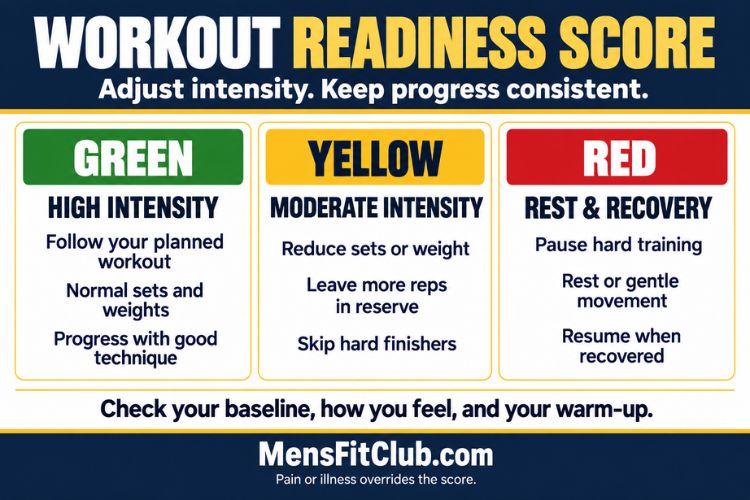
Instead of copying numerical thresholds from another person or platform, classify the day using the overall pattern. Green means your score, subjective assessment, and warm-up support the planned workout. Yellow means there is some evidence of reduced readiness. Red means symptoms, marked fatigue, or poor movement quality justify a substantial change.
These categories are practical examples, not medical classifications or device-specific instructions. One mildly unusual reading may call for observation. Multiple signs pointing in the same direction deserve more attention.
Green Readiness: Follow Your Planned Session
On a green day, complete the workout as written. Use your normal exercise selection, working sets, rest periods, and effort targets. If your program includes a planned progression and your performance supports it, take that progression.
A strong score is not permission to add every possible challenge. Extra sets, maximum attempts, and a hard finisher can turn a manageable session into unnecessary fatigue. Good readiness often means you can execute your existing plan well.
Keep the normal stopping rules. End a set when technique breaks down or when you reach the intended effort. Recovery data should support disciplined training rather than encourage impulsive training.
Yellow Readiness: Make a Small, Targeted Adjustment: Workout Readiness Score
On a yellow day, preserve the main purpose of the session while reducing its cost. You might remove an accessory set, skip the conditioning finisher, lower a demanding lift slightly, or keep more repetitions in reserve.
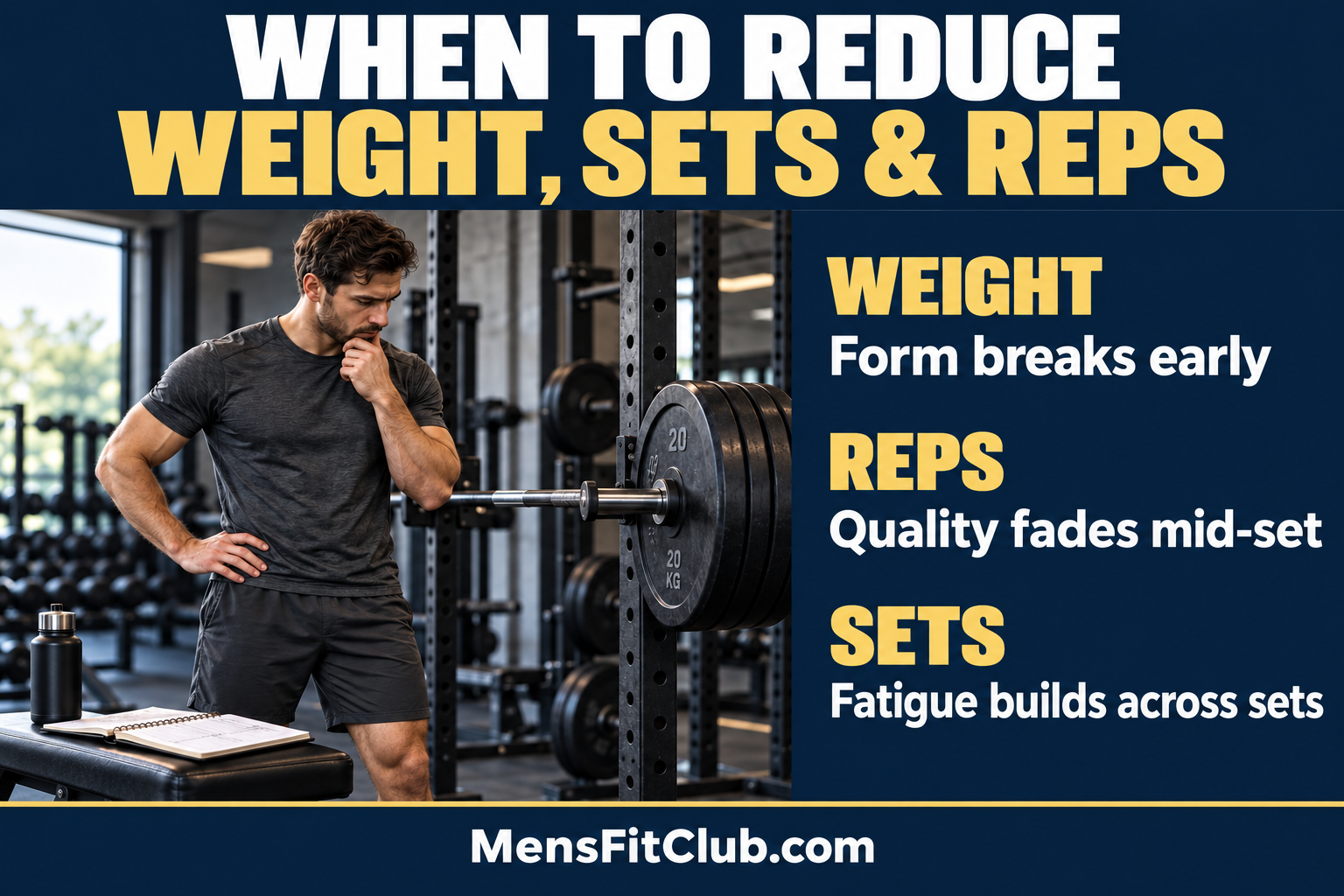
Choose the adjustment that matches the problem. If your first sets feel normal but you tire quickly, reducing total sets may help. If the first working weight already feels unusually heavy, reduce the load or repetitions immediately.
Avoid changing everything at once when a small adjustment works. Keeping most of the workout familiar makes it easier to compare performance and maintain continuity in your program.
Red Readiness: Prioritize Recovery or Easy Movement
A red day may warrant rest, especially when you feel ill or movement is impaired. If you are otherwise well but substantially fatigued, an easy walk or brief comfortable mobility session may fit better than demanding training.
Do not replace heavy lifting with an exhausting bodyweight circuit and call it recovery. The change should lower the overall demand. Easy activity should leave you feeling capable of continuing, rather than drained.
A low score alone does not diagnose illness or overtraining. However, persistent unusual fatigue, repeated performance decline, or unexplained symptoms deserve attention beyond a training adjustment.
How to Adjust Strength Training Workout Using a Readiness Score
Strength training offers several ways to control the session: sets, repetitions, load, exercise choice, and proximity to failure. The most useful variable depends on what feels different that day.
The following numbers illustrate possible adjustments. They are not research-validated prescriptions tied to readiness scores. Start conservatively, use your training experience, and reassess after the next set.
Reduce Sets When Performance Is Normal but Endurance Is Lower
Suppose your program calls for four sets of squats, three sets of presses, three sets of rows, and two accessory exercises. Your warm-up feels normal, but you slept poorly and expect to struggle with the full session.
One option is to perform three squat sets, two press sets, and two row sets, then omit the least important accessory work. You still practice the main movements and complete productive work while reducing total volume.
This approach is particularly useful when fatigue builds across sets. Preserve adequate rest between the remaining sets. Rushing them into a circuit can make the shortened workout harder than intended.
Reduce Weight When the Planned Load Feels Unusually Heavy: Workout Readiness Score
If your usual working weight requires excessive effort immediately, lower it. As an example, a small reduction of roughly five to ten percent may help restore the intended repetitions and technique. Some days require a different reduction, so let performance guide the choice.
For dumbbells, the available weight increments may be too large for a precise percentage change. Use the next manageable pair and keep the effort appropriate. You can also shorten the set when changing weights is impractical.
Do not insist on the original repetition target if movement quality deteriorates. The useful result is a controlled set that fits today’s capacity, rather than a completed number achieved through compensation.
Keep More Repetitions in Reserve
Repetitions in reserve describe how many additional clean repetitions you estimate you could perform before reaching failure. Two repetitions in reserve means you believe you could complete approximately two more with acceptable technique.
On a yellow day, you might finish sets with three or four repetitions in reserve instead of one or two. This is an illustrative way to lower effort without abandoning your normal exercises.
Estimating reserve takes practice and can be inaccurate, particularly for beginners. When uncertain, prioritize clearly controlled repetitions and stop before grinding. A consistent technique standard makes the estimate more useful over time.
Simplify Exercise Selection When Necessary: Workout Readiness Score
Sometimes an exercise demands more coordination or stabilization than you can provide comfortably that day. A supported row, machine press, or simpler squat variation may allow useful practice with less complexity.
A substitute still needs an appropriate load and effort target. Machines and supported exercises can become exhausting if you take every set to failure. Simpler equipment does not automatically make the session restorative.
If an exercise produces pain, avoid forcing a substitute into the workout just to complete the pattern. Choose comfortable movement when appropriate and investigate recurring discomfort rather than letting a readiness score explain it away.
Adjust Cardio, HIIT, and Power Work Carefully
Readiness decisions should reflect the type of training planned. A relaxed walk, repeated hard intervals, and explosive lifting create different demands. A lower score may justify changing one component without removing all physical activity.
Use perceived effort and movement quality alongside device feedback. Your usual pace or power output may feel harder on a fatigued day, so maintaining the same external target can change the session’s actual difficulty.
Modify Easy Cardio by Effort: Workout Readiness Score
For an easy aerobic session, choose a pace that allows comfortable conversation. If your familiar pace feels unusually demanding, slow down. You might also shorten a planned 40-minute session to 20 or 30 minutes.
Those durations are examples, not requirements. The important change is keeping the session easy enough for its intended purpose. Avoid chasing your normal speed simply because it appears in your training history.
Heart-rate targets can provide context, but they should not override symptoms or unusual effort. Review the session afterward to see whether the adjustment left you refreshed or added more fatigue.
Reduce or Replace Hard Intervals
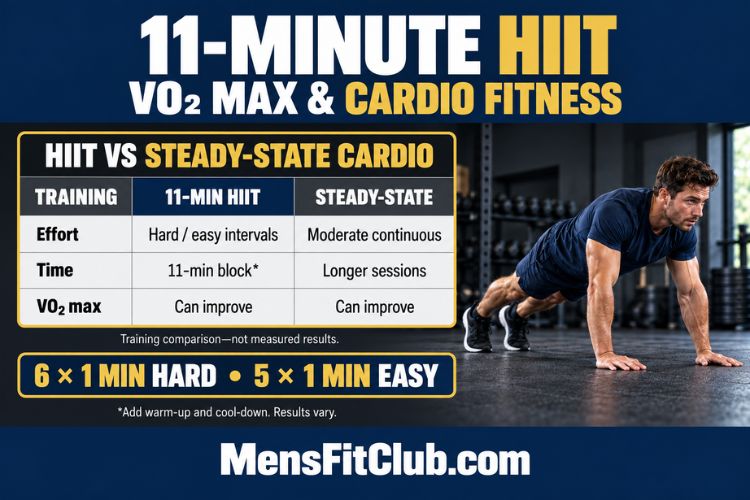
If you are mildly fatigued but moving normally, you could perform fewer intervals while maintaining generous recovery. For example, six planned efforts might become four controlled efforts. Stop if output or technique drops substantially.
When several readiness signals are poor, replacing HIIT with easy activity may be more appropriate. Short intervals can still be demanding, even when the total workout lasts only a few minutes.
Do not compensate for reduced lifting by adding extra conditioning. That approach preserves the fatigue you were trying to remove and can make the next strength session harder to complete.
Protect Quality During Power Training: Workout Readiness Score
Power work depends on producing fast, coordinated movement. Jumps, throws, and explosive lifts lose their purpose when fatigue turns each repetition into a slow struggle.
When readiness is reduced, consider fewer sets, longer rest, or postponing the power component. Stop when movement speed or control visibly declines. Avoid using technical lifts as a test of whether you can overcome a poor recovery reading.
A high score also does not establish that you have the skill required for an explosive exercise. Progression, coaching, and an appropriate training history remain relevant regardless of the device result.
Example: Adjusting a Full-Body Dumbbell Workout
Imagine a planned session containing goblet squats, dumbbell Romanian deadlifts, floor presses, supported rows, and a short carry. Your usual prescription is three working sets per exercise, with controlled repetitions and approximately two repetitions in reserve.
On a green day, follow the session and record your performance. If your program calls for adding a repetition and you can do so cleanly, make that progression. There is no need to invent extra work because the score is high.
On a yellow day after disrupted sleep, you might complete two sets per exercise and omit the carry. If the warm-up also feels heavy, select lighter dumbbells and stop with more reserve. Reassess after the first working set instead of committing to every adjustment in advance.
On a red day with substantial fatigue, choose rest or easy movement if appropriate. Resume the training sequence when you are ready rather than doubling the next workout. Missed volume does not need to be repaid immediately.
Fit Readiness Adjustments Into Your Weekly Program
Daily flexibility works best inside a stable weekly structure. Keep your main training goals and movement patterns consistent, then change the size of individual sessions when needed.
If Tuesday’s demanding leg workout no longer fits your condition, you may move it to Thursday and use Tuesday for recovery. However, check what happens to the sessions around it. Moving a workout can create back-to-back demanding days if you ignore the rest of the week.
Avoid Making Every Workout Optional: Workout Readiness Score
Constantly waiting for an ideal score can undermine consistency. Some normal fatigue is expected during training, and a perfect reading is not required for every productive session.
Use modest changes when the concern is modest. A shorter strength workout may be more useful than repeatedly canceling sessions. Evaluate whether your approach is helping you train consistently or encouraging unnecessary avoidance.
Recognize When You Need a Broader Reduction
Several poor sessions, sustained fatigue, and declining performance may justify reviewing the whole program. Consider recent increases in training, work demands, sleep disruption, and whether your weekly schedule allows adequate recovery.
A lighter week may be appropriate in that context, but a low score cannot establish the cause. Persistent problems should not automatically be labeled overtraining. Keep symptom concerns separate from routine programming decisions.
Track Whether Readiness-Based Training Works for You
Record your score, relevant circumstances, the workout adjustment, and the outcome. A short entry can include your main lift, repetitions, estimated effort, and how you felt afterward.
Over several weeks, compare similar sessions. Ask whether your changes reduced failed repetitions, improved consistency, or helped you maintain performance. Your goal is better training decisions, not proving that every score predicted the day correctly.
If the score repeatedly conflicts with your experience, investigate data quality and how you interpret it. You may find that warm-up performance and a simple fatigue check deserve more weight in your routine.
Frequently Asked Questions About Workout Readiness Score
Can You Build Muscle With a Lower Readiness Score?
A lower score does not automatically prevent a useful muscle-building workout. If you feel well and perform normally, a controlled session may still fit. Adjust the demand when effort, technique, or fatigue indicates that the original plan is excessive.
Should You Train Hard With a High Readiness Score?
Train hard when the program calls for it and your performance supports it. A high score should not turn a scheduled easy day into an unplanned maximum attempt. The weekly plan still provides the context.
Can You Use Readiness Without a Wearable?
Yes. You can assess sleep, energy, soreness, stress, and warm-up performance without buying a device. This informal assessment does not replicate a proprietary score, but it can help you make practical adjustments.
Should One Low Score Trigger a Deload?
Usually, one reading is insufficient to justify changing an entire training week. Look at the trend, your symptoms, and performance. A single poor night and a sustained decline in recovery are different situations.
Make Your Workout Readiness Score Useful for Long-Term Progress
Learning how to adjust your workout using a readiness score means putting the number into context. Review your personal baseline, assess how you feel, and use the warm-up to confirm your next step. Follow the plan when the signals agree, make targeted reductions when needed, and prioritize recovery when symptoms or substantial fatigue warrant it.
The best adjustment is the one that helps you complete useful training today while preserving your ability to train again. Keep a stable program, record what happens, and judge the approach by your progress over time.
To put readiness-based training into practice, explore our Progressive Overload Strength Training Program for ways to manage weights, reps, and sets, and use our Barbell Mobility Warm Up for Stiff Lifters to assess movement before heavier lifting. For structured training options, review the 8 Week Barbell Progressive Overload Program and 3 Day Strength Program for Sustainable Weight Loss. When reduced readiness calls for gentle activity, try our Rest Day Mobility Routine for Muscle Recovery.


Most Recommended

Subscribe to our Newsletter
Stay up to date on the latest men’s health, fitness and lifestyle trends and tips.
About Us
Men’s Fit Club was started with the goal of empowering men to get the most out of their lives. This meant going beyond exercise and diet tips to really address the broad range of issues that men face on a daily basis – topics like recreation, finding love, sexual health and even sound fashion advice.
Quick Links
© COPYRIGHT MEN'S FIT CLUB 2026. All Rights Reserved