
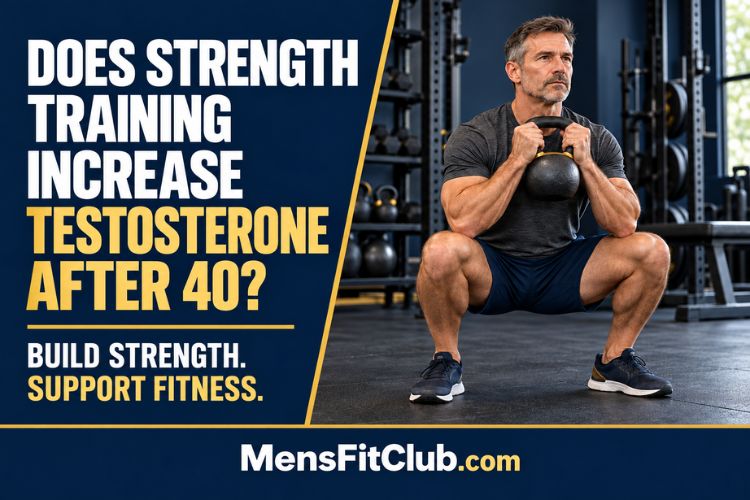
Does Strength Training Increase Testosterone After 40?

Are Drop Sets Better Than Straight Sets for Muscle Growth?

Rucking Workout for Men Over 50: Beginner Plan

Progressive Overload Calisthenics Without Weights
Does Strength Training Increase Testosterone After 40?
Turning 40 can change how you think about training. You may notice that recovery takes longer, your waistline grows more easily, or the energy you once brought to the gym feels harder to find. When these changes arrive together, testosterone often becomes the suspected explanation. That leads to a common question: does strength training increase testosterone after 40?
The answer requires a distinction. Resistance exercise can produce a temporary increase in testosterone around a workout, but regular lifting does not reliably create a large, lasting increase in resting testosterone. Its benefits remain valuable: stronger muscles, better physical function, and a practical way to support healthier body composition. These outcomes matter even when your hormone test barely changes.
For men over 40, the most useful approach combines consistent strength training with adequate recovery and attention to possible medical causes of symptoms. This guide explains the evidence, separates common myths from realistic expectations, and provides a manageable workout framework.
Does Strength Training Increase Testosterone After 40? The Short Answer
Strength training may increase testosterone temporarily after certain sessions. Whether your usual resting level rises over weeks or months is less predictable. A systematic review and meta-analysis focused on older men found that resistance training did not significantly increase basal testosterone overall. That finding challenges the popular promise that lifting heavy automatically restores youthful hormone levels.
This does not mean exercise has no role in hormonal health. Men differ in starting fitness, body weight, medical conditions, medications, and training history. Someone who becomes more active while addressing obesity may experience different changes from a lean, experienced lifter whose testosterone is already normal. However, an individual improvement is not proof that one particular workout directly raised testosterone.
Your training goal should therefore be broader than increasing a laboratory number. Building strength, improving daily movement, and maintaining muscle are meaningful outcomes on their own. Treat any hormone improvement as a possible benefit rather than the measure that determines whether the program worked.
Understanding Testosterone After 40
Age Is Only Part of the Picture
Testosterone contributes to sexual function, muscle maintenance, and bone health. Levels can decline with age, but men do not all follow the same pattern. Turning 40 does not create a sudden hormonal cliff, and being older does not automatically mean you have testosterone deficiency.
Body weight, illness, medications, and sleep disorders can also influence testosterone. The Endocrine Society identifies several of these factors among potential causes of low levels. This is why persistent symptoms deserve an assessment of your overall health rather than an assumption that aging alone explains them.
Total Testosterone and Free Testosterone Are Different
Total testosterone includes hormone circulating both bound to proteins and unbound. Free testosterone describes the unbound portion. A clinician may consider free testosterone when total testosterone is borderline or when changes in binding proteins make the total result harder to interpret.
Avoid comparing your result with a gym partner’s number without context. Laboratory methods, sampling time, symptoms, and individual health all affect interpretation. A higher number is not automatically a better outcome, and one result does not tell the full story of your strength, recovery, or health.
Temporary Testosterone Increases Versus Lasting Changes
What Happens Around a Strength Workout?
Some resistance sessions cause a short-lived rise in circulating testosterone. The response varies with the person and the workout, including the amount of muscle involved, training volume, and effort. An immediate post-workout measurement captures this temporary response rather than establishing your everyday baseline.
A brief hormonal rise should not be confused with a permanent increase in testosterone production. It also does not prove that a workout will build more muscle than another well-designed session. Measuring the largest short-term spike is a poor way to choose exercises or decide how long to rest.
Do Bigger Hormone Spikes Mean More Muscle?
Research in young men has examined whether exercise-induced hormone responses predict strength and muscle gains. One study found that the acute free-testosterone response was not associated with gains in lean mass or leg-press strength. Because the participants were younger, it cannot settle every question about men over 40, but it weakens the claim that bigger workout spikes necessarily produce better results.
For practical programming, prioritize a sufficient training stimulus, repeatable technique, and recovery. If you gradually perform more good-quality work, your program can be successful without producing a dramatic hormonal response. There is no need to shorten every rest interval or add exhausting sets simply to chase testosterone.
Why Strength Training Still Matters After 40
Build Strength and Maintain Useful Muscle
Strong legs help you climb stairs, rise from a chair, and carry heavy objects. A stronger upper body makes lifting, pushing, and pulling easier. These are direct reasons to train, regardless of whether your resting testosterone changes.
Training adaptations also involve skill and coordination. As you practice a movement, you learn to use your existing muscle more effectively. Later changes may include additional muscle tissue. Neither process requires you to document a large increase in circulating testosterone before progress can occur.
A year-long randomized trial in older men with low-normal testosterone compared testosterone treatment and placebo, with or without progressive resistance exercise. Among men who trained, additional testosterone did not improve strength or function compared with placebo, although body-composition outcomes differed. This specific result illustrates why strength progress and testosterone levels should not be treated as interchangeable.
Support a Healthier Body Composition
Strength training gives your muscles a reason to remain useful while you manage body weight. It complements nutrition and everyday activity, although lifting alone does not guarantee fat loss. Your food intake and overall energy expenditure still influence whether body weight rises, falls, or stays stable.
For men whose low testosterone is related to obesity, addressing excess body weight may improve the hormonal picture. The Endocrine Society notes that obesity-related hypogonadism can sometimes be reversible. Strength training can contribute to that broader effort, but a workout should not be presented as a guaranteed treatment for every cause of low testosterone.
The Best Strength Exercises for Men Over 40
Use Compound Movements for Efficient Training
Compound exercises involve several joints and muscle groups. Squats, presses, rows, and hip hinges allow you to cover much of the body with relatively few movements. Their practical advantage is training efficiency; they are not uniquely proven testosterone boosters.
Choose variations that match your experience and movement tolerance. A goblet squat may be easier to learn than a barbell back squat. A dumbbell press may feel more comfortable than a fixed barbell grip. A chest-supported row can reduce the demand on your lower back while you train your upper back.
Include Squat, Hinge, Push, and Pull Patterns
A balanced program should include a knee-dominant movement, a hip-dominant movement, an upper-body push, and an upper-body pull. Examples include a leg press, Romanian deadlift, incline dumbbell press, and cable row. Carries and controlled trunk exercises can round out the session.
There is no requirement to perform every classic barbell lift. Machines, dumbbells, resistance bands, and challenging bodyweight exercises can all serve a useful purpose. Select equipment that helps you train consistently and progress with control. The exercise you can perform well is more valuable than one you tolerate poorly because it has a reputation for boosting hormones.
How Often Should You Lift After 40?: Strength Training Increase Testosterone
Start With Two or Three Weekly Sessions
For a healthy beginner or returning lifter, two or three full-body workouts on nonconsecutive days are a practical starting point. This schedule provides repeated practice without requiring a daily gym commitment. It also leaves room for walking, other activities, and recovery.
Three sessions might fall on Monday, Wednesday, and Friday. If your schedule only supports two, use Monday and Thursday or another combination with recovery time between them. A program you complete regularly will usually serve you better than an ambitious schedule you repeatedly abandon.
Match Training Volume to Your Current Capacity
Start with roughly two working sets per exercise, especially if you have not trained recently. Add a third set selectively once the initial workload feels manageable. You do not need to begin with the maximum volume you might eventually tolerate.
Use your performance and recovery to guide changes. If your repetitions are improving, soreness settles, and joints feel comfortable, the workload may be appropriate. If fatigue accumulates and performance declines across several sessions, examine sleep, nutrition, life stress, and training demands before adding more work.
A Three-Day Strength Training Plan for Men Over 40
The following routine is an example for generally healthy men who can perform the movements comfortably. It is designed to build strength and train the major muscle groups, not to deliver a specific testosterone increase. Allow approximately 40–55 minutes per session, including your warm-up and rests.
Before lifting, spend five to eight minutes walking or cycling comfortably. Practice the first movements with light resistance, then gradually approach your working weight. Warm-up sets should prepare you rather than leave you tired before the main session begins.
Day One: Squat, Press, and Row
Perform a goblet squat for two or three sets of eight to ten repetitions. Follow it with a dumbbell bench press for two or three sets of eight to twelve repetitions and a chest-supported row for the same number of sets and repetitions. Keep each repetition controlled and use a range of motion you can manage comfortably.
Complete two sets of dumbbell Romanian deadlifts for eight to ten repetitions. Finish with two farmer carries lasting approximately 20–30 seconds each, using a clear walking space. If carrying is unsuitable, substitute a controlled trunk exercise such as a dead bug. Rest approximately two minutes after demanding sets, taking longer if needed to maintain technique.
Day Two: Hinge and Vertical Pull
Begin with two or three sets of a familiar hip-hinge exercise for six to ten repetitions. Options include a kettlebell deadlift or an elevated dumbbell deadlift. Choose the version you can perform with a stable trunk and controlled movement; lifting from the floor is not compulsory.
Add a lat pulldown for two or three sets of eight to twelve repetitions, then an incline push-up or machine chest press for the same prescription. Perform two sets of supported split squats for six to ten repetitions per leg. End with two comfortable sets of a Pallof press, maintaining normal breathing throughout.
Day Three: Balanced Full-Body Training
Use a leg press or another comfortable squat variation for two or three sets of eight to twelve repetitions. Follow with a seated cable row and a shoulder-friendly dumbbell or landmine press, each for two or three sets of eight to twelve repetitions. An incline chest press can replace overhead pressing if necessary.
Finish with two sets of glute bridges for ten to fifteen repetitions and a short carry or trunk exercise. Keep this session within your recovery capacity. The aim is another productive exposure to strength training, not a weekly test of how exhausted you can become.
Choose Weight and Progress Without Chasing Hormones
Leave a Few Repetitions in Reserve
Select a weight that makes the final repetitions challenging while leaving approximately two or three good repetitions available. This is often called repetitions in reserve. A set should require effort, but you should not need to twist, bounce, or dramatically change position to finish it.
Beginners may find effort difficult to judge, so start conservatively. Gradually increase resistance as the movement becomes familiar. You can build a productive routine without reaching muscular failure on every set, and repeated failure may make the next session harder to recover from.
Use a Simple Progression Rule
Suppose an exercise calls for eight to twelve repetitions. Begin with a weight you can lift for eight controlled repetitions. Over subsequent sessions, build toward twelve while keeping a similar effort level. When all prescribed sets reach twelve with sound technique, increase the load by the smallest practical amount.
Return toward the lower end of the repetition range after increasing weight. Progress may slow or pause during stressful weeks, which is normal. Keeping a short record of exercises, loads, repetitions, and effort will reveal useful trends without turning every workout into a hormone experiment.
Recovery Habits That Support Training and Health
Give Sleep a Consistent Place in Your Schedule
Plan enough time for sleep and keep bedtime reasonably consistent. Avoid repeatedly sacrificing sleep to fit in another workout. If late training leaves you too alert to settle down, move the session earlier or make evening sessions less demanding.
The testosterone response to sleep restriction is more complicated than popular headlines suggest. Some small studies report reductions, while other randomized studies in young men found no significant reduction under their protocols. Neither finding establishes a guaranteed hormone benefit from adding a particular number of sleep hours after 40. Sleep remains worth prioritizing for recovery and daily functioning.
Eat Enough to Support the Work: Strength Training Increase Testosterone
Build meals around protein-containing foods, vegetables or fruit, useful carbohydrate sources, and dietary fats. Examples include fish with potatoes and vegetables, chicken with rice and beans, or yogurt with oats and fruit. A sustainable eating pattern should support training rather than leave you chronically depleted.
If fat loss is appropriate, choose an approach that allows you to keep training and functioning well. Combining aggressive restriction with rapidly increasing exercise creates competing demands. No single food or meal schedule reliably corrects testosterone deficiency, and extreme dieting should not be mistaken for a hormone-supporting strategy.
Adjust During Demanding Weeks
Work stress, travel, and poor sleep can temporarily reduce what you can recover from. On those weeks, maintain the habit while reducing the workload. You might perform two sets instead of three or keep the load lighter and concentrate on technique.
An occasional easier week is a programming choice, not evidence that your testosterone has fallen. Persistent tiredness has several possible explanations. Avoid diagnosing hormonal problems from soreness, one weak workout, or a temporary loss of motivation.
Can Too Much Strength Training Exercise Lower or Increase Testosterone?
Excessive exercise and inadequate nutrition can be associated with temporarily lower testosterone, according to the Endocrine Society. That does not mean ordinary strength training is harmful or that a hard workout automatically suppresses your hormones. Context matters, including the workload, food intake, and recovery available.
Watch for a pattern of deteriorating performance, persistent fatigue, and difficulty recovering. These observations are reasons to review your routine, not proof of low testosterone or overtraining syndrome. Reduce unnecessary work, restore regular meals and sleep, and seek medical advice when symptoms continue despite sensible adjustments.
Strength Training, Cardio, and Testosterone Increase
Cardio can fit alongside lifting without requiring you to choose one form of exercise for hormonal reasons. Walking, cycling, and swimming provide additional ways to stay active. Select activities you enjoy and can repeat, then adjust their duration around the recovery demands of your strength sessions.
Start with comfortable walking on several nonlifting days. If you add harder intervals, increase them gradually and observe how your legs recover. Men returning to exercise do not need intense interval sessions to make their program worthwhile. There is no established requirement to use HIIT to obtain a testosterone benefit after 40.
When Should You Get Testosterone Checked?
Persistent Symptoms Deserve Medical Attention
Ongoing loss of sexual desire, reduced spontaneous erections, unexplained changes in muscle or bone health, or persistent fatigue can justify a discussion with a healthcare professional. These symptoms are not specific enough to diagnose low testosterone by themselves.
The Endocrine Society recommends diagnosing testosterone deficiency only when compatible symptoms and consistently low levels occur together. It recommends repeating a morning, fasting total-testosterone measurement to confirm the finding and investigating the cause when deficiency is identified. Routine screening of all men simply because they have reached a certain age is not recommended.
Exercise Complements Appropriate Treatment
Strength training cannot be expected to correct every testicular, pituitary, medication-related, or other medical cause of low testosterone. If testing confirms deficiency, treatment should follow an individualized evaluation. Testosterone therapy also requires discussion of risks, monitoring, and fertility plans; it is not a routine upgrade for anyone who wants better gym results.
Continue viewing exercise as part of your overall health plan. A clinician can help you decide whether symptoms require additional investigation and whether any training modifications are appropriate. Waiting for a workout to fix an underlying medical problem can delay useful care.
FAQ About Can Strength Training Increase Testosterone
Do Squats and Deadlifts Boost Testosterone More Than Machines?
Large-muscle exercises can produce temporary hormonal responses, but this does not establish that squats and deadlifts create superior resting testosterone levels. Machines can help you train hard with a manageable learning curve. Choose movements based on your goals, technique, and comfort rather than a promise of hormonal superiority.
How Long Does It Take to Increase Testosterone Through Strength Training?
There is no dependable timeline because a lasting increase may not occur. You may improve coordination, repetitions, or strength before noticing visible body changes. Track these outcomes over several weeks. If symptoms suggest deficiency, arrange medical evaluation instead of waiting for an arbitrary eight- or twelve-week deadline.
Can You Build Muscle If Testosterone Is Low-Normal?
Low-normal testosterone does not automatically prevent training progress. Consistent resistance exercise can still be worthwhile. However, confirmed deficiency accompanied by symptoms needs medical attention. Do not assume that struggling to gain muscle proves a hormone problem; training quality, food intake, and recovery also deserve review.
Strength Training After 40 With Realistic Testosterone Increase Expectations
Does strength training increase testosterone after 40? It may produce temporary increases, and broader health improvements may help some men, but lifting does not guarantee a lasting rise in resting levels. Its value extends well beyond testosterone.
Begin with a manageable schedule, train the major movement patterns, and add repetitions or resistance gradually. Support the work with regular meals and adequate recovery. Assess success through stronger lifts, easier daily activity, and a routine you can maintain. When persistent symptoms raise concern about low testosterone, combine that routine with proper medical evaluation.
To put the training advice in this testosterone guide into practice, explore our Best Compound Lifts For Men Over 40 and follow the 3 Day Barbell Strength Workout Program For Men Over 40. During busy weeks, use our Minimum Effective Dose Strength Training Guide to keep workouts manageable. Complement lifting with the Barbell Strength And Zone 2 Cardio Weekly Workout Plan, and read How To Build Strength For Longevity for a broader approach to maintaining muscle, recovery, and long-term fitness.


Most Recommended

Subscribe to our Newsletter
Stay up to date on the latest men’s health, fitness and lifestyle trends and tips.
About Us
Men’s Fit Club was started with the goal of empowering men to get the most out of their lives. This meant going beyond exercise and diet tips to really address the broad range of issues that men face on a daily basis – topics like recreation, finding love, sexual health and even sound fashion advice.
Quick Links
© COPYRIGHT MEN'S FIT CLUB 2026. All Rights Reserved