
Shoulder Mobility Workout for Bench Press: A Practical Warm-Up
Barbell Workout for Men With Limited Gym Time | MensFitClub

How Men Can Layer Cologne Deodorant and Body Wash
Dumbbell Workout Without a Bench Full-Body Plan
A bench can be useful, but it is not required for a serious dumbbell workout. With a pair of dumbbells and enough floor space to lie down and stand comfortably, you can train your legs, chest, back, shoulders, arms, and core. The key is to choose movements that cover the major patterns, use a challenging weight, and make the sessions progressively harder over time.
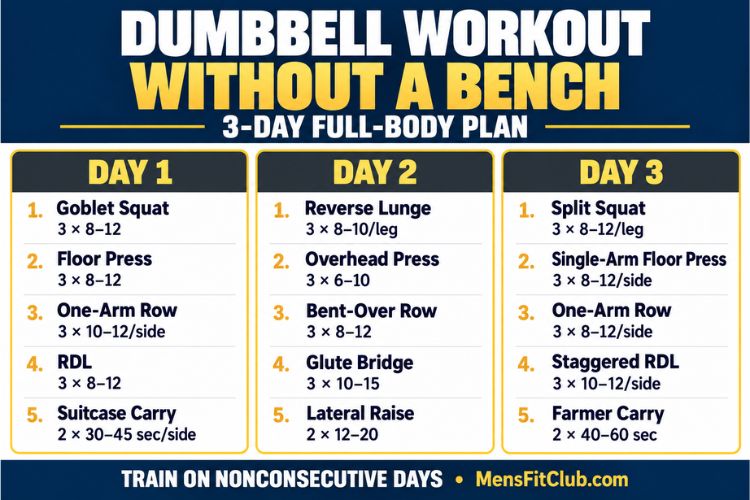
This dumbbell workout without a bench gives you three full-body sessions per week. Each day has a squat or lunge, a hip hinge, an upper-body push, an upper-body pull, and focused core or carry work. You will also find a shorter option, exercise substitutions, and clear guidance for making progress when your dumbbell selection is limited. Whether you train in an apartment, a spare room, or a small corner of a gym, the plan is designed to be practical without making equipment the limiting factor.
Can You Build Muscle With Dumbbells and No Bench?
Yes. Muscles respond to sufficient effort, useful range of motion, repeated training, and recovery; they do not require a specific piece of furniture. Floor presses train the chest and triceps, standing presses train the shoulders, and rows train the back. Squats, split squats, lunges, Romanian deadlifts, and bridges give your lower body plenty of work. The main challenge is selecting loads and variations that bring you close enough to a demanding set while preserving good form.
A floor press does have a shorter bottom range than a bench press because your upper arms stop at the floor. That is a real difference, especially if you want to practice the exact bench-press movement. For a general home strength and muscle plan, however, the floor press is a valuable pressing exercise. Pair it with an overhead press and train your pulling and leg movements consistently. If you have a particular sport or bench-press goal, add specific practice when you have access to appropriate equipment.
For most working sets in this plan, aim to finish with roughly one to three good repetitions left. If you could easily do another eight reps, the set is unlikely to be challenging enough for the stated range. If your form breaks halfway through, lower the load or shorten the set. You do not need to push every exercise to failure, especially when learning a new movement.
What You Need Before You Start no Bench Dumbbell Workout
You need one or two dumbbells, a clear non-slip floor, and shoes or flooring that let you stand securely. Adjustable dumbbells are convenient, but fixed dumbbells work as well. A mat can make floor exercises more comfortable. Keep enough clearance above and around you for overhead movements, and move breakable items away from the training area. Never press a dumbbell beneath a ceiling fan or low fixture.
Choose weights according to the exercise rather than expecting one pair to feel equally challenging everywhere. A weight that is appropriate for rows may be too heavy for lateral raises and too light for a two-legged squat. If you own only one pair, unilateral exercises, slower lowering phases, pauses, and higher rep ranges help bridge that gap. Do not make a weight harder by rushing or turning a controlled lift into a swing.
A Five-Minute Warm-Up
Start with one minute of easy marching or walking, then perform eight bodyweight squats, eight unloaded hip hinges, five reverse lunges per side, eight arm circles in each direction, and six slow repetitions of a standing reach and gentle trunk rotation per side. Do one light practice set of the first two exercises before your working sets. The goal is to feel prepared and establish the movement, not to become tired before training.
If you are returning after a long layoff, begin with fewer sets and lighter weights for the first week. Sharp pain, dizziness, or unusual symptoms are reasons to stop the session and seek appropriate professional advice. Normal muscle effort should feel different from joint pain.
The Three-Day Dumbbell Workout Without a Bench
Train on nonconsecutive days, such as Monday, Wednesday, and Friday. Allow at least one day between sessions. The prescribed rep ranges are targets for each set; choose a load that lets you keep the same basic technique through the last repetition. Rest 90 to 120 seconds after demanding squats, hinges, rows, and presses, and 45 to 75 seconds after lighter accessory or core work. Take more time when breathing or form needs it.
Day 1: Squat, Floor Press, and Row
Goblet squat — 3 sets of 8 to 12 reps. Hold one dumbbell vertically against your chest, set your feet at a comfortable width, and sit down between your hips. Keep your full foot grounded and stand tall without leaning backward at the top. If the dumbbell is light, lower for three seconds and pause briefly at the bottom. Stop the descent where you can retain control and a comfortable back position.
Dumbbell floor press — 3 sets of 8 to 12 reps. Sit on the floor with the dumbbells close to your hips, then carefully roll back and bring the weights above your chest. Bend your knees and plant your feet. Lower your elbows until the backs of your upper arms touch the floor gently, pause without bouncing, then press upward. A neutral grip, with palms facing each other, is comfortable for many lifters. Bring the weights down under control and roll to your side before standing.
One-arm dumbbell row — 3 sets of 10 to 12 reps per side. Take a staggered stance and support your free hand on your thigh. Hinge until your torso is inclined, keep your spine comfortable and steady, and pull the dumbbell toward your hip. Lower it slowly without twisting your shoulders to lift the weight. Your supporting leg and hand provide stability; a bench is unnecessary. Finish all reps on one side before changing sides.
Dumbbell Romanian deadlift — 3 sets of 8 to 12 reps. Hold the weights at your sides or slightly in front of your thighs. Soften your knees, move your hips back, and lower the weights close to your legs. Stop when you feel a strong hamstring stretch and can still keep your back position. Stand by driving through your feet and bringing your hips forward. This is a hinge, so avoid turning each repetition into a deep knee bend.
Suitcase carry or suitcase hold — 2 sets of 30 to 45 seconds per side. Hold one dumbbell at your side and stand tall without leaning toward or away from it. Walk slowly if you have a clear, safe path; otherwise hold still. Breathe normally and keep your shoulders level. This finishes the day with grip and trunk work without requiring another station or piece of equipment.
Day 2: Lunge, Overhead Press, and Posterior Chain no Bench Dumbbell Workout
Reverse lunge — 3 sets of 8 to 10 reps per leg. Hold the dumbbells by your sides, step backward, and lower under control. Keep most of your pressure through the front foot, then return to standing. Choose a stride that lets both knees bend comfortably. For balance, start without weights or hold a single dumbbell close to your chest. Alternate legs or complete one side before the other.
Standing dumbbell overhead press — 3 sets of 6 to 10 reps. Start with the weights near shoulder height, brace your midsection, and press overhead through a comfortable path. Finish with the weights stacked over your shoulders and hips rather than arching hard through your lower back. Lower with control. If ceiling height is limited, use a half-kneeling single-arm press where there is adequate clearance, or repeat the floor press instead.
Bent-over dumbbell row — 3 sets of 8 to 12 reps. Hold one weight in each hand, bend slightly at the knees, and hinge until your torso is inclined. Pull your elbows back while keeping your trunk stable, then lower the weights fully. Use a lighter pair than you would for a one-arm row if your position starts to change during the set. You should feel your back working without repeatedly jerking your torso upright.
Dumbbell glute bridge — 3 sets of 10 to 15 reps. Lie on your back with your knees bent and feet flat. Place one dumbbell securely across the front of your hips, holding it with both hands. Lift your hips until your torso and thighs form a comfortable line, pause for a second, then lower with control. Avoid throwing the weight onto your pelvis. A folded towel can add comfort; if setup is awkward, perform an unweighted single-leg bridge instead.
Dumbbell lateral raise — 2 sets of 12 to 20 reps. With light weights and slightly bent elbows, lift your arms out to the sides to about shoulder height, then lower slowly. Keep your neck relaxed and do not swing the dumbbells. If your lightest pair is too heavy, skip this movement and add a controlled set of overhead presses with a suitable weight when available.
Day 3: Single-Leg Strength and Full-Body Finish
Dumbbell split squat — 3 sets of 8 to 12 reps per leg. Set one foot forward and one back, with enough width between them to balance. Lower straight down and rise through the front foot. Keep the range of motion comfortable and the front knee tracking with your toes. Start with bodyweight or a single dumbbell if two weights make balance difficult. Split squats can make modest dumbbells challenging without needing a bench for rear-foot elevation.
Single-arm dumbbell floor press — 3 sets of 8 to 12 reps per side. Set up as you would for the regular floor press, with your nonworking arm out to the side for balance. Keep your ribs and hips steady while pressing. Use a weight you can bring safely into and out of position. If a single heavy dumbbell pulls you out of alignment, use a lighter weight or perform the two-arm version again.
One-arm dumbbell row — 3 sets of 8 to 12 reps per side. Repeat the supported staggered-stance position from Day 1. Pause briefly at the top and take two to three seconds to lower each rep. This deliberate tempo makes a lighter dumbbell more useful and helps you distinguish back work from body momentum.
Staggered-stance Romanian deadlift — 3 sets of 10 to 12 reps per side. Place one foot slightly behind the other as a kickstand, with most of your weight on the front leg. Push your hips back while keeping both hips roughly square. The rear foot helps you balance, but the front leg does most of the work. Change sides after the set. This is a practical step toward single-leg strength without demanding perfect one-leg balance.
Farmer carry or march — 2 sets of 40 to 60 seconds. Hold a dumbbell in each hand and walk along a clear path, or march slowly in place. Stand tall, keep your ribs over your pelvis, and use steady steps. If your grip fails before your trunk or legs feel challenged, reduce the time and build it gradually. This is a simple way to finish the week with loaded posture and conditioning.
How to Make the no Bench Dumbbell Workout Fit Your Schedule
Each full session should take roughly 35 to 50 minutes, depending on how much rest you need and whether you use one or two dumbbells. If you have only 20 minutes, complete the first three exercises of the scheduled day for two or three sets each. Those movements cover a lower-body pattern and an upper-body push and pull. On the next workout, resume the usual schedule instead of trying to make up every missed accessory set.
Two sessions per week can also work. Rotate through Days 1, 2, and 3 in order rather than always skipping the third day. For example, complete Days 1 and 2 in week one, Days 3 and 1 in week two, and Days 2 and 3 in week three. This keeps the different movements in your training over time. On a four-day schedule, repeat the cycle only if recovery and time allow, and keep at least one easier day between hard full-body sessions.
A Beginner Version
For your first two weeks, do two sets of each main exercise and one set of each carry or lateral raise. Use the lower end of every rep range and stop with around three to four reps in reserve. Practice the setup and the exit from the floor press with a light weight before making that lift challenging. Once the movement feels predictable and you recover comfortably, add the third set to the major exercises.
If doing five exercises in one session feels like too much, use four: a squat or lunge, a hinge, a press, and a row. This simple combination still trains the entire body. A consistent smaller workout is more productive than an elaborate routine that you cannot complete regularly.
How to Progress With Limited Dumbbell Weights
Use double progression. Start at the low end of the listed rep range with a weight you can control. Over subsequent sessions, add a rep to one or more sets while keeping the same form and rest periods. When you can reach the top of the range on every set with one to three reps still available, increase the weight at your next session and return to the lower end. For example, a floor press might progress from three sets of eight to three sets of twelve before you move to heavier dumbbells.
When the next pair is too heavy, progress in smaller ways. Add one rep to just the first set, extend the lowering phase to about three seconds, or pause for one second in the hardest controlled position. You can also switch from a two-leg squat to a split squat or from a two-leg hinge to a staggered-stance hinge. Make one change at a time so you can tell whether you are improving. Additional difficulty should come from cleaner, more demanding work, not from shortened rests that leave you too breathless to lift well.
Write down the date, exercise, weight, sets, and reps. A brief note about how many more good reps you could have completed will help you judge effort. After four to six weeks, review whether your reps, load, range of motion, or control have improved. If every set feels increasingly hard and your performance falls for several sessions, reduce a set or take a lighter week before building again.
What if Your Dumbbells Are Too Light?
Prioritize single-leg lower-body movements, one-arm presses and rows, deliberate lowering, and rep ranges of roughly 12 to 20 where appropriate. For a goblet squat that is very easy at 12 reps, a split squat with the same weight may provide a meaningful challenge. For upper-body lifts, controlled repetitions and short pauses can improve the quality of the set, although they cannot replace heavier weights indefinitely. If you regularly finish 20 or more technically sound reps and still have plenty left, a heavier dumbbell will make continued strength work easier to program.
Recovery and Results no Bench Dumbbell Workout
Train regularly, eat enough to support your goal, and allow time between demanding sessions. If building muscle is your priority, adequate overall food intake and protein help support training. If fat loss is your priority, nutrition largely determines the calorie deficit while strength training helps you retain muscle. Neither outcome depends on owning a bench. Sleep and manageable training volume matter as you increase the difficulty of the workouts.
Expect early improvements in coordination and confidence with the movements. Visible changes generally require sustained training over many weeks and vary with your starting point, food intake, and recovery. Compare your training log every month instead of judging one workout. A bench-free plan is effective when you can keep showing up and gradually do more quality work.
Related MensFitClub Workouts
For more bench-free training ideas, try this 30-minute dumbbell chest routine without a bench to expand your floor-press work. When time is tight, the 28-minute full-body dumbbell home workout offers another compact session. For a different three-day structure, see the full-body dumbbell workout plan. You can also use the 30-minute dumbbell muscle-building workout for more floor-press and hypertrophy ideas, or add focused leg work from the 30-minute lower-body dumbbell workout.
Put the Plan Into Practice
A useful dumbbell workout without a bench does not need a long list of clever exercises. Squat or lunge, hinge, press, row, and carry on a repeatable schedule. Use the three days above for the next four to six weeks, track the loads and reps, and increase the challenge when you can complete your sets with solid form. Your progress will come from the work you repeat, not from the bench you do not have.


Most Recommended

Subscribe to our Newsletter
Stay up to date on the latest men’s health, fitness and lifestyle trends and tips.
About Us
Men’s Fit Club was started with the goal of empowering men to get the most out of their lives. This meant going beyond exercise and diet tips to really address the broad range of issues that men face on a daily basis – topics like recreation, finding love, sexual health and even sound fashion advice.
Quick Links
© COPYRIGHT MEN'S FIT CLUB 2026. All Rights Reserved