


Sled-Free HYROX Workout Without Equipment at Home

Barbell Contrast Training Workout for Explosive Power

Kettlebell Clean and Press EMOM Workout for Strength
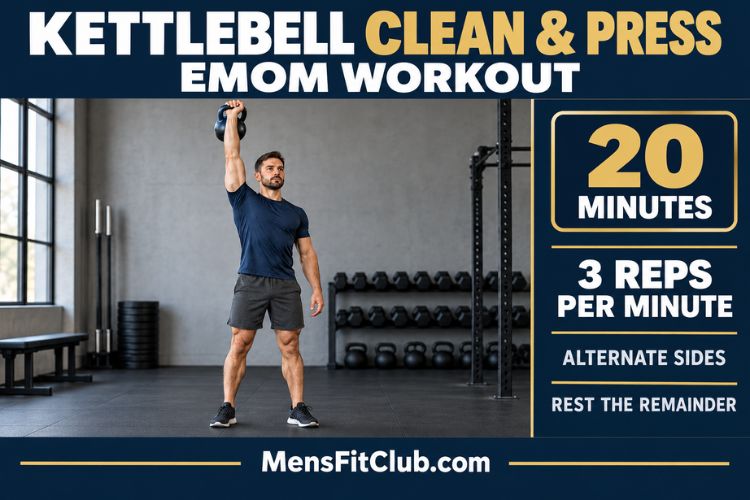
A kettlebell clean and press EMOM workout brings structure to one of the most useful combinations in kettlebell training. You move the bell into the rack position, press it overhead, and repeat a small number of controlled repetitions before resting. When the next minute begins, you start again. The format makes a short workout easy to follow while giving you clear information about your strength, technique, and ability to recover between sets.
For men training at home or working around a busy schedule, that simplicity matters. One kettlebell, enough overhead clearance, and an interval timer can support a productive session. However, the goal is not to squeeze as many repetitions as possible into every minute. The best version uses a manageable load, consistent technique, and enough rest to keep the last set looking like the first.
This guide explains how to perform the movement, choose your weight, and use a practical 20-minute routine. You will also find easier and harder variations, a four-week progression, and advice for fitting the session into a balanced training week. The sample programs are coaching templates rather than a research-tested protocol, so adjust them to your experience and recovery.
What Is a Kettlebell Clean and Press EMOM Workout?
EMOM stands for every minute on the minute. At the beginning of each minute, you perform a prescribed task and then rest for whatever time remains. If your set takes 20 seconds, you have approximately 40 seconds before the next interval. If it takes 35 seconds, your rest drops to approximately 25 seconds. Work and rest therefore depend on your repetition speed as well as the target itself.
In this kettlebell EMOM, the task is a small set of single-arm clean and presses. Odd-numbered minutes train the left arm, and even-numbered minutes train the right arm. Each side receives a new set every two minutes. This arrangement gives the pressing muscles on one side a longer break while the body still performs work at the beginning of every minute.
What Counts as One Repetition?
For this article, one repetition means one clean into the rack, one strict overhead press, and a controlled return to the rack. Between repetitions, lower the kettlebell into the backswing and clean it again. After the final repetition, park the bell safely on the floor. Clean before every press; do not clean once and perform several presses unless you deliberately choose that separate variation.
A strict press uses shoulder and arm strength without a knee dip to launch the bell upward. A push press adds leg drive. Both can be useful, but they create different demands. Keep the strict press as the standard throughout this plan so your training log compares the same movement from session to session.
Why Use the Kettlebell Clean and Press in an EMOM?
The clean and press combines an explosive hip-driven action with a controlled overhead lift. The clean challenges coordination and your ability to receive the bell smoothly. The press demands upper-body strength and a stable standing position. Linking the two movements provides a compact training option, especially when you have limited equipment and want a session with a clear beginning and end.
The timer also helps control your tendency to rush. Once you complete the planned repetitions, the job is to recover. You do not need to fill the remaining seconds with swings, push-ups, or extra presses. Preserving those breaks makes the workout repeatable and allows you to notice when fatigue begins affecting your performance.
A Useful Format for Tracking Progress
An EMOM gives you several practical measures: kettlebell weight, repetitions per interval, completed minutes, and approximate rest remaining. You can improve by completing the same work more confidently, adding a small amount of volume, or eventually moving to a heavier bell. These measures are more useful than judging success only by sweat or exhaustion.
Strength Work With a Conditioning Demand
Repeated cleans and presses can raise your breathing rate, particularly as the session continues. However, feeling winded does not automatically make the workout a complete cardiovascular program or a specific HIIT protocol. Shoulder strength may limit you before your cardiovascular system does. Use walking, cycling, running, or another appropriate aerobic activity alongside strength training when broader fitness is your goal.
Muscles Worked by the Kettlebell Clean and Press Emom
The clean uses the hips and legs to generate momentum while the trunk helps control the movement. During the press, the shoulders and triceps produce much of the overhead action. Your grip holds the handle, and your trunk works to resist unwanted bending and rotation under an uneven load. The upper back and shoulder girdle also help control the bell throughout its path.
This broad involvement makes the movement efficient, but it does not train every muscle equally. The strict press often determines the usable kettlebell weight, which can leave the lower body relatively underloaded. Keep squats, a more challenging hinge, and rows or pull-ups in your wider program. A full-body movement can be valuable without replacing every other exercise.
Who Should Try This Kettlebell Clean And Press EMOM Workout?
This routine suits lifters who can already perform a smooth single-arm clean and a pain-free strict press. You should be comfortable holding the rack, lowering the bell, and placing it back on the floor without losing control. Experience with a kettlebell deadlift and swing helps establish the hinge mechanics used in the clean.
New lifters can work toward this routine by practicing the parts separately. Learn the hinge first, then the clean, then the press from a stable rack. ACE includes the clean and press in its exercise library as an advanced movement, which supports treating technique practice as a prerequisite rather than learning it under time pressure.
Adjusting the Session for Men Over 40 or 50
Age alone does not determine your kettlebell weight or repetition target. Current strength, shoulder comfort, training history, and recovery matter more for daily programming. An experienced older lifter may handle the standard session comfortably, while a younger beginner may need a shorter introduction. Start conservatively after a layoff and let consistent performance guide progression.
If overhead pressing causes pain, stop that movement instead of forcing the bell upward. A qualified coach can assess technique, and persistent symptoms warrant appropriate clinical guidance. Stop the workout for dizziness, chest discomfort, or unusual shortness of breath. These are reasons to address the problem, not signals to push through an interval.
How to Choose Your Kettlebell Weight For Clean Press EMOM
Choose the bell according to your strict press on the weaker side. A weight you can swing easily may still be too heavy to press repeatedly with control. Before attempting the full session, perform a few untimed clean and press sets with generous rest. Check that the catch is smooth, the wrist stays aligned, and the press finishes without excessive backward lean.
For the standard three-repetition intervals, begin with a load that leaves approximately two or three additional clean repetitions available in an isolated set. That is only a starting estimate; repeated intervals create accumulating fatigue. The final minutes should still leave you short of failure. If you regularly grind the third repetition, reduce the weight or use two repetitions per interval.
Let Rest Time Help You Judge the Load
Aim to complete the assigned repetitions in roughly 15 to 25 seconds without rushing. This leaves approximately 35 to 45 seconds before the next minute. Your exact cadence may differ, but repeated sets taking more than 30 seconds are a useful signal to reassess. Reduce repetitions, choose a lighter bell, or add recovery minutes if the session becomes hurried.
There is no universal starting weight for all men. Kettlebells also often increase in relatively large jumps, so the next available bell may represent a substantial increase in pressing difficulty. Adjustable kettlebells can make progression easier, but with fixed weights you can build consistency and volume before changing load.
Kettlebell Clean And Press EMOM Technique
Practice technique without the timer before using it in an EMOM. Your setup should give the bell a clear path and allow your feet to remain planted. Keep the training area free of furniture, pets, and other obstacles. Check overhead clearance with a light practice repetition, including any ceiling fans or hanging fixtures.
Perform a Smooth Clean
Use a stable stance and hinge at the hips to initiate the clean. Drive through the hips while guiding the kettlebell close to your body. Let your hand move around the handle as the bell settles into the rack rather than allowing the bell to flip over and strike the forearm. Receive the weight quietly with the elbow near your torso.
Pause briefly in the rack before pressing. The handle should sit securely in your hand, with the wrist close to neutral and the bell supported against the forearm. Avoid treating the clean like a slow biceps curl. A smooth hip-driven clean should position the bell efficiently so the press begins from a controlled base.
Press With a Stable Trunk
Stand tall, brace your midsection, and press the kettlebell overhead through a comfortable path. Keep the legs still for the strict version. Finish with a straight elbow and the weight balanced above your base of support. Allow the shoulder blade to move naturally upward; do not force the shoulder down while reaching overhead.
If the press requires a large backward lean, you have likely exceeded your current strength or movement capacity for that repetition. Lower the bell with control and reduce the demand. The overhead finish should feel balanced, with the trunk supporting the load rather than compensating through an exaggerated lower-back arch.
Lower and Reset With Control
Return the kettlebell to the rack before initiating the next clean. Guide it into the backswing with a hinge instead of letting it pull you forward unexpectedly. After the last repetition, park the weight safely. Switch hands while the bell is resting on the floor rather than attempting a rushed airborne transfer between intervals.
Use a breathing rhythm that supports bracing without holding your breath through an entire multi-repetition set. Reset between repetitions as needed. Once the bell is parked, take a few relaxed breaths and prepare for the next side. Consistent breathing can help you recognize when the assigned pace is becoming too demanding.
Warm Up Before the EMOM
Allow about six to eight minutes for a progressive warm-up. Begin with comfortable marching or walking, followed by unloaded hip hinges and easy squats. Add controlled shoulder movements and overhead reaches within a comfortable range. The purpose is to prepare the positions you need, not to exhaust your legs or shoulders before the main work.
Move into light kettlebell deadlifts, then practice a few cleans on each side. Perform one or two easy presses per arm and finish with a brief rehearsal of the planned interval. Take a short break before starting the main timer. If the rehearsal already feels strenuous, adjust your weight or repetition target before committing to 20 minutes.
The 20-Minute Kettlebell Clean and Press EMOM Workout
Set your interval timer for 20 one-minute rounds. On minute one, perform three clean and presses with the left arm, park the bell, and rest. On minute two, perform three with the right arm, park the bell, and rest. Continue alternating sides through minute 20. Clean before every press and keep the press strict throughout.
The completed session contains 10 sets per arm. At three repetitions per set, that equals 30 clean and presses per side, or 60 total repetitions. Warm-up and cooldown time are additional, so plan approximately 30 minutes for the complete session. This is substantial pressing volume; choose your weight with that total in mind.
Minutes 1 Through 6: Establish Your Rhythm
Treat the early intervals as a check on your preparation. Each clean should settle smoothly, and each press should follow a similar path. Finish with plenty of rest remaining. If the first few sets already demand near-maximal effort, drop to two repetitions immediately or use a lighter bell rather than waiting for technique to deteriorate.
Minutes 7 Through 14: Keep the Same Standard
The middle intervals test whether your opening pace was sustainable. Resist adding repetitions because one set feels easy. Keep the target fixed and monitor the weaker arm. If it begins taking longer to finish, match both sides to the lower sustainable target. Balanced quality matters more than squeezing extra work from your stronger side.
Minutes 15 Through 20: Finish With Control
The closing intervals should remain deliberate. Some increase in effort is normal, but failed presses, harsh catches, or loss of balance indicate that the session needs to end or be reduced. Completing 16 good minutes is more useful than forcing four poor ones. Record the change so you can choose a better starting target next time.
Easier and Harder EMOM Variations
The standard workout is a starting option, not a requirement. Change one variable at a time so you can understand how it affects performance. Adjusting repetitions, duration, recovery, and load simultaneously makes the session harder to evaluate and can create an unexpectedly large jump in fatigue.
Easier Version: 12 Minutes With Two Repetitions
Alternate two left-arm repetitions and two right-arm repetitions for 12 minutes. This provides six sets and 12 repetitions per side, or 24 total. Use it when introducing the format after mastering the movement, returning from a break, or testing a new bell. Build toward 16 minutes before considering the full 20-minute session.
Recovery Version: Add a Rest Minute
Use a three-minute cycle: two or three left-arm repetitions, the same number on the right, then a full minute of rest. Repeat the cycle five times for 15 minutes. Each arm receives five sets. This format preserves regular starts while giving your whole body a longer recovery break after every pair of working intervals.
Advanced Version: Increase the Load Before Chasing Fatigue
Experienced lifters can try a heavier bell with two strict repetitions per minute over 12 to 16 minutes. Confirm that the new load is manageable in untimed sets first. The goal is stronger, clean repetitions with ample rest. Double-kettlebell clean and press work requires its own technique preparation and should be treated as a separate progression.
A Four-Week Kettlebell Clean And Press EMOM Progression
Perform this progression twice weekly, leaving at least one non-pressing day between sessions. Keep other overhead work modest while learning how you recover. Repeat a week when technique, sleep, or general fatigue suggests that advancing would be premature. The calendar gives structure, but it does not require you to increase difficulty every seven days.
Week 1: Establish Consistent Repetitions
Complete 12 minutes with two repetitions on alternating sides. Each session provides 12 repetitions per arm. Focus on smooth catches and repeatable presses. Choose a load that makes every interval comfortable enough to finish with generous rest, and write down any difference between sides.
Week 2: Extend the Session
Keep the same bell and two-repetition target, but extend the workout to 16 minutes. Each arm receives eight sets and 16 total repetitions. This increases the duration without changing the difficulty of an individual set. Return to 12 minutes if the added intervals create persistent soreness or poorer performance elsewhere.
Week 3: Reach Twenty Minutes
Continue with two repetitions per interval for 20 minutes. That produces 20 repetitions per side. Look for stable completion times and good control through the final pair of sets. You are building tolerance to repeated work, so there is no need to introduce heavier weight at the same time.
Week 4: Add Repetitions Selectively
Keep the 20-minute timer. Perform three repetitions in the first four intervals, then two in the remaining 16. Each arm receives two sets of three and eight sets of two, totaling 22 repetitions per side. This modest increase is easier to assess than moving every interval from two to three immediately. Add further three-repetition intervals gradually in later weeks.
Can This Workout Build Muscle and Support Fat Loss?
A clean and press EMOM can contribute to muscle-building training when the load challenges you, the weekly work is appropriate, and progression continues over time. However, easy sets performed far from failure may function mainly as practice and work-capacity training. The format itself does not guarantee hypertrophy. Dedicated strength sets and other exercises may better address muscles that this workout underloads.
For fat loss, the session adds physical activity and can help maintain a strength-training habit. Changes in body fat depend on your overall energy balance over time. Avoid assigning a guaranteed calorie burn to the workout; body size, load, pace, and conditioning all affect the result. Use the session alongside sustainable eating habits and regular movement rather than treating it as permission to ignore either.
Common Kettlebell Clean And Press EMOM Mistakes and Weekly Scheduling
The most common programming mistake is removing the rest that makes the workout manageable. Extra repetitions, added exercises, and faster cleans can turn a controlled EMOM into continuous fatigue. Another mistake is changing to a push press halfway through while recording the workout as strict pressing. Reduce repetitions instead, and keep your log accurate.
A practical week could place the EMOM on Monday and Thursday, with squats, rows, and a suitable hinge on Tuesday or Saturday. Include comfortable aerobic activity on other days according to your recovery and goals. If you already follow a demanding strength plan, begin with one EMOM session weekly and count its presses toward your existing workload.
FAQ About Kettlebell Clean And Press EMOM
Should You Do Clean and Press EMOMs Every Day?
Hard daily sessions are unnecessary for this plan. One or two weekly sessions are a more manageable starting point, particularly when other workouts include pressing. Adjust frequency using performance and recovery rather than assuming that more sessions always produce better results.
Is Twenty Minutes Enough?
Twenty minutes can provide meaningful clean and press volume, especially with a warm-up and consistent progression. It is enough for a focused session, but your complete weekly program should also address other movement patterns and aerobic fitness.
What If You Cannot Finish a Minute?
Park the bell safely and allow the interval to pass. Lower the next target or end the session. Do not carry unfinished repetitions into the following minute. Preserving recovery and control is more valuable than catching up to a number.
Make Every Minute Worthwhile
A kettlebell clean and press EMOM workout works best when the timer supports good lifting. Choose a bell you can press confidently, alternate sides, clean before every repetition, and rest after the assigned work. Build duration and repetitions gradually while keeping the same technical standard. With that approach, a simple one-kettlebell session becomes a measurable part of your strength and conditioning routine.
Get more from your kettlebell clean and press EMOM workout by building your foundation with our 3 Week Kettlebell Workout Plan for Beginners, exploring explosive and controlled movements in our Kettlebell Ballistics and Grinds Workout, and learning how to increase training demands with our Progressive Overload Kettlebell Workout Guide. For additional programming options, explore our 30 Minute Kettlebell Workout or expand your pressing routine with our Kettlebell Shoulder Workout.


Most Recommended

Subscribe to our Newsletter
Stay up to date on the latest men’s health, fitness and lifestyle trends and tips.
About Us
Men’s Fit Club was started with the goal of empowering men to get the most out of their lives. This meant going beyond exercise and diet tips to really address the broad range of issues that men face on a daily basis – topics like recreation, finding love, sexual health and even sound fashion advice.
Quick Links
© COPYRIGHT MEN'S FIT CLUB 2026. All Rights Reserved