

Sled-Free HYROX Workout Without Equipment at Home
Barbell Contrast Training Workout for Explosive Power

Upper Body Strength and Mobility Superset Workout
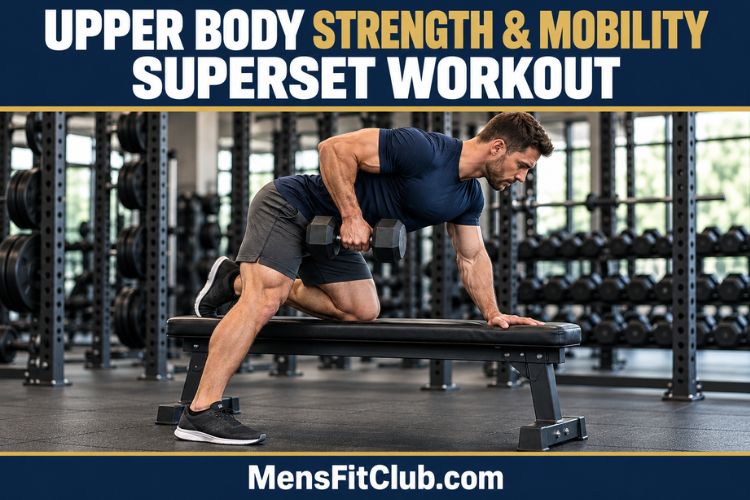
Building a strong upper body takes more than adding weight to your presses and rows. You also need enough comfortable movement to perform those exercises well. If your shoulders feel restricted, your upper back barely rotates, or your wrists struggle with push-ups, training can become a series of awkward compromises. An upper body strength and mobility superset workout gives both priorities a place in the same session.
This routine pairs traditional resistance exercises with gentle, controlled mobility movements. You will train your chest, back, shoulders, and arms while practicing the positions that support pressing, pulling, and reaching. The goal is a stronger upper body that moves comfortably, with a structure you can repeat at home or in the gym.
The workout takes approximately 45–60 minutes, including preparation and a short cooldown. You will need dumbbells, an adjustable bench, and access to a cable pulldown or a securely anchored resistance band. Each pairing includes clear sets, repetitions, and rest guidance. Beginners can reduce the workload, while experienced lifters can progress the resistance without turning the mobility drills into another exhausting workout.
What Is an Upper Body Strength and Mobility Superset Workout?
A superset generally means performing two exercises consecutively before taking a longer rest. Many routines pair two demanding strength exercises, such as a bench press and a row. In this workout, you will perform a strength exercise, transition to a low-effort mobility drill, and then rest before repeating the pair.
That distinction matters. The mobility movement should leave you feeling ready for the next strength set. It should not burn out your shoulders, challenge your breathing, or force you into a deep stretch. Think of it as useful movement practice within the session rather than a second hard exercise.
For example, a dumbbell press can be paired with a gentle thoracic rotation. You perform the press, set the weights down safely, complete the rotation, and recover. This keeps mobility work on the schedule while preserving the attention and energy required for productive lifting.
Strength, Flexibility, and Mobility Explained
Strength is your ability to produce force. Flexibility generally describes the available range of motion of muscles and other tissues. Mobility is commonly used to describe how well you can access and control movement through a joint or a broader movement pattern.
These qualities overlap, but they are not interchangeable. Being able to stretch an arm overhead does not automatically mean you can press a weight overhead with control. Likewise, a strong press does not guarantee that every shoulder position will feel comfortable.
This workout develops resistance-training skill and gives you repeated opportunities to practice controlled movement. It is not a diagnostic assessment or a treatment plan for shoulder pain. Your range of motion should reflect your current ability, with gradual improvements rather than forced positions.
Why Combine Upper Body Strength and Mobility Workout?
Combining these elements makes sense when your schedule repeatedly pushes mobility work aside. A few easy drills between lifting sets can make the session more comprehensive without requiring a separate, lengthy routine. The practical benefit is consistency: you actually perform the movements instead of promising to do them later.
Resistance training remains the foundation of the program. The American College of Sports Medicine’s updated guidance emphasizes regular training, gradual progression, and working the major muscle groups. This upper body session can contribute to that approach, but it should sit alongside lower body training in your weekly plan.
The mobility drills have a supporting role. They help you practice moving your shoulders, upper back, and wrists deliberately. They do not guarantee injury prevention, correct every posture concern, or automatically improve your next lifting set. Judge their usefulness by comfort, control, and whether they fit your training sustainably.
Balance Pressing and Pulling
The routine includes horizontal pressing, horizontal pulling, vertical pressing, and vertical pulling. Those categories create a broad training base rather than concentrating all your effort on chest exercises.
Rows and pulldowns challenge different pulling patterns, while bench presses and overhead presses cover different pushing directions. Arm exercises finish the session without taking priority over the larger movements. This balance helps distribute the workload, although your individual needs may justify changing particular exercises.
Practice Movement Without Sacrificing Recovery
Supersets are useful only when they support the goal of the workout. If a mobility drill makes the next strength set worse, reduce its repetitions, make it easier, or move it to the cooldown.
You can also use ordinary straight sets. Perform all sets of a strength exercise with full rest, then practice the mobility drill afterward. Heavy strength work, technical limitations, or an unusually tiring day may make this the better choice.
Workout Structure, Equipment, and Weekly Upper Body Mobility Superset Workout Frequency
The complete session contains five pairings. The first four cover the main upper body movement patterns, and the final pairing adds direct arm work. Most lifters will perform three rounds of each main pairing and two rounds of the arm pairing.
Use dumbbells that allow controlled repetitions with approximately two or three good repetitions remaining at the end of each set. This is called leaving repetitions in reserve. You should work hard enough to challenge the muscles while maintaining a repeatable technique.
Plan to perform the workout twice weekly, with at least one day between sessions and more recovery when needed. For example, train upper body on Monday and Thursday, and lower body on Tuesday and Saturday. Walking or easy cycling can fit around these sessions according to your overall workload.
How Long Should You Rest?
After each strength exercise, take approximately 15–30 seconds to set down the weights and position yourself for the mobility movement. Complete the drill slowly, then rest 90–120 seconds before starting the next round.
For demanding presses, rows, or pulldowns, extend that final rest to two or three minutes when necessary. The drill is not a reason to rush recovery. You should feel prepared to repeat the strength movement with similar control and effort.
The total time between strength sets includes the transition, mobility drill, and final rest. Expect roughly three to five minutes per round, depending on the exercise. This is why the full workout is best treated as a 45–60-minute session rather than a quick conditioning circuit.
Warm Up Before the Upper Body Mobility Superset Workout
Start with three minutes of easy walking, cycling, or another comfortable activity. Gradually increase your pace enough to feel warmer without tiring yourself. Then spend two or three minutes moving your arms and upper back through comfortable ranges.
Perform five slow shoulder circles in each direction, six standing upper-back rotations per side, and eight easy wall slides. Keep the movements relaxed. You are preparing to lift, so there is no need to chase a deep stretch or make the warm-up difficult.
Finally, complete one or two lighter practice sets of your first pressing exercise. Use approximately half your working weight for the first set, then a slightly heavier load if needed. Before later compound exercises, add a brief practice set whenever the movement or load requires preparation.
Check Your Readiness
During the warm-up, notice whether your normal range feels available. A little stiffness that eases with gentle movement is different from sharp pain, worsening discomfort, or a sense that the joint is unstable.
Adjust the session if a movement feels unusually restricted. Reduce the load, shorten the range, or choose a comfortable alternative. Stop an exercise that causes sharp pain, numbness, or symptoms that increase with each repetition rather than trying to stretch through them.
Superset One: Dumbbell Bench Press and Open-Book Rotation
This first pairing develops horizontal pressing strength and practices rotation through the upper back. Complete three rounds. Perform 6–10 dumbbell bench press repetitions, followed by five open-book rotations per side, then take your recovery period.
Dumbbell Bench Press: 6–10 Repetitions
Lie on a flat bench with your feet firmly supported. Position the dumbbells beside your chest with your wrists stacked over your forearms. A neutral or slightly turned grip may feel more comfortable than forcing your palms completely forward.
Lower the weights with control, keeping your elbows approximately 30–60 degrees away from your torso. Stop at a depth you can manage without shoulder discomfort. Press upward smoothly and finish with the weights balanced over your chest.
Keep your head, upper back, and hips supported. A small natural lower-back arch is acceptable, but avoid lifting your hips to finish a difficult repetition. Choose a load that lets your final repetition resemble your first.
Open-Book Rotation: Five Repetitions Per Side: Upper Body Mobility Superset Workout
Lie on your side with your hips and knees bent, placing a cushion under your head if needed. Extend both arms forward with your hands together. Keep your knees stacked as you slowly open the top arm across your body.
Let your upper trunk rotate as far as it comfortably can. Follow the moving hand with your eyes if that feels good. Breathe out gently, pause briefly, and return to the starting position.
The goal is controlled rotation rather than touching your hand to the floor. Keep the movement small if your shoulder feels pulled. This drill should take roughly one minute for both sides and remain easy throughout.
Superset Two: Chest-Supported Row and Wall Slide
The second pairing trains your upper back while practicing upward arm movement. Complete three rounds of 8–12 chest-supported rows and six to eight wall slides. Use an incline bench angle that allows you to row without the weights hitting the floor.
Chest-Supported Dumbbell Row: 8–12 Repetitions
Lie face down on an incline bench with your chest supported and feet stable. Let the dumbbells hang below your shoulders. Start with a neutral grip and keep your neck in line with your torso.
Pull your elbows toward your hips or lower ribs, depending on your bench position. Allow the shoulder blades to move naturally without forcing an exaggerated squeeze. Pause briefly at the top, then lower the weights until your arms extend comfortably.
Chest support reduces the need to hold a bent-over position and makes it easier to concentrate on the row. If you lack an adjustable bench, use a supported one-arm dumbbell row and complete both sides before the wall slides.
Wall Slide: Six to Eight Repetitions: Upper Body Mobility Superset Workout
Stand facing a wall with your forearms resting lightly against it. Keep your ribs comfortably stacked over your pelvis. Slide your forearms upward while allowing your shoulder blades to move around your rib cage.
Only raise your arms as far as you can without leaning backward or forcing your shoulders. Lower slowly and repeat. Gentle pressure against the wall is enough; this should not become a demanding shoulder exercise.
You do not need to keep every part of your arms perfectly attached to the wall. Prioritize smooth motion and relaxed breathing. If wall slides feel uncomfortable, substitute slow, unloaded arm raises within a smaller range.
Superset Three: Neutral-Grip Shoulder Press and Bench Rock-Back
This pairing combines vertical pressing with a gentle overhead mobility movement. Perform three rounds of 6–10 shoulder presses followed by six bench rock-backs. Use a seated position if it helps you control your torso.
Neutral-Grip Dumbbell Shoulder Press: 6–10 Repetitions
Sit on a supportive bench with the dumbbells at shoulder height and palms facing each other. Place your feet firmly on the floor. Brace your trunk gently without holding a prolonged breath.
Press upward through a comfortable path, allowing your shoulder blades to rotate naturally. Avoid forcing them down as your arms rise. Lower the dumbbells under control and stop before the shoulders feel compressed or painful.
Do not create extra range by flaring your ribs or leaning far backward. If overhead pressing is uncomfortable, use a high-incline dumbbell press at a tolerable angle. You can also omit this pairing temporarily while seeking guidance for persistent symptoms.
Bench Rock-Back: Six Repetitions: Upper Body Mobility Superset Workout
Kneel in front of a stable bench and place your hands or forearms on it. Gently shift your hips backward while letting your chest lower slightly between your arms.
Move only far enough to feel a mild stretch around the upper back or sides of the torso. Keep your abdomen lightly engaged so the movement does not come mostly from arching your lower back.
Pause for one relaxed breath, then return forward. Avoid pressing your head downward or forcing your shoulders into a deeper position. If the drill feels tiring or uncomfortable after pressing, shorten the range or perform it after the workout instead.
Superset Four: Lat Pulldown and Quadruped Thoracic Rotation
Vertical pulling complements the pressing exercises and challenges the back and arms. Complete three rounds of 8–12 pulldowns followed by five quadruped rotations per side.
Neutral-Grip Lat Pulldown: 8–12 Repetitions: Upper Body Mobility Superset Workout
Use a neutral-grip handle when available and secure your thighs beneath the support pads. Sit tall with your feet grounded. Begin with your arms extended to a comfortable overhead position.
Pull the handle toward your upper chest while guiding your elbows downward. A small backward lean is fine, but avoid swinging your torso to move the weight. Return the handle upward slowly, allowing the arms and shoulder blades to move naturally.
Keep the movement in front of your body rather than pulling behind your neck. At home, use a resistance-band pulldown only with a suitable, secure overhead anchor. If no safe anchor is available, substitute another supported rowing variation.
Quadruped Thoracic Rotation: Five Repetitions Per Side
Start on your hands and knees. Place one hand lightly behind your head, with no pulling on the neck. Slowly rotate that elbow toward the supporting arm, then open it toward the ceiling.
Keep your hips relatively still and use a comfortable upper-back range. Breathe normally and avoid rushing. The movement should feel like gentle practice rather than an effort to achieve the largest possible twist.
If supporting your weight on one arm fatigues the shoulder, perform a seated rotation with your arms crossed over your chest. This keeps the mobility portion easy enough to support the next pulling set.
Superset Five: Arm Strength and Wrist Upper body Mobility Workout
The final pairing adds direct biceps and triceps work. Perform two rounds. Complete 10–12 hammer curls followed by 10–12 cable or band triceps pressdowns, then practice 30–45 seconds of gentle wrist movement before resting 60–90 seconds.
This pairing contains two strength exercises, so allow a short pause between them if needed. It is optional when time is limited or your arms already feel adequately challenged by the compound movements.
Hammer Curl and Triceps Pressdown: Upper Body Mobility Superset Workout
For hammer curls, stand tall with your palms facing inward. Bend the elbows without swinging your torso or lifting your shoulders. Lower the dumbbells slowly and keep the wrists aligned with the forearms.
For pressdowns, keep your elbows near your sides and extend them smoothly. Avoid leaning heavily onto the handle or driving the movement with your shoulders. Use a cable or a resistance band attached to a suitable secure anchor.
If neither setup is available, substitute a light lying dumbbell triceps extension if comfortable. Reduce the weight whenever elbow discomfort appears. Direct arm exercises should finish the workout productively without overwhelming the joints.
Gentle Wrist Mobility
Extend your arms comfortably in front of you and slowly alternate between opening and closing your hands. Add small wrist circles in both directions, then gently move the wrists into flexion and extension.
Use active movement rather than pulling hard on your fingers. Keep each motion comfortable and stop before a strong stretch develops. Wrist mobility is especially relevant if you also perform push-ups, but it should not create soreness that affects gripping.
How to Progress the Upper Body Mobility Superset Workout Over Six Weeks
For the first two weeks, use two rounds per main pairing and one or two rounds of arm work. Learn the exercise setup, establish comfortable ranges, and record your weights and repetitions.
During weeks three and four, move to three rounds for the main pairings if recovery is good. Keep the loads similar initially. Adding a set increases the workload, so there is no need to increase weight at the same time.
In weeks five and six, progress individual exercises when you can complete every set at the top of the repetition range with good technique and approximately two repetitions remaining. Add the smallest practical weight increase and return toward the lower end of the range.
Progress Mobility Through Control
Mobility progression does not require aggressive stretching. Aim for smoother repetitions, less unnecessary torso movement, and a slightly larger comfortable range when available.
Do not add weights to the drills simply because the strength exercises are getting heavier. Their role remains low-effort movement practice. A smaller range performed comfortably is more useful than a forced position that disrupts training.
Keep a simple record of any drill that improves comfort or consistently causes fatigue. Replace movements that do not suit you rather than treating every exercise as mandatory.
Beginner, Home, and Over-50 Upper Body Mobility Superset Workout Modifications
Beginners can perform the first four pairings with two rounds each and skip direct arm work. Use manageable resistance, longer rest periods, and practice sets as needed. Building confidence with the setup is part of the training process.
At home, replace the bench press with a dumbbell floor press. Use a supported one-arm row if an incline bench is unavailable. Choose the seated rotation instead of floor-based drills when space or comfort requires it. Equipment substitutions should preserve the intended movement as closely as practical.
Men over 50 can use the same basic structure, with starting volume based on current training experience and recovery. Age alone does not determine the correct load. Recent activity, joint comfort, sleep, and previous lifting experience provide more useful guidance.
Common Upper Body Mobility Superset Workout Mistakes and Recovery Tips
The most common mistake is making the mobility exercises too intense. Deep stretches, long holds, and demanding shoulder drills can undermine the next strength set. Keep these movements brief and gentle, and move more substantial flexibility work to a separate period if desired.
Another mistake is cutting rest because the workout uses supersets. Strength development still requires quality repetitions. If performance drops sharply, extend recovery or reduce the load. Avoid chasing a sweat-heavy session at the expense of the lifting goal.
Between workouts, prioritize regular meals, sufficient protein, sleep, and a manageable overall training schedule. Mild muscle soreness can occur, especially when starting, but soreness is not a requirement for progress. Track stronger repetitions, more consistent technique, and easier movement instead.
FAQ About Upper Body Mobility Superset Workout
Can This Workout Build Muscle?
Yes, the resistance exercises provide a muscle-building stimulus when the sets are challenging and progressively developed. Your results also depend on total weekly training, nutrition, and recovery. The mobility drills support movement practice but should not be counted as hard muscle-building sets.
Should You Stretch Between Every Upper Body Mobility Superset Workout Set?
You do not have to. Use the proposed gentle drills only when they feel comfortable and preserve your lifting performance. Long or intense stretches are not necessary between sets. If you prefer uninterrupted recovery, complete mobility work before or after the strength portion.
Is This a Complete Weekly Upper Body Mobility Superset Workout Program?
It is a complete upper body session, but it does not train your entire body. Include lower body exercises elsewhere in the week and adjust your cardio to fit your goals. Repeat this routine consistently, progress the resistance gradually, and let comfortable, controlled movement guide every repetition.
To get more from your upper body strength and mobility superset workout, explore our Superset Workout Guide for exercise-pairing ideas and Dumbbell Bench Press Tips For Beginners to refine your pressing technique. Our Barbell Mobility Warm Up For Stiff Lifters offers additional preparation ideas, while the Progressive Overload Dumbbell Workout explains how to increase your training challenge. Complete your weekly schedule with our 30 Minute Lower Body Dumbbell Workout to complement your upper body sessions.


Most Recommended

Subscribe to our Newsletter
Stay up to date on the latest men’s health, fitness and lifestyle trends and tips.
About Us
Men’s Fit Club was started with the goal of empowering men to get the most out of their lives. This meant going beyond exercise and diet tips to really address the broad range of issues that men face on a daily basis – topics like recreation, finding love, sexual health and even sound fashion advice.
Quick Links
© COPYRIGHT MEN'S FIT CLUB 2026. All Rights Reserved