


Sled-Free HYROX Workout Without Equipment at Home

Barbell Contrast Training Workout for Explosive Power

When to Take a Deload Week From Progressive Overload
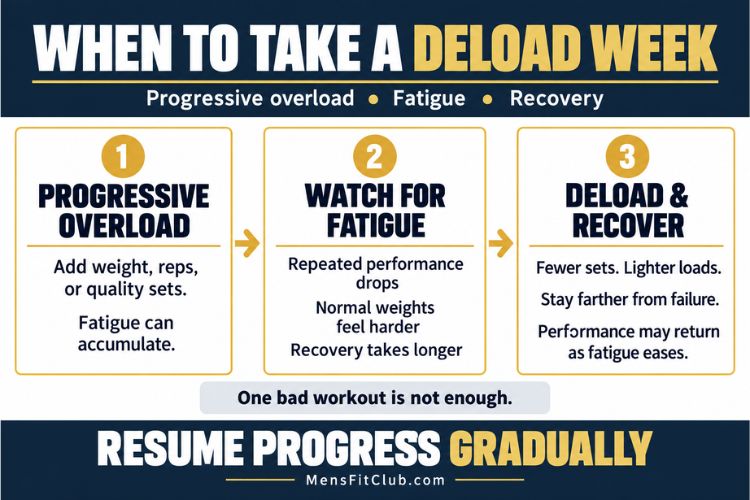
Progressive overload gives strength training a clear direction. You gradually increase the demands of your workouts by lifting more weight, performing additional repetitions, or improving how much quality work you can complete. However, successful training also requires knowing when to stop adding difficulty temporarily. When fatigue starts interfering with performance and recovery, a deload week can help you reassess your workload and prepare for another productive training block.
Consider taking a deload week when several workouts show declining performance alongside persistent fatigue, reduced motivation, or incomplete recovery. You can also schedule one after a demanding training block or during a stressful period. One disappointing session usually calls for a small adjustment, rather than an automatic week of reduced training.
The challenge is separating normal training discomfort from a pattern that deserves attention. This guide explains when to take a deload week from progressive overload, how to structure it, and how to return to training without immediately recreating the same fatigue.
What Is a Deload Week?
A deload week is a short period in which you deliberately reduce training demands. You might perform fewer sets, use lighter weights, train fewer days, or stop your sets farther from muscular failure. Many lifters continue practicing their usual exercises while making each session noticeably easier.
Expert consensus describes deloading as a period of reduced training stress intended to manage fatigue and improve readiness for subsequent training. That definition supports flexibility rather than one mandatory recipe for every lifter.
A Deload Is Different From a Regular Rest Day
Rest days provide recovery between individual workouts. A deload changes the workload across several days, which can be useful when your normal rest schedule no longer leaves you ready for the next session.
Imagine training hard on Monday, Wednesday, and Friday. Usually, the days between workouts are enough. After several demanding weeks, however, Friday’s fatigue may carry into Monday, and Monday’s session may make Wednesday harder. A deload interrupts that cycle by reducing the demands of the entire training week.
A Deload Can Include Training or Complete Rest
Reduced training often works well when you want to maintain your routine and practice familiar movement patterns. Complete rest may be more appropriate when illness, significant exhaustion, or another circumstance makes exercise unsuitable.
These approaches should not be treated as interchangeable in every situation. Choose the option that addresses your actual problem. If one exercise causes pain, simply making the whole program lighter may not resolve its cause.
Why Progressive Overload Does Not Mean Adding Weight Forever
Progressive overload describes increasing training demands over time as your capacity improves. It does not require adding weight every session regardless of technique, recovery, or performance.
Sometimes progress means completing the same repetitions with better control. Sometimes it means adding one repetition to a set. During a demanding period, maintaining your existing performance can be a reasonable outcome. Your program should allow those possibilities.
Training Stress Must Match Your Recovery Capacity
Your workload includes more than the weight on the bar. Sets, repetitions, exercise selection, proximity to failure, and training frequency all contribute to session difficulty. Running, physical work, and other sports add demands outside the weight room.
Recovery conditions also change. A program that felt manageable during a quiet month may become difficult during overtime, disrupted sleep, or increased family responsibilities. Deload timing should account for the relationship between training and your current circumstances.
More Work Is Not Always Better Work
Adding sets can help increase training stimulus, but those sets also cost time and recovery. If extra work reduces the quality of your main lifts and leaves you repeatedly unprepared for the next session, reconsider whether it is helping.
A deload creates an opportunity to examine that tradeoff. However, returning to an excessive workload unchanged often recreates the same problem. Recovery weeks work best alongside sensible ongoing programming.
Signs You May Need a Deload Week
Look for trends across multiple sessions instead of treating any single symptom as proof. Poor sleep, soreness, and low motivation have many possible causes. Their relevance increases when they appear together and coincide with worsening training performance.
Your Performance Declines Across Several Workouts
Repeatedly losing repetitions at the same load can suggest that your current workload exceeds what you are recovering from. For example, a bench press that usually allows three controlled sets of eight may become eight, six, and five despite similar rest periods.
Before deciding to deload, check whether conditions changed. Shorter rest intervals, different equipment, altered technique, or training at an unfamiliar time can affect performance. Compare similar sessions and look for a repeated downward pattern.
Normal Working Weights Feel Unusually Difficult
A familiar load may suddenly require much more effort. Warm-up sets feel sluggish, and working sets approach failure earlier than expected. If this persists beyond one session, it deserves attention.
Record effort alongside repetitions and weight. Two sets with identical numbers can represent different levels of difficulty. A useful training log captures whether you finished comfortably or had to grind through the last repetition.
You Rarely Feel Recovered Before Training Again
Occasional soreness after a new exercise is unsurprising. More concerning is a pattern in which the same muscles remain substantially sore when their next workout arrives, forcing you to change technique or shorten your range of motion.
Soreness alone does not measure workout effectiveness or diagnose overtraining. Nevertheless, persistent soreness that interferes with normal movement is a reason to adjust the workload and reconsider recent exercise changes.
Aches Are Increasing Instead of Settling
Recurring irritation during pressing, squatting, or pulling should not become something you automatically push through. Temporarily reducing training stress may be appropriate, but pain requires its own assessment.
Stop or modify movements that provoke symptoms. Sharp pain, swelling, numbness, sudden weakness, or persistent worsening pain warrants professional evaluation. A deload is a programming tool; it does not diagnose an injury or guarantee that injured tissue has recovered.
Motivation Drops Alongside Physical Fatigue
Everyone occasionally prefers doing something other than training. A more useful signal is a sustained loss of enthusiasm combined with unusually difficult workouts, poor recovery, and declining performance.
Ask whether you need reduced training stress, a different schedule, or a less repetitive program. Mental fatigue may also reflect pressures outside the gym. Your solution should fit the reason that training has become difficult.
How Often Should You Take a Deload Week?
There is no universally established interval that works best for everyone. Training experience, workload, exercise choices, and life stress all influence the decision. Avoid treating a calendar recommendation as a biological deadline.
For a demanding program, reviewing recovery after roughly four to eight weeks is a practical starting point. That is a planning suggestion, not a proven optimal range. You may need an earlier reduction, or you may continue progressing comfortably beyond it.
Beginners Often Need Smaller Adjustments First
A beginner performing a manageable full-body routine may not need frequent scheduled deloads. Early stalls can result from oversized weight increases, inconsistent attendance, limited technique practice, or unrealistic expectations.
Before inserting a recovery week, check the basics. Use smaller load increases, allow adequate rest between sets, and choose a sustainable number of working sets. If performance and recovery remain good, there is little reason to interrupt productive training solely because another week has passed.
Experienced Lifters Can Review Demanding Blocks
Lifters with more training experience may accumulate fatigue through heavier loads, greater weekly volume, or repeated sets near failure. A planned review point after a challenging block can help identify whether reduced training is appropriate.
Training experience alone does not determine recovery needs. An experienced lifter using a modest program may need fewer adjustments than someone newer who combines high-volume lifting with hard conditioning and physical work.
Men Over 40 or 50 Should Use Their Own Recovery Trends
Age can influence training decisions, but birthdays do not prescribe a deload schedule. Sleep, training history, health, physical workload, and exercise tolerance all matter.
For men over 40 or 50, a useful approach is to track how reliably you recover between sessions. If heavy lower-body training repeatedly affects your next workout or daily activities, adjust the ongoing dose rather than relying on frequent recovery weeks to make an unsuitable program manageable.
Planned Deloads Versus Deloading When Needed
You can schedule reduced training in advance or introduce it when your recovery trends suggest a need. Both approaches can be practical. The important part is having a clear reason for the reduction.
Planned Deloads Offer Structure
A planned deload can follow the final demanding week of a training block. For example, you might build repetitions and loads over five weeks, then use the sixth week for easier sessions before starting another block.
This approach can also fit travel or a predictable period of work stress. It reduces scheduling friction and makes recovery part of the plan. Still, review how you feel; a fixed schedule should not force you to ignore problems that arise earlier.
Deloading When Needed Offers Flexibility
An adjustable approach uses performance and recovery to guide timing. If your program remains productive, continue it. If several indicators worsen together, reduce the workload.
This requires honest monitoring. Lifters who habitually dismiss fatigue may benefit from planned checkpoints. Lifters who interpret every difficult session as a warning may benefit from waiting for a consistent pattern before changing the whole week.
Combine a Review Date With Permission to Adjust
A practical compromise is to schedule a recovery review while allowing earlier changes. At the review, compare recent performance, effort, soreness, motivation, and your outside workload.
You may decide to deload, remove a few sets, or continue unchanged. The review itself is valuable because it replaces guesswork with a deliberate decision.
How to Structure a Deload Week
The following guidelines are practical examples rather than a scientifically established prescription. Start with the variables that seem to be creating the most fatigue, and make the week clearly easier than normal.
Reduce Your Working Sets
Cutting working sets is an easy way to lower training volume. As a starting example, reduce your usual sets by roughly one-third to one-half. A four-set exercise might become two sets, while a three-set exercise might become one or two.
Prioritize familiar exercises and remove optional finishers. If your sessions have expanded through extra arm work, drop sets, and conditioning circuits, those additions are logical places to reduce demands.
Lower the Load When Necessary
You can also reduce working weights, particularly when normal loads feel unusually difficult. Using approximately 10–20% less than your recent working weight can be a starting example, adjusted to make the sets comfortable.
These percentages refer to your usual working load, not your one-repetition maximum. If you normally lift 100 pounds, a 20% reduction means 80 pounds. The correct choice is the load that permits controlled, easy repetitions.
Stay Farther From Failure
Avoid grinding repetitions and failure training during the deload. Aim to finish sets with several repetitions still possible, such as approximately four or five repetitions in reserve.
If the lighter weight still feels exhausting, reduce repetitions or sets further. A deload has missed its purpose when you compensate for lighter weights by performing much longer sets to failure.
Reduce Frequency if Your Schedule Is Part of the Problem
Some lifters prefer keeping their usual training days with shorter sessions. Others benefit from dropping one or two sessions, especially when time pressure contributes to poor sleep or rushed recovery.
Choose the arrangement that makes the week more manageable. You do not need to preserve every workout simply to maintain the appearance of consistency.
Example Deload Week for a Three-Day Strength Program
This example suits a lifter who normally trains full body three days per week. Adjust exercises to your ability and available equipment. Every working set should feel comfortably submaximal.
Monday: Easy Squat and Upper-Body Practice
After a brief warm-up, perform two sets of five squats, two sets of six bench presses, and two sets of eight rows. Use lighter working weights and rest long enough that breathing and concentration recover.
Skip heavy finishers and optional burnout sets. Finish while you still feel capable of doing more, rather than extending the session because it feels unusually short.
Wednesday: Reduced Hinge and Pressing Work
Perform one or two sets of five Romanian deadlifts, two sets of six overhead presses, and two sets of eight pulldowns. A comfortable plank can be included if it does not add meaningful fatigue.
Choose movements you already know. A recovery week is a poor time to experiment with exercises that produce unfamiliar soreness or require extensive technical practice.
Friday: Light Full-Body Training
Complete two easy sets each of a squat variation, a push-up or dumbbell press, and a supported row. Keep repetitions controlled and stop well before technique deteriorates.
Use Tuesday, Thursday, and the weekend for ordinary daily movement and optional easy walking. Hard intervals, long endurance sessions, and intense recreational sport can undermine the intended workload reduction.
Deloading a Four-Day Upper/Lower Split
If you normally train upper body twice and lower body twice each week, you can retain that structure while reducing sets and effort. This often keeps the routine familiar without maintaining its usual demands.
For upper-body days, perform one or two easy sets of a press, a row, and a vertical pull. Add a small amount of arm work only if it remains comfortable. For lower-body days, use one or two sets of a squat pattern and a hinge, with minimal accessories.
Alternatively, combine the week into two brief full-body sessions. That can work well when missed sleep or schedule pressure contributes to fatigue. The aim is a meaningful reduction across the week, not preserving a particular split at all costs.
What Research Can and Cannot Tell You About Deloads
Deloading has practical support, but research does not establish that every lifter needs a scheduled recovery week or that it automatically improves muscle growth. Studies also use different forms of reduced training.
A 2024 trial involving 39 trained participants compared continuous training with a program containing one week of complete resistance-training cessation. The break did not improve measured lower-body muscle growth, and continuous training produced greater strength improvements. This does not establish that lighter training has the same effects as complete cessation.
A small 2026 study in 19 untrained young men reduced training frequency and sets during two weeks of an eight-week program. It found no statistically significant between-condition differences in the measured muscle growth and strength-endurance outcomes. Its narrow exercise selection and population limit generalization.
The practical interpretation is modest: reduced training can fit a program, but claims that deloads universally accelerate gains go beyond these findings.
How to Return to Progressive Overload After a Deload
Your first session back should help assess readiness. It does not need to prove that the deload worked through a personal record.
Resume With a Manageable Workload
Use your recent successful training as a reference. If fatigue was substantial, return with slightly fewer sets or a modestly lighter load. If you feel recovered and your previous workload was reasonable, moving closer to the usual routine may be appropriate.
Evaluate warm-ups, technique, and effort before deciding on the full session. Adjusting the plan during a workout is sensible when actual performance differs from expectations.
Progress One Variable at a Time
Avoid simultaneously restoring every set, increasing the weight, adding repetitions, and introducing new conditioning. A measured return makes it easier to understand what your body tolerates.
For example, resume three sets of an exercise and rebuild repetitions within a target range. Add weight only when you complete that range with the intended effort and consistent technique.
Change the Program if Fatigue Returns Immediately
If the same problems return within several sessions, reconsider weekly volume, exercise overlap, failure training, and conditioning placement. Also examine food intake, sleep, and outside stress.
Repeated deloads should not become the only adjustment you make. A smaller ongoing workload may produce more consistent training than alternating exhausting blocks with frequent recovery weeks.
Common Deload Week Mistakes
One common mistake is replacing lifting with equally demanding exercise. Hard HIIT, lengthy runs, or daily high-repetition circuits may maintain fatigue even though the barbell workload has fallen.
Another mistake is testing strength because the warm-up feels better. Feeling fresh is a reason to preserve the recovery plan, rather than abandon it halfway through.
Avoid drastically restricting food because you are training less. Continue regular meals and adequate protein, and adjust intake thoughtfully if necessary. Recovery is also an opportunity to improve sleep consistency and reduce avoidable scheduling pressure.
Finally, do not assume a deload will fix every plateau. A program may need better progression rules, smaller weight increases, or clearer exercise priorities.
Frequently Asked Questions About Deload Weeks
Should You Deload if You Are Still Making Progress?
Not automatically. If performance is improving, technique remains consistent, and recovery feels adequate, continue monitoring your training. A planned easier week may still fit your schedule, but progress alone does not create an urgent need to reduce training.
Is One Bad Workout Enough to Justify a Deload?
Usually, one poor session is better handled with an immediate adjustment. Use lighter weights, remove an optional set, or finish earlier. Consider a broader reduction when similar problems recur across comparable workouts.
Can a Deload Help During a Fat-Loss Phase?
It can help manage training demands when recovery becomes difficult. However, also review whether your calorie deficit and conditioning workload are unnecessarily aggressive. Reducing lifting for one week will not resolve an ongoing mismatch between demands and recovery.
How Do You Know Whether the Deload Worked?
Look for easier warm-ups, improved willingness to train, less lingering soreness, and a return toward your normal performance at familiar effort levels. These are useful observations rather than a formal diagnostic test.
If unusual fatigue or declining performance persists despite reduced training and improved recovery habits, consider other causes and seek appropriate professional guidance.
Make Deloading Part of Sustainable Strength Training
Knowing when to take a deload week from progressive overload starts with paying attention to patterns. Record your training, compare similar sessions, and notice whether your workload fits your current recovery capacity.
When a reduction is justified, make the week clearly easier through fewer sets, lighter loads, greater distance from failure, or fewer sessions. Then return gradually and correct any programming issue that contributed to the problem.
Choose a training dose you can recover from, progress when your performance supports it, and use easier weeks when they serve a clear purpose. That approach keeps progressive overload practical across months of training.
To balance progressive overload with recovery, explore our 8 Week Barbell Progressive Overload Program and Progressive Overload Dumbbell Workout for structured training ideas. During your deload week, keep movement comfortable with our Rest Day Mobility Routine for Muscle Recovery or explore gentle options in our Active Recovery Workouts Guide. For your next training block, use our Weekly Workout Routine for Men to help organize lifting and planned recovery days.


Most Recommended

Subscribe to our Newsletter
Stay up to date on the latest men’s health, fitness and lifestyle trends and tips.
About Us
Men’s Fit Club was started with the goal of empowering men to get the most out of their lives. This meant going beyond exercise and diet tips to really address the broad range of issues that men face on a daily basis – topics like recreation, finding love, sexual health and even sound fashion advice.
Quick Links
© COPYRIGHT MEN'S FIT CLUB 2026. All Rights Reserved