


High Protein Beef and Pumpkin Chili: A Hearty Recipe
When to Reduce Sets Reps or Weight During a Workout
RPE Strength Training Guide Lift Smarter and Get Stronger
Strength training works best when your workouts challenge you enough to improve without turning every session into a maximum-effort test. The difficulty is that the same weight does not always feel the same. A squat that moves smoothly on Monday can feel demanding on Friday after several nights of poor sleep, a stressful workweek, or another hard workout. This RPE strength training guide explains how to match your effort to your goals and your performance on the day. RPE helps you answer a useful question: how close was that set to your limit? Once you understand the answer, you can choose better working weights, adjust demanding sessions, and recognize progress beyond simply adding plates.
You do not need an expensive device or a complicated spreadsheet. You need consistent exercise technique, an honest estimate of your remaining repetitions, and a training plan that gives those observations a purpose.
What Is RPE in Strength Training?
RPE stands for rating of perceived exertion. It describes how hard an effort feels. Several RPE scales exist, but strength programs commonly use a resistance-training-specific scale from 1 to 10 that connects effort with repetitions in reserve, or RIR.
Repetitions in reserve are the additional repetitions you believe you could perform before reaching your limit. For this guide, count only repetitions completed with the same acceptable technique and range of motion. Extra repetitions that require bouncing, shortening the movement, or losing control should not count as available reps.
An RPE 8 set means you estimate that you could complete approximately two more clean repetitions. An RPE 9 set leaves roughly one. RPE 10 means you have no additional repetition available. Research has examined this repetitions-in-reserve approach in both experienced and novice squatters, providing a foundation for its use in resistance training.[1]
Set RPE Strength Training Is Different From Overall Workout Difficulty
A workout can feel exhausting even when individual sets remain far from muscular failure. Short rest periods, demanding supersets, heat, and heavy breathing can all make the session feel harder. That does not automatically mean your last set was RPE 9.
When rating a strength set, focus on how many more repetitions you could perform under the same conditions. You can separately record overall session difficulty, but label it clearly. Keeping these ratings distinct makes your training log more useful.
Understanding the RPE Scale and Repetitions in Reserve
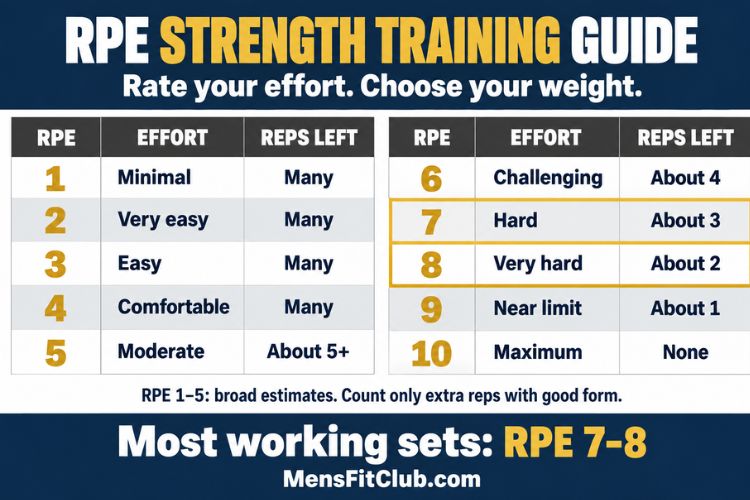
The most useful part of the scale for everyday strength training is usually RPE 6 through 10. These ratings help distinguish manageable work from demanding sets that approach your limit. Lower ratings are less precise because estimating many remaining repetitions becomes difficult.
RPE 6: Approximately Four Repetitions Remaining
RPE 6 feels controlled and relatively comfortable. You finish with confidence that several good repetitions remain. This effort can suit introductory training, lighter technique work, or reduced-demand sessions. However, a set rated RPE 6 is still a working set if the load and repetitions make it meaningful for the exercise.
RPE 7: Approximately Three Repetitions Remaining: RPE Strength Training
RPE 7 provides a moderate challenge while preserving a clear buffer. The final repetition may require more concentration, but you remain in control. It is a useful starting target when learning an exercise or building consistency with a new program.
RPE 8: Approximately Two Repetitions Remaining
RPE 8 represents hard, repeatable training. Your final repetitions require effort, yet you believe you could complete two more without changing technique. Many lifters use this target for regular working sets because it creates a clear boundary before maximum effort.
RPE 9: Approximately One Repetition Remaining: RPE Strength Training
RPE 9 is demanding. You could probably complete one additional clean repetition, but another beyond that is unlikely. Use this rating deliberately. A program may include selected RPE 9 sets, but accidentally reaching it on every compound exercise can make the planned workload difficult to sustain.
RPE 10: No Repetitions Remaining
RPE 10 means the set reaches your current repetition limit. You do not need to attempt and fail another repetition to assign this rating. If another clean repetition is unavailable, the set is already at the top of the scale.
These are estimates rather than exact measurements. A difference between RPE 7.5 and 8 may be less meaningful than recognizing that a planned moderate set has become an all-out effort.
Why Use RPE for Strength Training?
RPE gives a structured way to adjust training when daily performance changes. It does not replace your program. It helps you carry out the program at the intended difficulty instead of forcing a predetermined weight regardless of how the repetitions move.
Match Your Weights to Your Performance
Suppose your plan calls for three sets of five squats at RPE 7–8. Last week, you used 185 pounds. Today, the first working set at that weight feels like RPE 9. The target tells you to lower the load for the remaining sets rather than repeat work that is substantially harder than intended.
The reverse can also happen. If the same weight feels clearly below the target, a small increase may be appropriate. RPE creates room for both adjustments while keeping the exercise, repetition prescription, and overall training goal consistent.
Recognize Progress Without Adding Weight Every Session
Completing the same load and repetitions at a lower RPE can indicate progress. If a dumbbell press changes from eight repetitions at RPE 9 to eight repetitions at RPE 7–8, your performance has improved even before you select heavier dumbbells.
One easier workout is not enough to establish a trend. Look for repeated improvements under similar conditions, including technique, range of motion, rest periods, and exercise order.
How to Estimate RPE Strength Training Accurately
RPE becomes more useful through practice. Beginners often struggle to predict their remaining repetitions because they have limited experience with challenging sets. Experienced lifters can also misjudge effort, particularly during unfamiliar movements or high-repetition work.
Ask the Same Question After Every Working Set
Immediately after finishing, ask: how many additional repetitions could I perform with the same technique? Avoid rating the set based on whether you liked the weight, whether it looked impressive, or whether you want your log to show improvement.
Write the rating before the next set. Waiting until the workout ends encourages you to blend several different efforts into one vague memory. Consistent observations are more valuable than occasionally producing a highly detailed rating.
Use Repetition Speed as Supporting Information: RPE Strength Training
Slower final repetitions can help you recognize increasing effort, especially when you intend to lift the weight promptly. However, repetition speed is not a universal RPE calculator. Exercise choice, deliberate tempo, technique, and individual lifting style all affect how fast a repetition moves.
A slow squat may still leave several repetitions available. A small isolation movement may feel difficult without an obvious change in speed. Combine what you see with your estimate of remaining clean repetitions.
Keep Your Standards Consistent
Define what counts as a completed repetition before the set begins. For a squat, use a consistent depth. For a row, avoid turning controlled repetitions into increasingly large torso swings. For a press, maintain the intended range of motion.
If your standards change as fatigue rises, your RPE estimate becomes harder to interpret. Video can help you compare technique across sessions, particularly when your perception of a repetition differs from what actually happened.
How to Choose Your Starting Weight Using RPE
You do not need to know your one-repetition maximum before using RPE. Start with a weight you expect to handle comfortably for the prescribed repetitions, then use warm-up and working sets to refine that estimate.
Build Up Through Warm-Up Sets: RPE Strength Training
Begin with general movement and exercise-specific practice. For a barbell lift, perform a light set, then increase the load through a few progressively heavier sets. Reduce warm-up repetitions as the weight increases so preparation does not become a demanding workout itself.
Your warm-ups should improve confidence and reveal how the movement feels. If familiar warm-up weights feel unexpectedly difficult, begin your working sets conservatively. Warm-up performance provides useful information, although it cannot perfectly predict every working set.
Let the First Working Set Guide the Next Decision
For three sets of eight at RPE 7–8, choose a conservative first working weight. If the set lands inside the target, keep it. If it is clearly too easy, make a small increase. If it is too hard, reduce the weight before continuing.
Avoid repeated large changes while chasing an exact number. A small adjustment and another honest observation usually provide more useful information than turning the session into a series of load experiments.
How to Adjust Weight, Repetitions, and Sets
RPE is most helpful when your program includes simple adjustment rules. Otherwise, you may notice that the session is too difficult without knowing what to change. Use the smallest adjustment that brings the work back toward the intended goal.
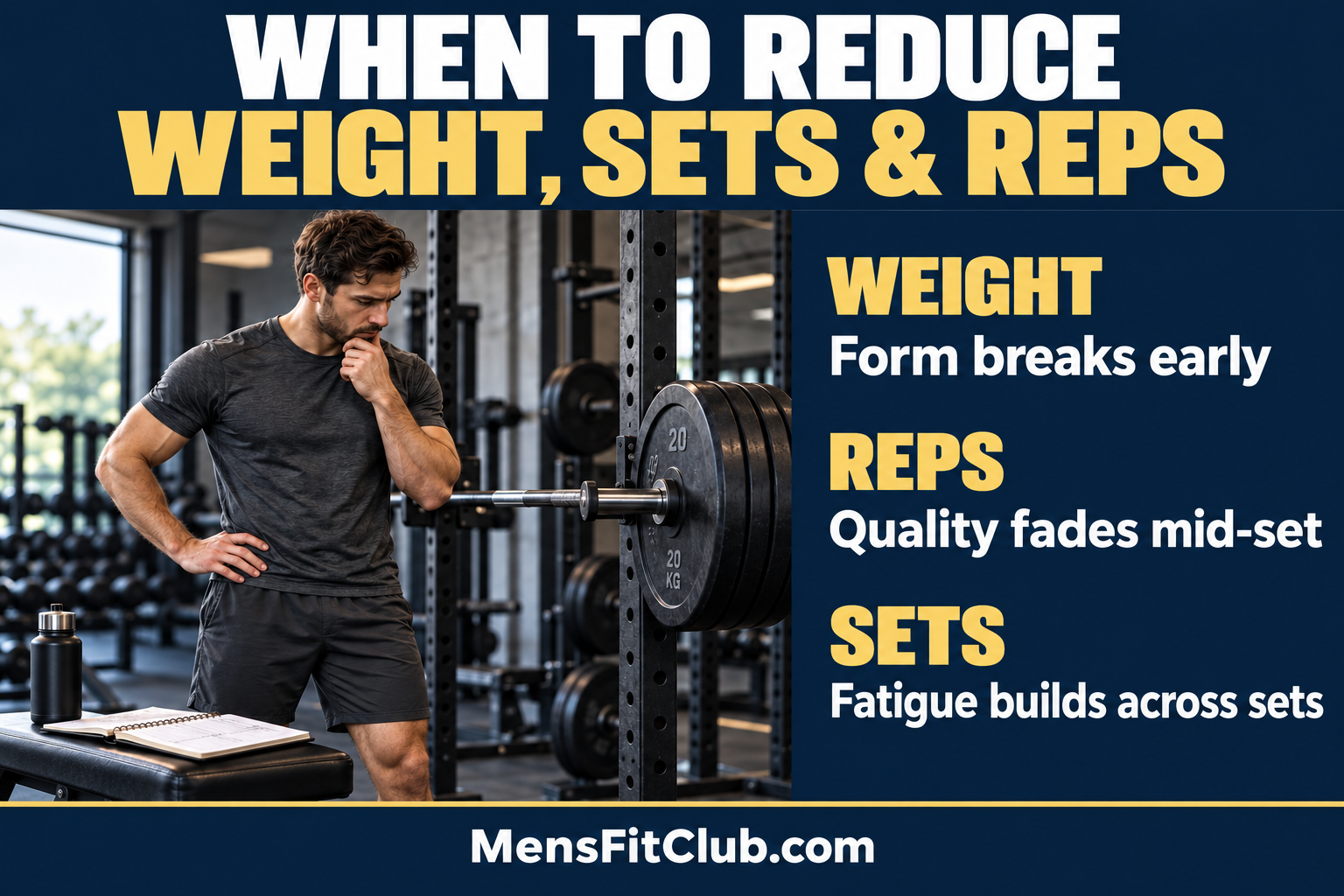
Reduce Weight When the Load Exceeds the Target
If a set prescribed at RPE 8 reaches RPE 9–10, first check whether your rest period was adequate. If you were rushing, resting longer may solve part of the problem. If the load itself remains too demanding, reduce it.
A reduction of around 5% is a practical starting experiment for some barbell exercises, not a universal formula. Dumbbell increments, machine settings, and the exercise itself may require different changes. Judge the next set rather than assuming any fixed percentage guarantees a particular RPE.
Adjust Repetitions When the Program Allows a Range
For a prescription of eight to ten repetitions at RPE 8, stop at eight if two clean repetitions remain. On a better day, ten may reach the same effort. The repetition range allows flexibility without changing the exercise or abandoning the target.
If the plan specifies an exact repetition count for a particular reason, adjust the load instead. Avoid changing weight, repetitions, and sets simultaneously unless a substantially easier session is clearly needed.
Reduce Sets When Quality Keeps Declining
Sometimes fatigue continues rising despite adequate rest and a lighter load. If technique deteriorates or each set substantially exceeds the target, omitting the final set may be appropriate. Completing fewer controlled sets can better match the session’s purpose than forcing increasingly poor repetitions.
RPE describes effort, not injury risk or medical readiness. Sharp pain, dizziness, chest discomfort, or unusual symptoms require stopping and appropriate assessment rather than simply lowering the RPE target.
A Three-Day RPE Strength Training Program
The following example suits generally healthy lifters who already know the basic movements. Train on nonconsecutive days, such as Monday, Wednesday, and Friday. The listed sets are working sets; complete appropriate warm-ups separately. Choose exercise variations that match your experience and available equipment.
Start near the lower end of each RPE range. Rest approximately two to three minutes between demanding compound sets and around one to two minutes between smaller accessory sets. Extend rest when needed to restore controlled performance.
Day One: Squat and Horizontal Push
Perform a squat variation for three sets of five at RPE 7–8. Follow with a barbell or dumbbell bench press for three sets of six at RPE 7–8. Use a chest-supported row for three sets of eight to ten at RPE 8, then a Romanian deadlift for two sets of eight at RPE 7.
Finish with two controlled sets of a dead bug or another suitable trunk exercise. Stop before you lose position rather than forcing these exercises into an exact repetitions-in-reserve estimate. On bench presses, use correctly positioned safeties or a competent spotter.
Day Two: Hinge and Vertical Push
Perform a familiar deadlift variation for two sets of four at RPE 7. Add a dumbbell overhead press for three sets of six to eight at RPE 7–8, then a lat pulldown for three sets of eight to ten at RPE 8.
Complete a supported split squat for two sets of eight per leg at RPE 7–8. Rate each side separately when necessary, and let the weaker side guide the load. Finish with two sets of a controlled curl or triceps exercise for ten to twelve repetitions at RPE 8.
Day Three: Full-Body Practice and Volume
Perform a goblet squat or leg press for three sets of eight at RPE 7–8. Follow with an incline dumbbell press for three sets of eight at RPE 8 and a cable row for three sets of ten at RPE 8.
Add a hip thrust or another familiar hip-extension exercise for two sets of ten at RPE 7–8. Finish with two sets of calf raises for ten to fifteen repetitions at RPE 8. Keep the session controlled and avoid adding extra work simply because the first exercises felt good.
How to Progress an RPE-Based Program
Progression means increasing your training demands over time while maintaining the intended effort and movement quality. RPE does not remove progressive overload. It helps you decide when an increase is supported by your performance.
Add Repetitions Within the Prescribed Range
For three sets of eight to ten at RPE 8, begin with a load that allows eight controlled repetitions per set. Over subsequent sessions, gradually increase repetitions while remaining close to the target effort.
Once all three sets reach ten repetitions without exceeding RPE 8, consider a small load increase. You may return to eight repetitions with the heavier weight. This approach is particularly convenient for dumbbells and machines, where available weight jumps can be relatively large.
Increase Load Gradually for Fixed Repetitions
For three sets of five at RPE 7–8, consider increasing the weight after all prescribed sets repeatedly stay within the target. Use the smallest practical increase, especially for upper-body lifts. There is no requirement to add weight every week.
If the new load pushes your effort above the target, adjust it. One unsuccessful increase does not erase your progress. It gives you information about what you can currently repeat with the desired control.
Review Trends Before Planning Easier Training
If familiar weights feel consistently harder across several workouts, review sleep, food intake, rest periods, other activity, and total training volume. A single difficult set does not automatically call for a deload week.
When several lifts decline and fatigue remains elevated, an easier week may be useful. Reduce working sets, load, or both, and use lower effort targets. Treat this as a planned adjustment, then reassess performance as you return to your normal schedule.
Common RPE Strength Training Mistakes
The first mistake is treating RPE 8 as a percentage of your maximum. It describes proximity to your repetition limit, not a fixed weight. Five repetitions at RPE 8 and ten repetitions at RPE 8 will generally require different loads.
Another mistake is rating discomfort instead of remaining repetitions. Burning muscles and heavy breathing can influence your perception, especially during long sets. Keep asking whether additional clean repetitions are available rather than assuming discomfort means failure is near.
Lifters also misuse RPE by changing the program whenever motivation drops. Autoregulation still needs boundaries. Keep your scheduled exercises, reasonable work targets, and progression rules. Adjust training based on observed performance instead of repeatedly replacing challenging work with whatever feels easiest.
Finally, do not expect every set at the same weight to have the same RPE. Fatigue can make the final set harder. An increase from RPE 7 to 8 may fit the prescription perfectly. A jump to RPE 10 calls for a different decision.
RPE Training for Beginners and Men Over 40
Beginners can start with broad effort categories while learning the scale. Describe sets as comfortable, moderately challenging, or hard with repetitions remaining. Then connect those descriptions with approximate RPE ratings. Consistent technique and a repeatable schedule matter more than distinguishing small numerical differences.
Men over 40 can use the same principles. Age alone does not dictate a particular RPE ceiling, but experience, health, exercise tolerance, and recovery affect appropriate training. Begin conservatively after a layoff, and avoid using past personal records to choose today’s starting weights.
For busy men, RPE also helps preserve useful training during demanding weeks. A slightly lighter session that follows the planned movement patterns and effort targets can keep the program moving forward. The objective is sustainable practice that creates opportunities to improve.
Frequently Asked Questions About RPE Strength Training
Is RPE 8 a Good Target for Every Exercise?
RPE 8 can be useful for many working sets, but it is not a universal requirement. Technique practice may use lower effort, while selected accessory sets may use higher effort. Choose targets that fit the exercise, your experience, and the purpose of the session.
Can You Use RPE With Dumbbells and Bodyweight Exercises?
Yes. Estimate remaining repetitions in the same way. When dumbbell weight jumps are large, use a repetition range. For bodyweight exercises, adjust assistance, leverage, or the movement variation while keeping your repetition standards consistent.
Do You Need to Train to Failure to Learn RPE?
No. Repeated practice, honest logging, and feedback can improve your estimates. You do not need to test failure on demanding barbell exercises. A qualified coach can help you compare perceived effort with visible technique and repetition performance.
What Should You Record in Your Training Log?
Record the exercise, weight, repetitions, and RPE for each working set. Add short notes when rest periods, technique, or exercise variations change. Review comparable sessions to decide whether to increase the challenge, maintain it, or temporarily reduce it.
Make RPE a Consistent Part of Your Strength Training
Start by adding an RPE target to one or two familiar exercises. Estimate your remaining clean repetitions, record the result, and adjust subsequent sets when the effort clearly misses the target. Expand the approach as you become more comfortable with the scale.
The purpose of RPE strength training is to make effort deliberate. Follow a clear program, keep movement standards consistent, and build gradually. Over time, your log should help you see when you are ready for more work and when a modest adjustment will keep training productive.
To put RPE strength training into practice, start with our guide on How To Choose Dumbbell Weight For Every Exercise, then apply gradual progression through our 8 Week Barbell Progressive Overload Program. If your schedule is tight, explore Minimum Effective Dose Strength Training for manageable workouts with clear effort targets. Older lifters can find additional guidance in Strength Training After 50 Sets Reps And Recovery, while our Rest Day Mobility Routine For Muscle Recovery offers gentle movement options between lifting sessions.


Most Recommended

Subscribe to our Newsletter
Stay up to date on the latest men’s health, fitness and lifestyle trends and tips.
About Us
Men’s Fit Club was started with the goal of empowering men to get the most out of their lives. This meant going beyond exercise and diet tips to really address the broad range of issues that men face on a daily basis – topics like recreation, finding love, sexual health and even sound fashion advice.
Quick Links
© COPYRIGHT MEN'S FIT CLUB 2026. All Rights Reserved